This guide provides a practical B2B decision framework. Final specifications, market obligations, testing scope, labels, packaging and shipment requirements must be confirmed for the exact finished SKU and destination.
2. Direct-Answer Introduction
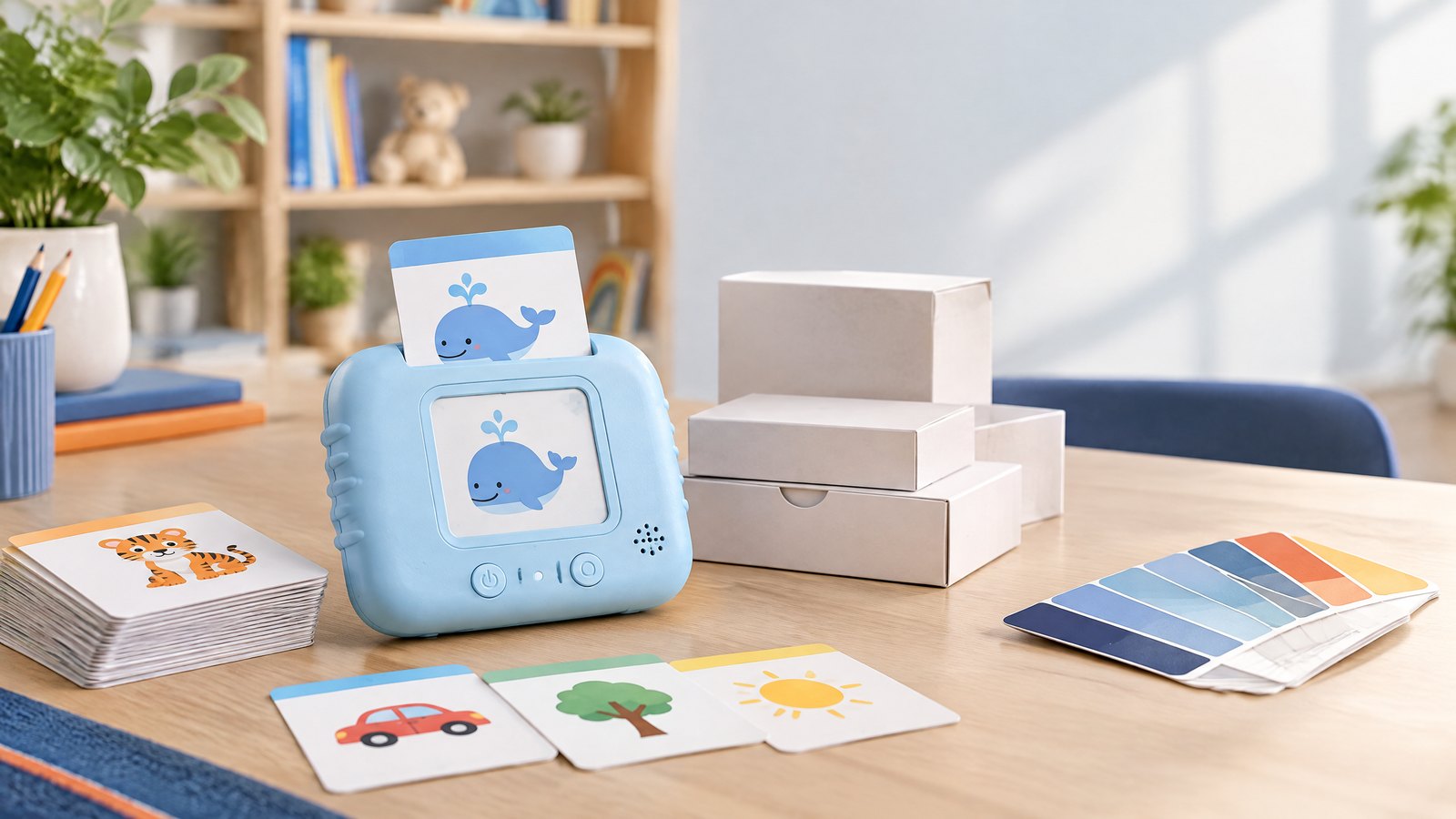
Buyers should plan talking flashcard machine audio content as a controlled product component, not as a last-minute collection of voice files. The reliable sequence is to define the learner and language scope, own or license every content element, create a card taxonomy, lock a machine-readable content map, record and review assets against written rules, and validate the complete card-to-audio experience on production-representative samples. Only after that process should a brand decide what the package may promise.
This order matters because a working speaker does not prove that a learning product is coherent. A child can hear an audio file that is too fast, paired to the wrong illustration, mapped to the wrong card identifier, or supplied under rights that do not allow sale inside a physical product. Each defect is expensive to find after cards, cartons, and firmware are already in production.
A practical buyer brief should therefore answer six questions before requesting an OEM/ODM quotation: who is learning; which language variety is being taught; what each card is intended to teach; who owns the script, recordings, and art; how the device finds the correct audio; and what evidence supports each marketing statement. The framework below is designed for offline or simple scan-and-play talking flashcard machines. A connected model, a recording function, or a companion app adds a separate privacy and connectivity review.
For an initial content-map and sample-scope discussion with LcdWritingTablet, contact info@lcdwritingtablet.com. Bring a draft learner profile and target-market list; a polished script can follow after the product brief is aligned.
3. Who This Guide Is For
This guide is for brand owners, importers, curriculum teams, educational distributors, gift-category buyers, and private-label project managers who are sourcing a talking flashcard machine from a Shenzhen OEM/ODM supplier. It is particularly useful when the buyer is adding a new language set, replacing generic audio, localising an existing range, or combining a device with printed cards and retail packaging.
The guide assumes that the buyer, not the factory, makes the educational and commercial decisions. LcdWritingTablet can manufacture and configure the physical product and may support content integration within the agreed specification. The buyer should still nominate a single content owner who can approve scripts, pronunciation, translations, illustrations, and final claims. Where there are multiple stakeholders, such as a distributor, publisher, and voice studio, the purchase order should identify who has final acceptance authority.
It is not a substitute for legal, educational, product-safety, privacy, or market-access advice. Classification is fact-specific. For example, a product designed, manufactured, or marketed as a plaything for children under 14 can be a “toy” under U.S. CPSC guidance; U.S. children’s-product testing and certification requirements generally apply to products designed or intended primarily for children 12 and under.1 In the EU, toys must meet applicable safety requirements and carry CE marking before sale; the Commission notes that a new Toy Safety Regulation will apply after its transition period.2 A buyer should obtain market-specific advice based on the final age grade, claims, batteries, radio functions, and sales channels.
The framework is deliberately content-led. It does not repeat general wholesale selection, device-mechanics, compliance, private-label packaging, or battery-comparison guidance. Its purpose is to help a procurement team decide what must be true of the audio and card library before hardware configuration is frozen.
4. Buyer Decision Framework
Start with the learning job, not the number of cards
A card count is a manufacturing quantity. It is not a learning design. Write a one-sentence learning job for each SKU, such as: “Help a preschool learner recognise and repeat familiar everyday nouns in Language A,” or “Help a beginner learner distinguish common English words, simple sentences, and phonics sounds.” This statement fixes the age range, instructional language, target language, expected caregiver role, and whether the action is recognition, repetition, listening discrimination, or recall.
Do not claim that a device will make a child fluent, guarantee vocabulary growth, or deliver a measured cognitive outcome unless the buyer holds evidence adequate for that specific claim. The U.S. Federal Trade Commission states that advertisers must have a reasonable basis for objective express and implied claims before dissemination; what is reasonable depends on the claim, product, consequences, and relevant expert expectations.3 A more supportable package statement describes supplied content and intended use, for example, “Includes spoken vocabulary and category-based cards for guided practice,” provided the delivered SKU does include them.
Choose language scope with enough specificity to produce audio
“Spanish,” “Chinese,” and “English” are market labels, not complete recording instructions. The language brief should specify the language tag, region where relevant, script where relevant, pronunciation standard, transliteration convention, and whether the spoken form follows a child-facing or school-facing vocabulary. Unicode notes that standard language identifiers follow IETF BCP 47 conventions and can use language, territory, and script subtags, such as fr-CA or zh-Hant.4 That makes tags useful as stable fields in an audio manifest; they do not by themselves select a voice or settle a curriculum decision.
The language plan should separate: the learner’s home language; the language of caregiver instructions; the target spoken language; and any visible word on the card. A bilingual card may play a target-language word first and a home-language gloss second, but that is a different instructional experience from target-language-only playback. Make the choice at SKU level rather than mixing modes without a rule.
The OECD’s developing PISA foreign-language assessment treats reading, listening, and speaking as separate skills.5 A simple flashcard player can contribute to exposure, word recognition, and prompted repetition, but it does not itself assess open speaking or demonstrate proficiency. Plan outcomes within those limits.
Make rights a sourcing gate
Treat every deliverable as a separate right: written script and translations, illustrations or photographs, voice performance, the final recorded sound file, music or sound effects, and any third-party curriculum material. The U.S. Copyright Office distinguishes the underlying musical or textual work from a sound recording and explains that sound recordings are generally authored by performers and/or producers; a commissioned work is not automatically a work made for hire merely because a buyer paid for it.6 The WIPO Performances and Phonograms Treaty also recognises rights of performers and phonogram producers in fixed aural performances.7
For each asset group, obtain a written agreement that identifies the licensed territory, media, term, exclusivity, derivative-edit permissions, sublicensing to the manufacturer and distributors, and the right to embed copies in devices sold through the agreed channels. Do not rely on an invoice label such as “voiceover included.” Have counsel confirm ownership and enforceability in the relevant jurisdictions, especially for stock audio, AI-generated material, translations, and talent contracts.
Freeze the content contract before firmware freeze
The content contract is a versioned pack containing the approved script, card artwork list, audio files, content manifest, pronunciation and review rules, rights register, and approved claims. Every card and audio file must have a stable identifier. The first production sample should prove the contract, not invite a new content direction. New words, language variants, or reordered categories after mapping can create both rework and ambiguous version control.
5. Comparison, Cost, Quality, and Specification Choices
The table below compares common procurement routes. Cost is shown as a relative planning variable rather than a quoted figure because it depends on language count, talent rates, script condition, file preparation, card count, revisions, storage capacity, and the final hardware specification.
| Content route | Buyer supplies | Relative content cost and lead-time exposure | Quality-control advantage | Primary risk to control | Appropriate use |
|---|---|---|---|---|---|
| Existing generic library | Little beyond brand direction | Low initial cost; short preparation if files, rights, and mapping already exist | Existing audio can be screened quickly | Rights may not cover embedded resale; vocabulary and accents may not match the brand | Entry-level SKU only after rights and mapping review |
| Buyer-owned, ready-to-integrate library | Approved script, art, audio, and manifest | Moderate integration effort; recording cost already incurred | Buyer controls educational and linguistic approval | Inconsistent file naming, codecs, or card IDs can delay integration | Brands with established curriculum assets |
| Commissioned voice and content pack | Learning brief and approvals | Higher upfront content cost; time for script, casting, recording, editing, and reviews | Voice, pacing, and language variant can match the target market | Scope creep, unclear ownership, and unbudgeted retakes | Differentiated private-label launch |
| Multilingual core plus local packs | Shared core and market-specific addenda | Moderate to high; repeats review for each locale | Common taxonomy supports cross-market reporting | Literal translation can break word length, image fit, or cultural relevance | Regional distributors and expandable catalogues |
| Audio-only change on an existing card set | New audio and a revised manifest | Lower than reprinting, but still requires complete mapping validation | Card art stays stable | Same image can become misleading in another language or dialect | Controlled localisation where visuals remain valid |
A technical specification should be treated as a compatibility checklist, not as a list of presumed capabilities. Confirm with the factory in writing: supported file format and codec; sample rate and bit depth accepted by the device; file-name or index-length limits; audio storage budget after system files; card-ID format; maximum cards or audio entries per SKU; sorting behaviour; language switching behaviour; volume steps and default; wake-up or repeat response; firmware version; and the process for loading, checksum verification, and locking a production image.
Do not choose an audio quality target only from studio headphones. The practical test is intelligibility from the actual speaker, enclosure, and volume settings in a normal indoor environment. Sound-producing toys have specific sound and volume requirements under ASTM F963, and CPSC advises manufacturers and importers to review them carefully; electrically operated toys and battery-operated toys have separate applicable requirements.1 Technical and regulatory testing must be planned against the final product and market, not inferred from a clean source WAV file.
6. Product, Application, and Technical Detail
Use a card taxonomy that tells the learner what to do
A taxonomy is the controlled classification system that connects a card’s visible design to a learning purpose and an audio sequence. At minimum, create the hierarchy SKU → language pack → level → category → concept → card → prompt. A “farm animals” category might include a recognition card (“cow”), an attribute card (“The cow is black and white”), a sound association only where rights and age suitability are clear, and a simple prompt (“Can you find the cow?”). Those are different learning objects, even if they use the same illustration.
Keep each card focused on one primary target. In an early-learner pack, a noun card can use the spoken word, a short pause, and an optional repeat. A phonics pack may need a separate rule for letter name, letter sound, and example word so the device does not silently mix them. A beginner language pack may pair a word, a simple phrase, and a caregiver prompt. Define the playback sequence per card type before a studio records it.
Use an editorial style sheet for pace, pauses, numbers, articles, plural handling, names, speech level, and forbidden ambiguity. Pronunciation review should be conducted by a qualified native or target-variety reviewer who is independent of the performer wherever possible. A reviewer is not simply checking whether a word sounds pleasant; they are checking that the delivered form matches the approved language brief.
Build an audio manifest that firmware can execute
The audio manifest is the bridge between curriculum and firmware. A spreadsheet or CSV can work if its columns are fixed and versioned. A useful minimum record is shown below.
| Field | Example purpose | Acceptance rule |
|---|---|---|
sku_id and content_version | Separates one retail configuration from another | Every physical sample and carton revision references the same approved version |
card_id | Unique printed-card identifier | One card ID maps to one intended playback rule |
language_tag | Identifies language and variant, e.g., en, es-MX, zh-Hant | Uses the agreed BCP 47-style tag and no informal substitutes |
category and learning_objective | Explains why the card exists | Matches the approved taxonomy and learner brief |
script_id and approved_text | Controls the spoken source | Text is signed off before recording and retained with revision history |
audio_file and checksum | Identifies the production asset | File name, duration, and checksum match the delivered master |
playback_sequence | Defines word, pause, prompt, or translation order | Behaviour is repeated correctly on the device sample |
artwork_id | Links visible image to concept | Human reviewer confirms word, image, and audio agree |
rights_record | Points to contract or licence evidence | Rights scope covers the intended embedded-product use |
The factory integration team should not have to interpret labels such as “final-final-new” or guess whether dog2.mp3 is British English, U.S. English, or a second recording. Use immutable IDs and controlled filenames. Send a read-only release package, maintain a change log, and require a written confirmation of the imported content version and firmware build.
Map content behaviour, not just files
A talker’s perceived quality depends on the chain: card identification, lookup, audio selection, decoding, amplification, speaker response, and user action. The sample plan should therefore test positive mapping, negative mapping, and edge cases. Positive mapping asks whether the intended card produces the intended audio. Negative mapping asks whether an adjacent or similar-looking card can trigger the wrong audio. Edge cases cover rapid repeated scans, language changes, low battery states if relevant, maximum-volume playback, and restart behaviour.
If the model adds Bluetooth, Wi-Fi, recording, an app, or cloud updates, document these as separate product functions. The FCC states that an RF device must go through the applicable equipment-authorization procedure before it is marketed, imported, or used in the United States, and that intentional radiators include Bluetooth and Wi-Fi devices.8 For a child-directed connected service, COPPA can apply to covered online services, including IoT smart toys, that collect, use, or disclose children’s personal information; a recording containing a child’s voice is personal information under the FTC’s guidance.9 An offline playback-only SKU may avoid those data flows, but a buyer should validate the final function rather than assume privacy compliance.
7. Sample, Testing, and Quality-Control Workflow
Gate 1: pre-recording approval
Approve a content brief, script deck, taxonomy, language tags, visual references, voice-direction sheet, and rights register before any full recording session. Record a small “calibration set” first: one easy noun, one multi-syllable word, one sentence, one prompt, and any language-specific sound that might reveal a pronunciation issue. Have the nominated language reviewer approve the delivery style and the buyer approve brand suitability. This is less expensive than discovering halfway through a library that pauses, warmth, or pace are wrong.
Gate 2: file-level acceptance
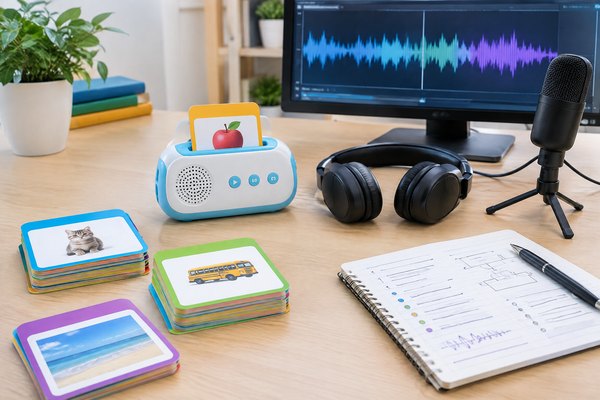
The studio or buyer should deliver masters with a manifest. Verify file count, IDs, duration range, intelligibility, silence trimming, unwanted noise, loudness consistency, and the absence of clipped or duplicated files. Do not normalise quality only by visual waveform. Listen to representative files through both reference headphones and the actual product speaker. Retain the approved source and the device-ready derivative separately, with checksums or another method that detects accidental substitution.
Gate 3: engineering-sample mapping validation
Load the agreed content pack into an engineering sample and conduct a 100% card-to-audio audit for every language and card type. The inspector should scan or present each card, capture pass/fail against card_id, and log the observed file or spoken output. A table-driven audit is stronger than a demonstration of a few attractive cards. It finds one-to-many errors, missing prompts, untranslated strings, wrong language selection, and indexing shifts.
At the same time, perform an audio usability test on the actual sample. Test normal listening distance, the full volume range, repeated activation, and category transitions. The result should state observations, settings, sample serial number, firmware version, content version, test date, tester, and corrective action. It should not say “sound good” without defined conditions.
Gate 4: production-representative and shipment inspection
Before mass production, repeat the audit on a production-representative sample with final card stock, print finish, package, speaker, battery configuration, and firmware image. Confirm that the final printed card IDs or encoded features match the approved mapping. During pre-shipment inspection, use a statistically agreed sample plan for hardware and packaging while also verifying version-control markers on units and cards. For a high-risk launch, expand the audio-card functional check beyond the ordinary sample rate; content mapping defects can repeat systematically across a whole batch.
If coin or button cells are used, content planning still affects the package because a “ready to play” claim implies an actual configuration. CPSC guidance explains that applicable U.S. requirements can include secured compartments, warnings on product/packaging/instructions, and battery-access testing; toy products complying with applicable toy-standard requirements are treated differently under the cited rule.10 Confirm the final battery configuration and market obligations with the responsible compliance party. If a rechargeable battery is shipped by air, packing and declarations must reflect the final battery type, watt-hour rating, and shipment configuration. IATA notes that air-transport handling depends on configuration and rating and directs shippers to its current battery guidance.11
8. Ordering and Implementation Preparation
A purchase order is stronger when it references a content release schedule rather than saying only “English audio included.” Attach the exact content-pack version, manifest format, card-art revision, audio master delivery date, factory integration date, engineering-sample date, buyer review window, correction window, and mass-production release condition. Define whether an audio change after approval is treated as a content change, a firmware change, a print change, or all three.
Assign responsibilities clearly. The buyer should own learner goals, market selection, scripts, rights approvals, terminology, claims, and final commercial sign-off. The recording provider should deliver agreed audio and usage documentation. LcdWritingTablet should confirm the agreed technical import specification, map supplied assets to the device build, identify integration exceptions, and provide the sample for acceptance under the agreed configuration. The importer or named responsible party should own applicable market-access and product-information obligations unless contractually arranged otherwise.
Prepare a controlled delivery folder with: 01_brief, 02_scripts, 03_artwork, 04_audio_masters, 05_device_ready_audio, 06_manifest, 07_rights, 08_test_records, and 09_packaging_claims. Include a one-page release note listing the SKU, language pack, firmware, content version, file count, checksum file, open issues, and approver. This makes a later reorder or regional adaptation traceable.
Packaging claims should be operationally exact. “X cards,” “Y categories,” “spoken vocabulary,” “bilingual mode,” “offline playback,” or “includes [language] audio” can be checked against the product release. Avoid implying a language proficiency level, child-development result, teacher endorsement, or test-proven effect unless the exact claim has prior substantiation. Do not print a certification mark or regulatory statement because an audio content sheet says it is needed; the final product, intended age, market, and technical configuration determine the applicable assessment.
9. Practical Applications and Scenarios
Scenario A: a preschool distributor adds a single-market vocabulary pack
The distributor wants a simple first-word product for caregivers. The learning job is recognition and repetition of familiar objects, not independent reading. The content owner selects one target language variant, records one clear word per card, and limits every image to a single unambiguous concept. The package can truthfully state that it includes category-based spoken vocabulary once the released card count and categories are verified. It should not promise literacy, bilingual fluency, or a developmental result.
Scenario B: a bilingual retailer uses a shared visual core
The retailer sells the same product in two regions. It keeps a common visual taxonomy but prepares two language packs, each with its own language tag, script, reviewer, audio files, and content version. The local team checks that food, animal, transport, and family terms remain culturally and linguistically appropriate rather than assuming a literal translation is enough. The engineering sample demonstrates language selection, correct card mapping in both packs, and the absence of a fallback into the other language.
Scenario C: an education brand creates a progressive starter range
The brand separates the product line into stages: first nouns, phonics awareness, simple phrases, and classroom vocabulary. Each stage has a different playback rule and learning objective. A card in the phonics SKU may play a sound and example word; the same illustrated object in a vocabulary SKU may play a spoken label and a short phrase. The content manifest prevents the factory from treating the two assets as interchangeable merely because the art is similar.
Scenario D: a retailer converts an offline product into a connected update model
The retailer wishes to add downloadable packs and a child voice-recording feature after launch. That change is not just a new audio library. It changes the data-flow, firmware, security, connectivity, RF, customer-support, and privacy questions. The buyer should scope a separate product and legal review, establish consent and retention requirements where relevant, and validate whether the added radio function changes market-access work. The original offline pack remains a useful baseline, but it does not prove the updated model is ready.
10. Detailed FAQ
1. How many languages should one talking flashcard machine include?
Include only the languages that can each receive complete script review, qualified pronunciation review, rights clearance, mapping validation, and packaging support. One well-controlled language pack is usually more defensible than several incomplete packs. If multiple languages are offered, state exactly which variants are included and how a user changes them.
2. Can we use AI voices to reduce cost?
Possibly, but cost reduction does not remove rights, quality, or disclosure questions. Confirm the provider’s commercial terms for embedded retail use, derivative editing, territory, term, and any voice-cloning restrictions. Test intelligibility, pronunciation, emphasis, and consistency on the device speaker. Do not represent a synthetic voice as a named human performer, and obtain specific legal advice before cloning or simulating a recognizable voice.
3. Who should own the audio files after a commissioned recording?
The contract should answer this explicitly. It should identify rights in the script, performance, master recording, edits, translations, and artwork, then specify what the buyer may do with each. Payment alone is not a complete ownership chain. The Copyright Office’s explanation of sound-recording authorship and work-made-for-hire conditions illustrates why a written, fact-specific rights agreement is important.6
4. What is the minimum acceptable sample test?
At minimum, use a production-representative device with the intended cards and run a 100% audit of card-to-audio mapping for each language pack. Also test the actual speaker at normal use settings, volume range, repeated use, restart, and any language switch. Record the device serial, firmware version, content version, result, and corrective actions.
5. Can the package say “learn English” or “educational toy”?
Those phrases can carry different implied meanings depending on layout, imagery, and accompanying statements. A factual description of included English audio is easier to verify than a promise of learning results. Review all objective explicit and implied claims against the evidence held before distribution, consistent with the FTC’s reasonable-basis approach.3 Market-specific consumer and product rules may also apply.
6. Do different English accents require separate SKUs?
Not always, but they require a decision. If pronunciation, vocabulary, spelling, or caregiver expectations differ materially for the target market, create separate language or locale packs and label them accurately in the manifest and package. Do not imply that one recording represents every English variety. A calibration recording reviewed by the target-market language reviewer is the practical first check.
7. Must content be revalidated when only the firmware changes?
Yes, whenever the change could affect lookup, decoding, file order, timing, language selection, or power behaviour. The test scope can be risk-based, but the buyer should document why a full or partial mapping audit is appropriate. A firmware number and content version should always be recorded together on the acceptance report.
8. Can an offline talking flashcard machine make a child-privacy claim?
An offline design may reduce collection and transmission pathways, but the claim must match the actual final product. Check for microphones, recording functions, companion apps, Bluetooth or Wi-Fi, diagnostic logs, update tools, and packaging QR journeys. COPPA’s scope includes certain child-directed online services and IoT devices that collect, use, or disclose personal information; it should not be used as a slogan for an unreviewed feature set.9
11. Conclusion and Final Email-Only CTA
A successful talking flashcard machine launch begins with a content release discipline: define a modest learning outcome, specify the target language precisely, secure rights for every asset, classify cards by learning purpose, map immutable IDs to firmware behaviour, and audit every physical card on the representative sample. That discipline turns “audio included” into a traceable product configuration that can be repeated, localised, inspected, and described accurately.
For an OEM/ODM discussion focused on content specification, device-ready audio integration, and sample validation, email info@lcdwritingtablet.com. Include the intended age range, target markets, language variants, provisional card count, whether audio and artwork already exist, and the claims you expect to place on the package.
References
Turn this sourcing plan into a product brief.
Share your target market, product requirements, packaging preference and estimated volume for a practical OEM / ODM discussion.