This guide provides a practical B2B decision framework. Final specifications, market obligations, testing scope, labels, packaging and shipment requirements must be confirmed for the exact finished SKU and destination.
2. Direct-Answer Introduction
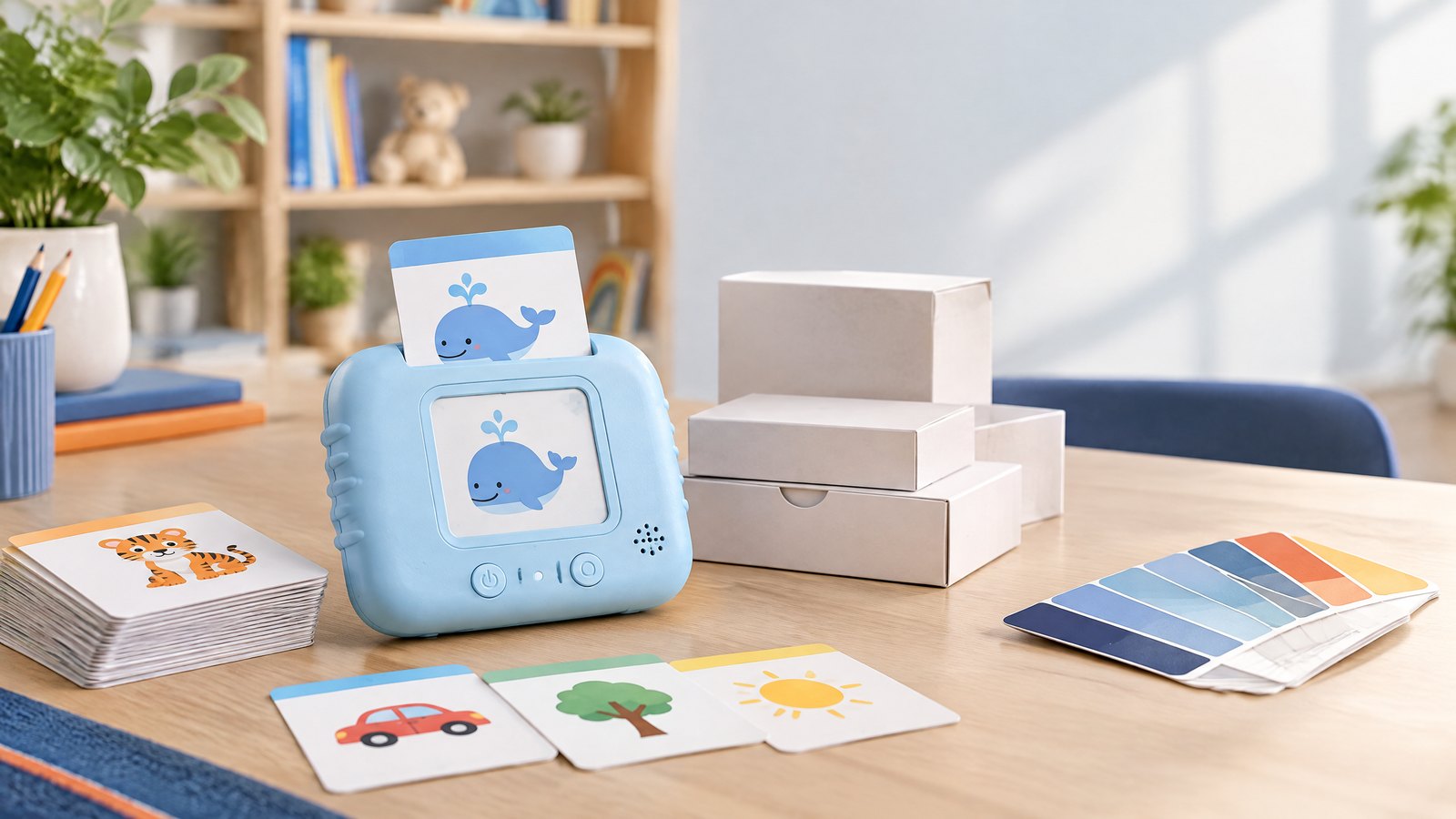
To private label a talking flashcard machine, begin with a fixed product brief, then approve a representative sample, lock the bill of materials and content, prepare market-specific compliance evidence, and inspect the finished order against an agreed standard. A logo on a housing or box is only one part of the job. The buyer also has to define the age grade, language audio, card set, battery and charging arrangement, warnings, traceability information, packaging, and route to market. For a children’s learning product, the brand or importer should treat the supplier’s files as inputs to its own market obligations, not as a substitute for them.
This guide gives distributors, education brands, retailers, and promotional-product buyers a controlled way to source from LcdWritingTablet, a Shenzhen OEM/ODM manufacturer of LCD writing tablets, talking flashcard learning machines, and smart electronic badges. It focuses on the decisions that protect a private-label launch from vague specifications, late artwork changes, undocumented component substitutions, and avoidable border or marketplace problems.
Important scope note: This is a procurement guide, not legal, laboratory, customs, or marketplace advice. Requirements depend on the exact model, age grade, claims, electrical design, destination, sales channel, and responsible economic operator. Confirm the applicable obligations with qualified advisers, laboratories, and the relevant authorities before placing goods on a market.
3. Who This Is For
This process is for a buyer who wants a branded learning device rather than a commodity listing. It suits an educational-toy distributor building a phonics range, a book or stationery brand adding audio learning aids, a retailer developing an exclusive programme, an importer serving schools or early-learning stores, and a promotional supplier assembling a literacy kit. It also suits a buyer that wants one core device with several language, curriculum, or channel variants.
The process is less suitable for a buyer who has only a logo and an assumed target age. Private labelling should not begin with an unqualified request for “the cheapest talking cards.” It should begin with a buyer-owned product definition. For a product directed primarily to children 12 or younger in the United States, third-party testing and a Children’s Product Certificate (CPC) can be required where relevant children’s product safety rules apply.2 4 In Great Britain, a company that has a toy manufactured and markets it under its name or trademark is treated as a manufacturer under the toy guidance; that guidance also assigns importers verification and identification duties.8 The commercial choice to private label can therefore affect who must do what.
4. Buyer Decision Framework: Decide Before You Design
Treat the project as a sequence of gates. Each gate should answer one question and leave a record that the next gate can rely on. A purchase order is not the right place to discover whether the card format, child age, battery format, or language files were never agreed.
Gate 1: Define the user, learning promise, and age grade
Write a one-sentence use case before choosing a model: for example, “a parent-supervised vocabulary activity for preschool learners” or “a portable pronunciation practice device for beginning language learners.” Then describe what the child does, what an adult does, the anticipated duration of use, and the environment. Avoid claims such as “guarantees reading progress” unless the buyer has substantiation and the review needed for the market. Use the age grade consistently on the product, retail box, instructions, online listing, and advertising.
Gate 2: Freeze the product architecture
Separate what is core from what is variable. Core elements include housing, circuit board, speaker, controls, card-reading technology, power source, charge port, cable, and supplied accessories. Variable elements can include shell colour, printed logo, language pack, card graphics, carton artwork, inserts, and bundle composition. If an item is variable, name the permitted versions and who approves them.
Gate 3: Own the content and localization record
For every audio and image, create a content register. It should include the card ID, printed word, image file, audio filename, language or accent, source or rights status, version, and approver. Where content is supplied by the buyer, specify the required file format, sample rate or other technical parameters only after the factory confirms its platform requirement. Where content is supplied by the factory, agree what may be used, what may be reused, what rights are represented, and who approves the final playback.
Gate 4: Map market and channel before tooling or mass print
Create a destination matrix that lists each country or region, intended sales channel, target age, device configuration, electrical features, language, operator role, needed markings or documents, packaging language, and launch owner. A non-wireless, fixed-audio model may be simpler to map than a Bluetooth- or Wi-Fi-enabled version, but the mapping still belongs to the exact model.
For example, all toys sold in the EU must carry CE marking as the manufacturer’s declaration that essential toy-safety requirements are met; the Commission identifies physical, mechanical, flammability, chemical, electrical, hygiene, and radioactivity risks within the framework.5 The EU’s newer Toy Safety Regulation enters into force in 2026 but applies after its transition period from 1 August 2030, so buyers should track the timing rather than assume a future requirement applies immediately.5 Electronic equipment can also bring environmental frameworks into scope. The Commission states that RoHS generally applies to products with an electrical and electronic component unless specifically excluded and restricts ten listed substances.6
In the EU, the General Product Safety Regulation has applied since 13 December 2024, covers consumer products including online sales, and requires a responsible economic operator in the EU for each covered product.7 In Great Britain, toy and electrical-product obligations, markings, documents, identification, and importer details must be checked against the current GB rules; official guidance also distinguishes GB and Northern Ireland treatments.8 9 These are examples of why a “global” model needs a market map rather than one universal carton.
Gate 5: Convert the decision into a controlled specification
5. Comparison and Specification Table: Choose the Right Private-Label Scope
The following table is a buyer planning tool, not a catalogue of guaranteed options. Confirm availability, technical limits, and implications for the selected LcdWritingTablet model in writing.
| Decision area | Entry OEM: controlled branding | Expanded OEM: content and pack customisation | ODM / feature change: differentiated programme | Buyer evidence to approve |
|---|---|---|---|---|
| Housing and identity | Existing housing with logo and selected approved colour | Logo, colour treatment, retail box, insert and bundle changes | New housing, button layout, mould or interface concept | Marked-up artwork, colour reference, placement photos, revision log |
| Learning cards | Existing card set and language | New card selection, images, language or packaging set | New recognition approach, card form factor, curriculum system or accessory | Card master list, print proof, rights record, card-to-audio index |
| Audio | Existing audio package | Buyer-approved language files or voice version | New firmware logic, content system, speaker or user-interface change | Audio manifest, pronunciation review, playback sample and approval record |
| Power system | Existing approved battery arrangement | Packaged cable, instructions, approved accessories | Battery, charge circuit, connector, charger or power-rating change | Battery/charger specification, applicable test evidence, transport record |
| Wireless / connectivity | None in the core configuration | Usually none; confirm any electronic change | Bluetooth, Wi-Fi, app or other radio feature | Radio market assessment, applicable authorization plan, privacy/security review |
| Validation impact | Verify the production configuration matches the reference | Recheck content, packaging, labels and relevant finished-product requirements | Reassess safety, electrical, radio, software, documentation and logistics scope | Change-impact review signed by technical and compliance owners |
| Commercial control | Lowest decision burden; less differentiation | More brand relevance; more approval dependencies | Maximum differentiation; higher schedule and validation risk | Development plan, ownership terms, change-control and contingency path |
The key comparison is not “cheap versus expensive.” It is stable versus changing. A private-label release becomes difficult when a buyer asks for a low-risk existing platform but permits untracked changes to audio, printed cards, packaging, charger, battery, or wireless function. Those are product changes, not decoration.
Planning a branded talking flashcard machine? Send a concise brief to info@lcdwritingtablet.com with target markets, age grade, language set, device configuration, card count, packaging concept, required delivery window, and requested documents. Ask for confirmation of what is standard, what is customizable, and what needs technical review before committing artwork or a purchase order.
6. Buyer Checklist: What to Have Before Mass Production
A useful checklist is an evidence list, not a box-ticking exercise. The buyer should assign an owner and due date to each item. If a line is “not applicable,” state why and retain the decision with the model record.
| Control point | What to confirm | Acceptance evidence | Typical owner |
|---|---|---|---|
| Commercial identity | Model code, private-label brand, Incoterm, quantity, payment milestones, delivery destination and change process | Signed quotation or purchase order with revision-controlled attachments | Buyer / operations |
| Use and age grade | Intended user, age grade, supervision assumptions, claims, warning approach and foreseeable misuse | Approved product brief and market matrix | Brand / compliance |
| Product configuration | Housing, components, firmware version, power source, cable, accessories and pack-out | Approved golden sample, BOM summary and configuration sheet | Product / supplier |
| Cards and audio | Every card visual, word, language, audio trigger and playback file | Card-and-audio master, native review record and final sample sign-off | Content owner |
| Brand and package | Logo, colour, die-cut, retail carton, insert, label, barcode, country-specific text and online asset consistency | Press proof, packaging mock-up and final artwork approval | Brand / channel owner |
| Safety and compliance | Applicable market rules, test plan, certificates or reports where required, declarations, traceability and responsible operator | Market-specific compliance file reviewed by the responsible party | Compliance owner |
| Battery and freight | Battery chemistry and rating, charger/cable, UN 38.3 summary where applicable, package marks and carrier instructions | Current supplier documents and freight-forwarder confirmation | Logistics |
| Quality controls | Functional checks, cosmetic standards, sampling plan, defect definitions, rework rule and final inspection timing | Approved quality plan and inspection report | Quality owner |
| After-sales readiness | Instructions, troubleshooting, replacement policy, defect escalation, complaint coding and retained samples | Support FAQ, issue log template and retained-reference record | Customer operations |
For U.S. children’s products subject to relevant rules, a CPC is not simply a supplier’s generic certificate. CPSC says the domestic manufacturer or importer certifies based on results from a CPSC-accepted third-party laboratory, and its CPC guidance specifies seven required elements, including product identification, cited rules, certifier identity, test-record contact, manufacture date/place, testing date/place, and test laboratory identity.2 Ask whether the evidence identifies the actual product configuration, not merely a similar-looking model. Where rules or scope are uncertain, obtain a professional determination before using a mark or making a compliance claim.
A private-label buyer also needs traceability that works during a complaint. Build a product code or batch logic that ties the unit, carton, production date, content and firmware revision, and key components to records. UK toy guidance illustrates this operational principle by requiring toy and manufacturer identification, continuing-production conformity, complaint and recall records, and supply-chain identification in its stated conditions.8 The right exact format varies by market, but the capability to identify the configuration and route an issue back to the batch is universally valuable.
7. Sample, Testing, Factory, and Shipment Inspection Workflow
1. Pre-production sample: validate the concept
Request a sample that represents the selected device, card stock, audio, power arrangement, pack-out, and accessories as closely as possible. Test recognition, buttons, volume, cards, print, power behaviour, and supplied parts as a user would. Record each result by model code and revision. The review outcome should be accepted, accepted with documented corrections, resample required, or project hold. A battery, enclosure, speaker, firmware, or charger change is a configuration change, not a casual correction.
2. Compliance and verification sample: validate the market configuration
Before final print or large-scale assembly, ensure any required evaluation uses the intended configuration. In the United States, CPSC identifies ASTM F963 as mandatory for children’s toys and flags sound, battery, electrical/thermal, small-object, and use-and-abuse considerations that may apply.1 A radio-enabled version is a separate release decision: RF devices subject to FCC authorization must be authorized before U.S. marketing or importation.11
3. Pre-production meeting: translate approvals to the line
4. During-production control: catch repetition early
5. Pre-shipment inspection: compare finished goods to the frozen standard
Schedule inspection before shipment release under the agreed sampling plan. Check quantity, model and batch ID, appearance, function, card recognition, audio, accessories, instructions, labels, package, barcode, master cartons, and packing. An inspection does not replace validation, testing, or regulatory responsibility; it checks whether inspected goods match the approved specification. Retain the report, corrective-action record, and a finished-good reference sample when practical.
6. Shipment release: check documents and physical configuration together
Before booking, reconcile invoice, packing list, product code, quantity, carton count, weight, battery description, and consignee details to the physical shipment. For battery-powered products, obtain current carrier and freight-forwarder instructions. IATA states that, subject to its stated button-cell exception, the UN 38.3 test summary applies whether cells and batteries are shipped alone or in equipment.10
8. Ordering and Implementation Preparation
Prepare retail-channel assets in parallel with production, but keep them subordinate to the approved facts. Product-page copy should use the same age grade, contents, functions, warnings, battery information, and language description as the physical product. A marketplace may have its own barcode, preparation, labelling, hazard, and document rules. Build a channel preflight for the selected marketplace and fulfilment route shortly before shipment; do not assume one retailer’s requirements transfer to another.
For EU-bound electrical products, plan beyond the first sale. The Commission describes WEEE as a framework for separate collection and proper treatment, while the Batteries Regulation addresses lifecycle obligations.12 13 Registration, labelling, financing, take-back, and reporting vary by country and role, so establish the responsible party before stock lands. Provide concise instructions and code complaints by issue type so that support records become corrective-action data for the next order.
9. Practical Applications: Build One Platform, Not One Generic Product
A private-label talking flashcard machine works best when the learning purpose is specific. For an early-language range, the buyer might organize cards around familiar nouns, actions, colours, and simple categories while keeping the device controls minimal and adult instructions clear. For a bilingual range, the same hardware platform may support separate card-and-audio packs, but every language version needs its own final review rather than a presumption that translation alone is sufficient.
A bookshop or publisher can develop a companion product around an existing learning series, provided the artwork and sound rights are resolved and the product does not make unsupported educational claims. The commercial value is coherence: the card art, box copy, product page, and accompanying print content use the same vocabulary and intended learner. The operational control is the master content register, which preserves the exact relationship between each printed card and its audio.
The same discipline supports a multi-country rollout. Use a shared core-device specification with country-specific artwork and content addenda. Each SKU should identify its market, language, packaging, required local details, card/audio revision, and destination compliance file. That structure permits localization without mixing Spanish cards into an English carton, an EU label into a GB shipment, or a non-wireless manual with a connected model.
10. Detailed FAQ
What does private label mean for a talking flashcard machine?
It means the product is offered under the buyer’s brand or trademark, usually with agreed changes to the device identity, packaging, content, or bundle. It does not mean that every technical detail is new, and it does not automatically move all legal responsibilities to the factory. Identify the responsible economic operator and applicable roles for every destination. If a business places EEE on the GB or NI market under its own name or trademark, official GB guidance says it must meet manufacturer obligations.9
Can I only change the logo and carton?
Often that is the most controlled way to start, but it is still important to approve the exact model, placement, pack-out, instructions, age grade, warnings, and market details. A logo-and-carton project can fail if the carton describes a feature the device does not have, if the barcode points to another variant, or if the age and product claims are inconsistent with the marketing. Treat packaging as part of the finished product configuration.
Should I create custom cards and audio for the first order?
Only if the buyer has an approved content owner, rights route, language reviewer, file-control method, and enough time for a full sample review. Custom cards create differentiation, but they also create hundreds of potential print-to-audio mismatches. A first release can use a small, well-reviewed custom set rather than an oversized curriculum. The scale should match the buyer’s ability to review every item.
How do I choose the age grade?
Start with the intended learner, product use, design, marketing, and foreseeable use—not a desired retail shelf. For the United States, CPSC considers several factors including the manufacturer’s reasonable intended-use statement, representations in packaging and advertising, consumer recognition, and age-determination guidance.4 The physical product must support the chosen age range after relevant safety assessment. If a product contains detachable or potentially liberated small components, under-three risk requires particular attention.3
Is a CE mark enough for every EU requirement?
No. CE marking on a toy is the manufacturer’s declaration relevant to the applicable EU framework; it is not a universal shortcut for all product, environmental, online-sale, or country-level duties. The EU toy framework can sit alongside other applicable legislation, and the Commission specifically says toys must comply with other EU legislation applicable to them.5 Identify the exact device features, country, sales model, and responsible operator before deciding the documentation and labelling route.
Does a rechargeable version require more planning than a replaceable-battery version?
Usually it introduces different planning questions rather than simply “more” or “less” work. Confirm battery type, rating, charge circuit, cable or charger, overheating and access risks, user instructions, transport classification, and the final product configuration. For applicable lithium or sodium-ion cells and battery-powered equipment, have the current UN 38.3 test-summary route ready for the carrier and supply chain.10 Do not switch the power system after testing or sample approval without a documented change assessment.
What if we want Bluetooth or a companion app later?
Treat it as a new product version. Wireless hardware can change authorization, testing, labelling, user-information, security, privacy, content, and support considerations. In the United States, RF devices subject to FCC equipment authorization must be authorized before marketing or importation, and the applicable procedure depends on the device.11 Make the market and compliance assessment before hardware selection, not after retail artwork is printed.
Can the supplier’s old test report cover my new product?
It may be useful background evidence, but do not assume it covers a different configuration, age grade, factory, materials, battery, charger, card set, audio feature, radio function, or market. Compare the report’s product description, samples, dates, standards, deviations, and identified model against the purchase specification. The responsible party should decide whether it is applicable, whether a gap exists, and whether additional work is needed.
What should a pre-shipment inspection check?
It should check the finished goods against the frozen specification: correct model and revision, quantity, visual appearance, function, card recognition, audio, power behaviour, included accessories, instructions, labelling, retail package, barcode, master cartons, and packing. Define defect severity and the sampling approach before production. Inspection is a quality control step; it is not a replacement for required conformity assessment, testing, or certificate obligations.
How should we plan a reorder?
Do not begin with “same as last time.” Start with the exact previous approved configuration, batch feedback, complaint record, inventory of artwork and content files, current market requirements, component status, and any proposed changes. Reapprove anything that changed. Retained samples, document versioning, and batch codes make it possible to know what “same” actually means.
11. Conclusion: Private Label Is a Controlled Launch, Not a Logo Exercise
A successful private-label talking flashcard machine begins with an honest choice of scope: a stable OEM platform, a content-and-packaging programme, or a deeper ODM development path. It continues with a buyer-owned specification, a fully reviewed sample, market-specific documentation planning, controlled production changes, and an inspection that compares finished goods to the approved reference. The discipline is especially important because a small change—an age claim, new audio language, rechargeable battery, charger, card accessory, or wireless feature—can affect the product’s risk and documentation path.
Use the framework in this guide to make each approval visible: who decided, what version was approved, what market it serves, and what evidence supports release. That approach does not guarantee compliance or commercial outcomes, but it gives the brand, factory, laboratory, freight team, and channel operator a shared record on which to act.
Ready to turn a learning concept into a controlled private-label programme? Email info@lcdwritingtablet.com with your market list, target age, learning objective, language and card requirements, preferred power configuration, branding files, packaging concept, expected quantity, and target launch window. Request a model-specific discussion of standard options, customization boundaries, sample steps, and the documents needed for your intended route to market.
References
Turn this sourcing plan into a product brief.
Share your target market, product requirements, packaging preference and estimated volume for a practical OEM / ODM discussion.