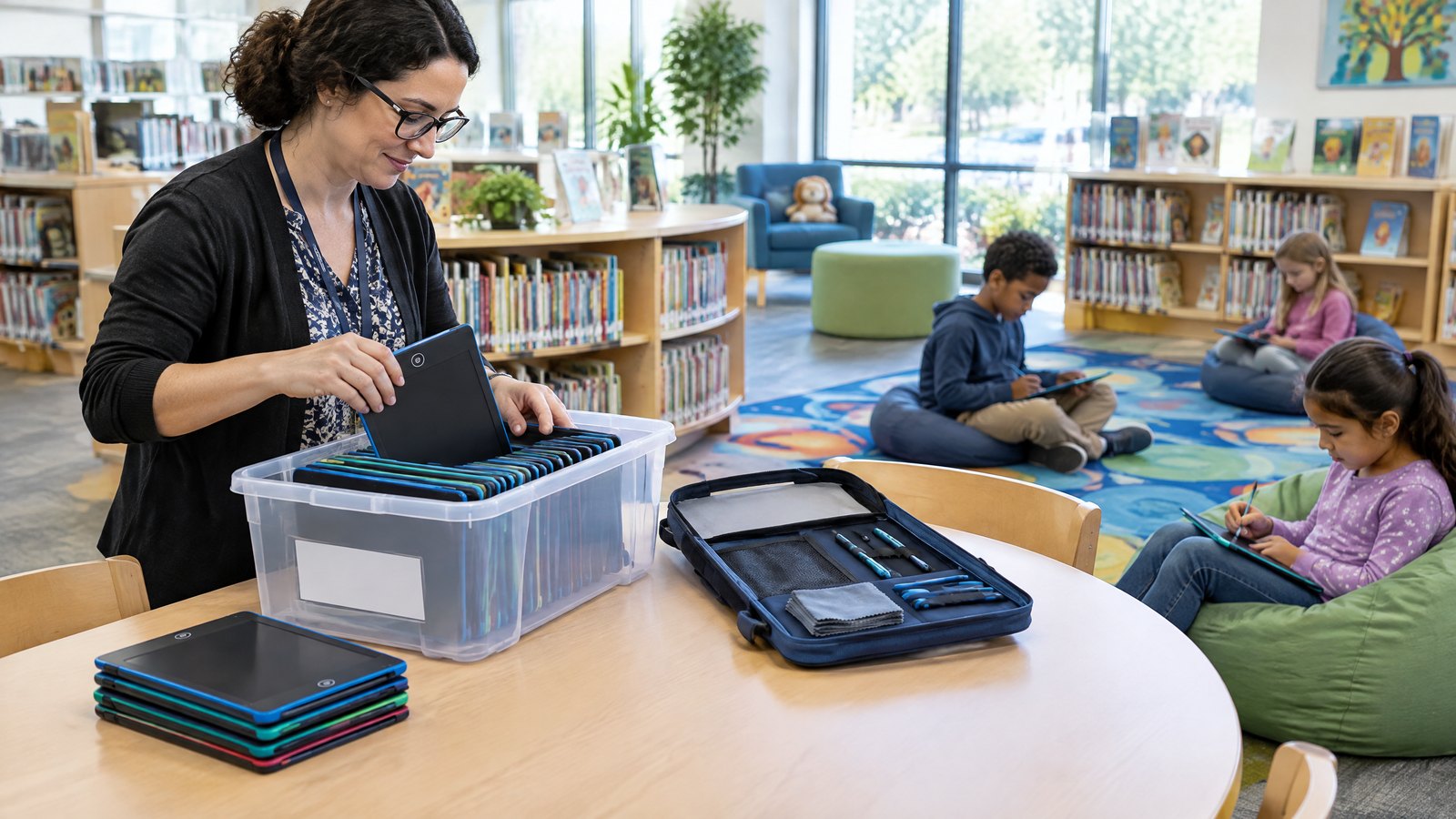
This guide provides a practical B2B decision framework. Final specifications, market obligations, testing scope, labels, packaging and shipment requirements must be confirmed for the exact finished SKU and destination.
LCD Writing Tablets for Nonprofit Literacy Programs: Grant Budgeting, Distribution, and Impact-Ready Procurement
Module 1 — Direct answer: how to buy for a literacy program
An LCD writing tablet nonprofit purchase works best when it is designed as a controlled learning-supply program, not as a promotional giveaway. Define the writing activity, target learner group, distribution owner, and grant rationale first. Convert those decisions into a written specification, comparable quotations, pre-release inspection, and handover tracking.
For early writing practice, tutoring sessions, family-literacy events, volunteer-led reading circles, and classroom stations, a reusable writing tablet can provide a low-consumable surface for letter formation, spelling attempts, sight-word practice, drawing meaning from a text, and quick formative checks. It is not a substitute for books, trained instruction, accessible materials, or a device that requires apps and connectivity. Its value depends on the learning routine around it: an adult prompt, a chance to try, an erase-and-retry cycle, and a way to notice progress.
This guide is for grant managers, procurement leads, school partners, and community organizations in the United States, United Kingdom, Germany, and France who are considering a bulk order from LcdWritingTablet, a Shenzhen OEM/ODM manufacturer. It deliberately does not assume a model, price, certification, lead time, or learning outcome. Ask for current model-specific evidence before committing funds. That is especially important where tablets use button or coin cells, are marketed to children, or will be placed on the buyer’s own brand.
Module 2 — Set the program purpose before setting the quantity
A procurement file should begin with a one-sentence use case: “Learners aged [range] will use one tablet during twice-weekly small-group literacy sessions to practise [named skill], supervised by [role].” This sentence prevents a common failure: buying an attractive device before deciding who will teach with it, where it will live, and how it returns after a session.
Turn literacy aims into observable routines
Use the following planning matrix as the program’s first decision record. It is intentionally a single-page tool: the same choices should appear in the request for quotation (RFQ), grant budget narrative, receiving plan, and facilitator briefing.
| Program decision | Procurement instruction | Evidence to retain | Practical risk control |
|---|---|---|---|
| Learner and setting | State age range, supervision level, language needs, and indoor/outdoor use | Session plan and partner approval | Do not use a child-oriented design or claims without reviewing applicable product rules |
| Learning task | Define writing, drawing, or response activities and frequency | Sample facilitator prompt and baseline count | Test contrast, stylus grip, and erase action with representative users before volume release |
| Quantity | Separate learner units, facilitator demos, spares, and replacement reserve | Site-by-site allocation list | Avoid ordering only the headline learner count; plan for loss, breakage, and pilot findings |
| Product configuration | Specify screen size, body colour, stylus attachment, battery type, lock feature if offered, branding, instructions, and packaging | Dated specification and approved artwork | Treat any change to battery, enclosure, component, artwork, or intended age as a re-qualification event |
| Delivery and custody | Name consignee, delivery terms, carton limit, storage location, and site handover owner | Purchase order, packing list, signed receiving records | Ship in labelled site lots and reconcile serial/batch identifiers where available |
| Impact evidence | Define a small set of outputs and learning-practice signals | Attendance, issue log, reuse/return count, observation form | Report what the program observed, not an unsupported causal impact claim |
Decide whether a reusable board is the right tool
A literacy program writing tablet is strong where paper resupply is difficult, practice is frequent, the tablet will be shared or returned, and facilitators need a fast response surface. It is weaker where learners must retain their written work, where fine-motor or visual-access needs require specialized tools, or where there is no adult routine to turn a blank screen into practice. In those cases, paper, pencil grips, large-print materials, or other adaptive supplies may deserve more of the budget.
Run a small, supervised pilot using the proposed size and configuration. Ask learners to write a short prompt, erase it, attach and remove the stylus, and hand the item back. Ask facilitators whether the display is legible in the actual lighting, whether instructions are understandable, and whether the activity takes less time to set up than the paper alternative. Document findings and only then freeze the specification.
Module 3 — Write a specification that an OEM can quote and a receiver can test
The strongest RFQ describes outcomes and testable attributes rather than vague phrases such as “high quality” or “education grade.” For an OEM/ODM conversation, identify the exact model baseline or ask the manufacturer to propose a model against your required dimensions. Request a dated product sheet that identifies the display type, active writing area, outer dimensions, approximate unit weight, battery chemistry and type, erase mechanism, stylus material and retention method, intended age, operating/storage conditions if known, and items included in the retail or bulk pack.
Separate must-haves from preferences
Must-haves should be measurable. Examples include: a specified minimum writing area; one stylus per unit; a tether, slot, or other agreed retention approach; a reliably functioning erase control; a defined battery-compartment closure; a one-colour logo in the approved position; English, French, or German user guidance as needed; individual protective sleeves; and carton labels that match the allocation plan. Preferences may include colour, silhouette, retail-style packaging, or a particular logo treatment.
Ask the supplier to acknowledge each line item in writing, not merely reply “yes.” Attach an approved artwork proof and a version-controlled specification to the purchase order. If the supplier proposes an equivalent component, require a written change notice, updated samples, and buyer approval before production continues. An ODM project may involve shared engineering choices; an OEM project may focus on applying your brand or packaging to an existing design. In either case, clarify who owns artwork, tooling, product files, and the right to use them after the order.
Design for real community use
If the intended users include children 12 and under in the United States, classification is based on factors including manufacturer statements and how the item is represented in packaging, displays, promotion, and advertising; a label alone does not settle the issue. Children’s products require third-party testing and a Children’s Product Certificate where applicable. 2 That is why the intended user, age grading, packaging visuals, and safety documentation must agree.
Module 4 — Build a distribution design, not a one-time donation drop
The phrase bulk LCD writing board donation often describes a good intention but a weak operating plan. A donation becomes usable community literacy supplies only when the receiving organization can identify the units, store them, teach the routine, replace consumables if necessary, and decide what happens to lost or damaged items.
Choose a named distribution model: a labelled site kit, a take-home issue with acknowledgement, or a circulating facilitator kit. Site kits are easiest to reconcile; take-home programs need a clear replacement policy and minimal, privacy-sensitive records.
Create an allocation sheet before shipment with site name, consignee, planned unit count, spare count, carton count, and receipt deadline. For each site, identify one custodian and one backup. They should know where unopened cartons go, who can replace a battery if that is part of the program, how to isolate a damaged item, and how to report a problem. Do not put personal learner information on exterior cartons or commercial invoices.
Pilot across representative sites before full rollout and keep a decision log. If configuration changes after the pilot, revise the quotation and recheck the effect on product documentation or testing.
Module 5 — Run a transparent supplier and RFQ process
A nonprofit school supplier should be judged on the complete evidence package and the ability to perform to the written order, not on an unusually low ex-works figure. Ask at least comparable sources to price the same specification wherever funder rules or organizational policy call for competition. For U.S. federal-award purchases, recipients and subrecipients must use documented procurement procedures, maintain contractor oversight, and follow the applicable procurement standards; the rules also address competition and methods of procurement. 1 The award, pass-through entity, and local rules may be stricter, so treat this guide as a planning aid rather than as grant-law advice.
A useful RFQ requests: price at the stated quantity tiers; currency and quotation validity; minimum order quantity; sample process and cost; tooling, mould, or artwork charges; production lead time after sample/artwork approval; factory location; carton dimensions, gross/net weights, and units per carton; available Incoterms; payment milestones; warranty or defect remedy; model-specific compliance documents; inspection access; and a named contact authorized to approve technical answers. Request photos or video of the proposed model, but do not use them as a substitute for an approved physical sample.
Email-only procurement CTA: For a model-specific RFQ, sample request, artwork checklist, or carton data, email info@lcdwritingtablet.com with your destination country, quantity range, target age/use, branding needs, and requested delivery date.
Module 6 — Budget the program, not merely the units
An educational tablet grant budget should show the full cost to put a working tablet into a learning routine. Start with unit price multiplied by planned units. Then add sample and artwork costs, packaging changes, pre-shipment inspection, freight, cargo insurance if used, customs duty and import taxes, broker or clearance charges, domestic onward distribution, storage, translation or printing of instructions, facilitator orientation, batteries or replacement accessories if planned, a defect/loss reserve, and monitoring costs. Obtain actual quotations for the material cost drivers rather than inserting unsupported estimates.
Use a transparent calculation in the grant narrative: Total project cost = product + supplier customization + quality assurance + international logistics + import/clearance + in-country distribution + implementation + contingency/reserve. Then divide the total by the number of tablets actually placed into service, not by the number ordered. If the grant requires a cost-per-learner figure, state the planned number of distinct learners and the time period, explain whether devices are shared, and do not imply that every learner owns one.
Build a modest, named reserve rather than hiding uncertainty inside a unit price. A replacement reserve can cover dead-on-arrival units, transit damage, missing styluses, or early losses. It is not a license to accept broad defects. Define the defect threshold, evidence required, claim window, replacement method, and responsibility for return freight or disposal in the contract.
Module 7 — Make the grant file audit-ready and impact-ready
Many funders will care as much about the rationale and stewardship of donated assets as the number purchased. Read the award notice, approved budget, procurement clauses, branding rules, reporting schedule, and any prior-approval requirements before ordering. Grants.gov itself stresses that each funding opportunity’s instructions define eligibility; similarly, award-specific rules govern what a particular grant will fund. 8
For a grant-funded reusable writing tablet program, retain the approved budget and narrative; needs assessment; conflict-of-interest documentation where relevant; solicitation/RFQ; comparison quotations; scoring or selection memo; supplier due-diligence notes; sample approval; signed order and change orders; invoice, payment evidence, shipping documents, customs records, and receiving reports; distribution records; inspection records; issue/repair logs; and funder reports. Under U.S. federal-award rules, records are subject to the applicable retention requirements, so follow the award and organizational schedule rather than creating a shorter program-only rule. 1
Plan evidence that is useful, proportionate, and ethical
Separate outputs from outcomes. Outputs might include units received, sites supplied, sessions delivered, facilitator attendance, or tablets returned to inventory. Practice indicators could include completed writing prompts or observed willingness to attempt a word. Outcomes may require a more deliberate evaluation design, a comparison baseline, consent considerations, and appropriate privacy controls. Do not attach a percentage improvement to the product unless the program has evidence to support that exact claim.
For device custody, use an asset or batch log appropriate to the tablet value and program risk. A batch-level record may be enough for supervised site kits; a unit-level serial or assigned asset label can be better for mobile lending. Avoid collecting sensitive child information merely to prove distribution. Where photographs are proposed for funder communications, secure permissions through the organization’s established process and do not make receipt of supplies conditional on publicity.
Module 8 — Treat compliance as a qualified, destination-specific workstream
United States
If the item is a children’s product, U.S. CPSC rules distinguish it from a general-use product based on intended use and representations, and children’s products must undergo third-party testing and have a written CPC where required. 2 Request the applicable test reports and certificate for the exact product configuration, and ask who is responsible for required labeling and tracking information. Products with button or coin-cell batteries demand heightened scrutiny. A CPSC recall of writing tablet toys reported that a battery-compartment screw did not remain attached as required, creating a battery-ingestion hazard. 3 That specific recall does not establish that another model is unsafe, but it is a practical reason to test compartment security as part of sample approval and lot receiving.
European Union: Germany and France
For electrical and electronic equipment covered by harmonised EU rules, CE marking may be required; the manufacturer must identify applicable requirements, assemble technical documentation, and draw up and sign an EU Declaration of Conformity. The EU also makes clear that CE marking is not a centrally issued permission and applies only where specific EU rules require it. 4 When a nonprofit, distributor, or brand owner has a role in bringing goods to market, obtain tailored advice on responsibilities rather than assuming the overseas factory carries every obligation. If the organization has a tablet made under its own name or brand, the EU explains that it is considered the manufacturer for these responsibilities. 4
Electronic equipment also intersects with national implementation of EU waste rules. The WEEE framework requires separate collection and proper treatment of waste electrical and electronic equipment, with national registers and arrangements relevant to placing equipment on the market. 6 Germany and France apply their own implementation and producer-responsibility mechanisms. Confirm, before shipment, which entity bears registration, marking, reporting, take-back, battery, and packaging responsibilities in the exact sales/distribution model. This is not legal advice.
United Kingdom
For Great Britain, consult the current sector-specific rules and marking guidance for the precise product. UK government guidance says manufacturers must prepare technical documentation including a Declaration of Conformity, and importers must check that conformity processes, documentation, marking, and identification requirements are in place. 5 Do not treat “UKCA” or “CE” on a carton as proof by itself. Confirm the current recognition position, applicable regulations, economic operator, and documentation for the model and route to market.
Packaging creates a separate question. UK guidance says organizations importing packaged goods are among the activities that can make a business a packaging producer, subject to thresholds and circumstances; it also notes a charity exemption in the described EPR framework, with limits. 7 Verify the organization’s status and any country-specific packaging obligations rather than relying on a generic exemption.
A practical document request list
Before release, request an exact-model bill of materials or product identification; dated declaration(s) appropriate to the destination; associated reports or technical evidence where appropriate; labels/artwork and instructions; battery details and safety information; packaging material breakdown if needed for local reporting; and a change-control commitment. Have a qualified compliance adviser, importer, or responsible local party review the file when your role, product, or market requires it. Keep the file linked to the purchase-order version and batch/date code.
Module 9 — Quality assurance and receiving: inspect what learners will use
Quality control has three gates: sample approval, pre-shipment verification, and receiving inspection. The approved sample is the reference. Photograph it from all sides, record its version or model identifier, capture the approved screen appearance, accessories, packaging, logo position, and key dimensions. Store the evidence with the specification. For bulk orders, agree an inspection plan before production is finished. It should identify the lot, sample size or method, acceptable defect criteria, tests, photos required, and who can authorize corrective action. A third-party inspector can be useful, but the organization should still define the test rather than delegate the program’s requirements without direction. Test a representative sample for writing response, erase operation, screen damage, dead or weak display areas, loose components, sharp edges, stylus fit or tether security, branding accuracy, language inserts, packaging count, battery-compartment closure, and carton labels. For tablets with a battery compartment, inspect the closure and screw retention against the approved model and applicable requirements; never improvise a safety judgment from appearance alone.
At destination, quarantine suspect cartons before distribution. Count cartons against the bill of lading or carrier receipt, check for wetness, crushing, puncture, tampering, or mislabelling, and photograph any damage while it is still associated with the delivery. Then perform an incoming sample check that mirrors critical pre-shipment tests. Record the date, recipient, batch/carton identifier, sample count, defect type, photographs, and disposition. Reconcile carton quantities to the site allocation plan.
Define two paths in advance. A non-safety functional issue may be logged for supplier remedy under the agreed claim process. A suspected safety issue should stop distribution of affected units, preserve evidence, notify the responsible internal owner and supplier, and follow applicable local reporting and recall procedures. Do not distribute units “temporarily” while a battery or component concern remains unresolved.
Module 10 — Packaging, freight, and delivery that support field operations
Use carton labels that help receivers work quickly: purchase-order number, destination site code, model/configuration, colour if mixed, units inside, carton number of total, gross weight, country-of-origin marking where required, and handling marks where appropriate. Avoid putting a child’s name, beneficiary identity, or sensitive program label outside a carton. Include an internal packing list and a small number of extra facilitator cards, not excess unneeded consumer inserts.
Select delivery terms with the importer role in view. A freight forwarder or customs broker should review the commodity description, value, country of origin, tariff classification, battery details, and document set for the shipment. Ask whether the batteries and packaging create any carrier, air-freight, or destination documentation requirements. The answer depends on actual battery configuration and transport mode; obtain it in writing from qualified logistics providers. Allow a buffer between international arrival and program launch for clearance, inbound inspection, sorting, and redistribution.
Image plan for the buyer guide
- Recommendation 1 — Purpose: Show the learning context without making unsupported impact claims. Placement: After Module 1. Caption: “Reusable writing practice during a facilitator-led literacy session.” ALT: “Learner using an LCD writing tablet while a literacy facilitator gives a writing prompt.” English AI prompt: “Documentary-style editorial photograph, diverse adult facilitator guiding two school-age learners at a community literacy table, one learner using a simple LCD writing tablet for letter practice, books and printed prompt cards visible, bright natural indoor light, respectful nonprofit setting, no visible logos, no text overlay, realistic 16:9.”
- Recommendation 2 — Purpose: Make the specification and receiving discussion concrete. Placement: In Module 3 or Module 9. Caption: “Approved-sample checklist: display, stylus, erase control, enclosure, battery compartment, and pack contents.” ALT: “Close-up flat lay of an LCD writing tablet, stylus, instruction card, and quality-control checklist.” English AI prompt: “Clean procurement flat lay photograph of a generic LCD writing tablet with stylus, blank inspection checklist, ruler, carton label and protective sleeve, neutral background, sharp product-detail lighting, no brand names, no certification marks, no text overlay, 4:3.”
- Recommendation 3 — Purpose: Explain site allocation and low-waste logistics visually. Placement: In Module 10. Caption: “Cartons sorted by partner site before last-mile distribution.” ALT: “Labelled cartons and reusable writing tablets being sorted for distribution to community literacy sites.” English AI prompt: “Realistic nonprofit warehouse preparation scene, small team sorting plain labelled cartons and reusable LCD writing tablets by partner site, clipboard with non-readable checkmarks, clean organized tables, no personal data or logos, documentary editorial style, 16:9.”
- Recommendation 4 — Purpose: Support the grant-reporting message with a simple operational visual. Placement: In Module 7. Caption: “A minimal evidence loop: receive, issue, use, return, review.” ALT: “Simple five-step diagram showing receipt, issue, literacy use, return, and program review for reusable writing tablets.” English AI prompt: “Minimal accessible vector infographic in English showing five circular steps: Receive, Issue, Use, Return, Review; generic LCD writing tablet icon; navy, teal and warm yellow palette; high contrast; plain white background; no brand logos; clean nonprofit grant-report style, 16:9.”
Module 11 — FAQ and conclusion: make reuse accountable
Frequently asked questions
Are LCD writing tablets an eligible grant expense? Eligibility and allowability come from the specific funder, award terms, approved budget, and applicable policy—not from the product category. Read the notice and award, retain the rationale and procurement evidence, and obtain written approval where the award requires it. The fact that many nonprofit types can be eligible for some federal opportunities does not make a particular purchase eligible. 8
How many tablets should a literacy program order? Order from the delivery model backward. Calculate simultaneous learners per session, facilitator demonstration units, shared-site buffers, planned spares, and a limited replacement reserve. Pilot first where feasible. Do not confuse the total number of participants over a year with the number of units needed on a given day.
Can a nonprofit add its own logo and still use a supplier’s compliance paperwork? Possibly, but never assume it. Branding, packaging, intended-age statements, components, battery arrangements, and the party placing goods on a market can affect responsibilities and the relevance of existing documents. In the EU, an organization having a product made and selling it under its own name or brand is considered the manufacturer. 4 Ask qualified advisers to assess the specific route to market.
What should receiving staff test first? Verify carton count and damage, then test the agreed critical functions on a recorded representative sample: writing, erase action, display condition, stylus/accessory presence and retention, enclosure integrity, battery-compartment closure where present, packaging labels, and correct instructions. Isolate any suspected safety issue before distribution.
Should recipients keep the tablets? Either model can work. Site-based custody supports repeated use and easier inventory; take-home distribution may extend practice beyond sessions but requires clearer instructions, replacement rules, and a practical way to handle damaged products. Choose based on supervision, storage, program goals, and funder conditions.
What is a credible impact claim? Say what the program actually measured: tablets issued, sessions delivered, opportunities to practise, facilitator observations, and, where methodologically sound, changes on a defined writing task. Avoid claims that the product improved literacy outcomes unless the organization’s own evaluation supports that conclusion.
Conclusion
A reusable writing tablet program earns its value through disciplined implementation: a defined literacy routine, an accessible specification, transparent sourcing, destination-appropriate compliance review, documented quality checks, workable distribution, and modest but credible evidence of use. This approach protects grant funds and respects learners more than a large, untracked donation ever can. LcdWritingTablet can be considered as a Shenzhen OEM/ODM sourcing option when its current model, documentation, sample, commercial terms, and capacity meet the program’s written requirements.
Email-only procurement CTA: To request a tailored bulk quotation or discuss an OEM/ODM configuration for a nonprofit literacy rollout, email info@lcdwritingtablet.com with your country, target quantity, application, branding/packaging needs, and delivery timeline.
References
Continue with the next sourcing decision.
Use these internal links to compare products, check common buyer questions, review compliance preparation, or send your requirements to the factory.
Turn this sourcing plan into a product brief.
Share your target market, product requirements, packaging preference and estimated volume for a practical OEM / ODM discussion.