This guide provides a practical B2B decision framework. Final specifications, market obligations, testing scope, labels, packaging and shipment requirements must be confirmed for the exact finished SKU and destination.
Primary keyword: LCD writing tablet for libraries
Supporting keywords: library kids activity tablet; community learning writing board; library lending tablet kit; LCD writing tablet literacy program; public library activity supplier; reusable drawing tablet library
LCD Writing Tablets for Libraries and Community Learning: Lending, Storage, and Program Planning
Direct answer: The best LCD writing tablet for libraries is a simple, non-connected board specified as a circulation-ready kit: durable board, stylus, secure battery solution, asset ID, protective storage, age guidance, and receiving test. Pilot one branch or cohort, design lending and returns before ordering, then scale the proven configuration. For children’s activities, select the compliance path by actual age range, marketing, battery design, and destination—not a generic “CE” claim.
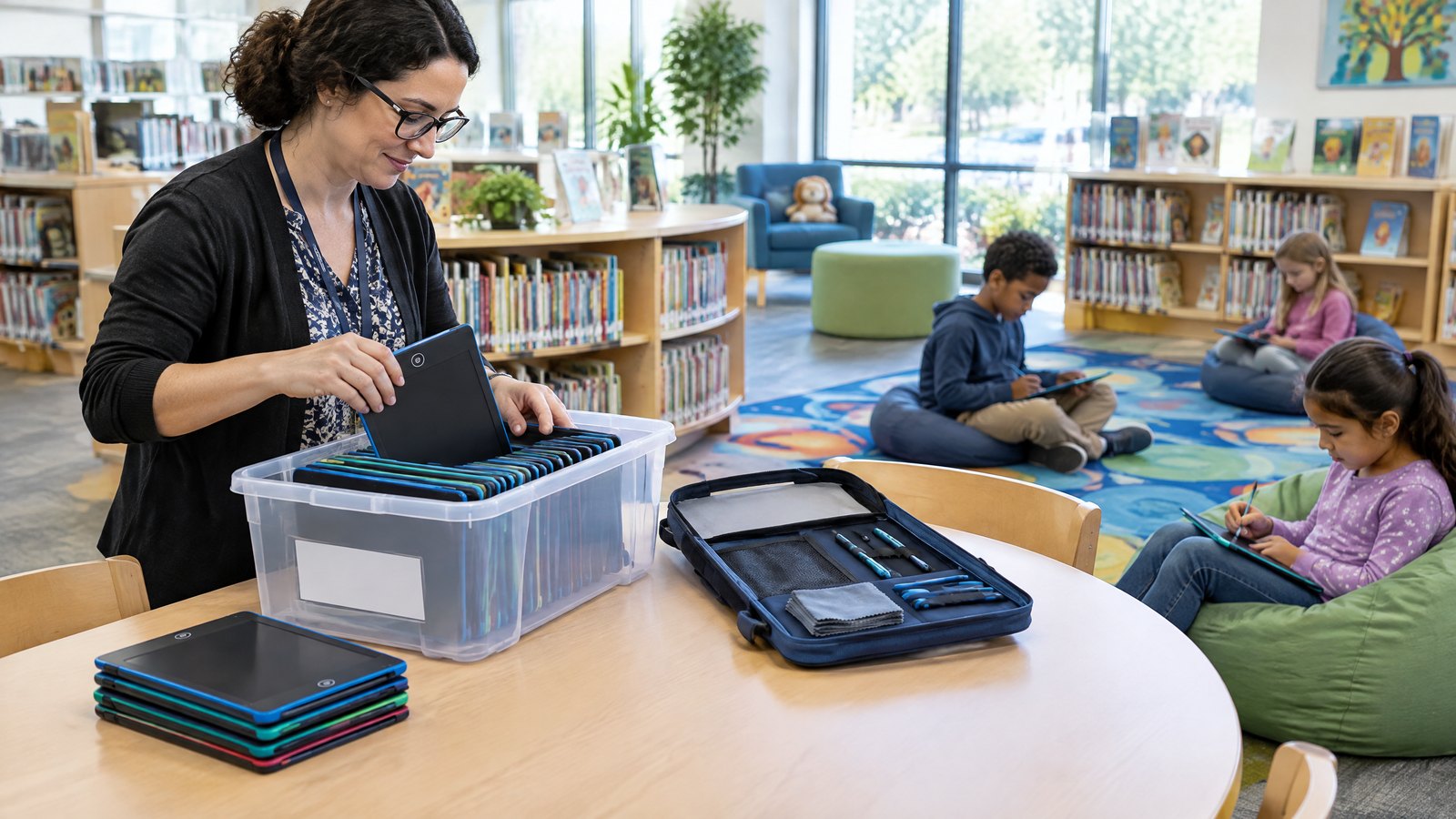
Libraries can use reusable boards for story prompts, early mark-making, language practice, family workshops, and quiet zones without user accounts, charging, content controls, or reset work. Still, a missing stylus, weak erase function, crushed display, or unclear battery door can interrupt an activity.
Module 1 — Define the library use case before comparing models
A buyer should begin with the service outcome, not screen size. The same 8.5-inch board can be a take-home literacy prompt, tabletop resource, or outreach-kit component. Each use changes hygiene, control, accessory, labeling, and replacement needs. IFLA emphasizes quality library services, shared practice, literacy cooperation, and programming; a board should support those aims rather than be novelty stock. 1
Write a one-page brief covering user, age band, location, loan period, expected sessions, and success measure. A branch may need a library kids activity tablet for storytimes, measured by participation and caregiver conversation. An adult beginner-language community learning writing board may instead prioritize legibility, writing area, and wipe-clean storage.
Separate three operating models. An in-library activity pool stays in a supervised zone and should optimize quick reset and simple storage. A program kit is checked out internally by a facilitator, often with cards and signage. A patron-lending kit crosses the building threshold and needs catalog records, complete-kit verification, loss policy, and protection from transport damage. Treating all three as identical is a common cause of unsuitable accessories and uncontrolled losses.
| Operating model | Best use | Core specification priority | Circulation control |
|---|---|---|---|
| In-library pool | Drop-in drawing, storytime, quiet play | Easy erase, rounded housing, tethered stylus | Staff count at opening and close |
| Facilitator program kit | Outreach, class, maker or literacy session | Carry case, activity cards, spare styluses | One kit record and contents card |
| Patron-lending kit | Family learning at home | Protective pouch, ID label, instructions, replacement policy | Item-level barcode/asset record and return inspection |
A non-connected LCD board uses pressure marks and a clear button; it normally has no Wi-Fi, accounts, or files. Confirm every claimed function. Do not infer saving, color, locking, or rechargeable power from product photos.
Module 2 — Specify a circulation-ready kit, not a loose device
Create a controlled BOM for every library lending tablet kit. Specify model/color, stylus and attachment, battery state, pouch, instructions, cards, label position, carton insert, and master-carton count. Give each component a part number or revision, so a changed pen loop, battery cover, magnet, or insert is visible.
In young-child settings, assess the stylus first. A docking channel or robust tether can reduce separation, but check a tether for pinch, pull, snag, and age implications. A stylus reserve may be more practical than complex attachment. Choose a case only for a real transit risk; a supervised cart may need dividers instead.
The battery decision should be explicit. Many basic boards use a replaceable coin cell to power the clear function. A board with no charging port removes charging-cable logistics, but it creates battery-life, battery-cover, and replacement responsibilities. Ask whether a battery is factory-installed, isolated by a pull tab, packed separately, or absent. Ask which exact battery designation and brand is used; a generic “button battery included” is not a usable answer. For US products containing button or coin batteries, CPSC guidance under Reese’s Law identifies requirements covering compartment security, warnings, packaging, instructions, and certification for in-scope products. 2
For public-facing kits, place a short durable insert inside the pouch: “Write with the attached stylus. Press erase only when ready. Return board, stylus and card together. Do not disassemble the battery compartment.” Match wording to the approved labeling and local policy. This is not a substitute for legally required warnings; it is an operational instruction that reduces avoidable returns.
Module 3 — Turn product features into measurable acceptance criteria
A useful request for quotation (RFQ) translates preferences into testable characteristics. “Good quality LCD tablet” produces vague samples. “The board shall clear fully with one normal press after a full-screen writing pattern, and the stylus shall write without permanent dead areas” produces evidence. Give the supplier a drawing, target size, tolerance expectations, color references, logo file, and the intended market. If no tolerance is agreed, do not later reject a batch merely because it differs from an unspoken expectation.
For a reusable drawing tablet library order, request active area, dimensions, weight, display/housing/stylus materials, clear and lock mechanisms, exact battery and cover, factory function checks, display-defect standard, logo/artwork approval, lot coding, and packed-carton dimensions and weight.
Do not accept an erase-cycle claim without a defined method. Writing pressure, coverage, stylus, temperature, storage, and failure definition change results. Request the factory method and report, then run the same full-screen write/erase comparison on shortlisted samples.
Likewise, check the visual experience with actual library tasks. A child drawing a character, an adult writing a name, and a facilitator holding a board at circle time reveal different needs. View the marks from the expected angle and distance in the branch’s lighting. Thin, pale lines may be acceptable for a personal note board but poor for group display. A larger diagonal dimension is not automatically better if the board becomes awkward for small hands or cannot fit the storage bay.
Module 4 — Design lending rules around completeness and privacy
Library technology-lending planning begins with goals, technology, policy, budget, execution, and evaluation, including inventory, loss, damage, and replacement funds. 3 For simple LCD boards, policy can focus on possession, condition, and complete-kit return.
Create a record at the level you lend. A pouch with two boards, pens, cards, and a contents card is one barcoded kit; individually circulated boards need individual IDs. Test label adhesion after cleaning. A duplicate case ID helps reconcile returns.
Set loan periods to purpose. Use a clear incomplete-return rule: inspect at the desk, record missing parts, and offer a policy-consistent replacement route. A missing stylus creates staff work and can sideline a kit.
Because an LCD writing board is normally offline and stores no user profile, it can be a lower-privacy-risk option than connected equipment. Still, never advertise “no data” without confirming the exact model has no memory, camera, wireless module, or companion app. If the product includes a memory function, connectivity, or rechargeable electronics, reassess it as a more complex device and involve the library’s privacy and IT stakeholders before lending.
For a specification worksheet, sample review, or quoted library kit configuration, email info@lcdwritingtablet.com.
Module 5 — Plan storage, charging-free handling, and daily reset
Storage determines readiness. Loose stacks cause stylus loss and screen abrasion. Use vertical dividers or numbered slots for a pool. Give each kit a labeled board pocket and visible pen position so a missing item is obvious.
Set a return-to-shelf flow: scan, compare contents, check write/clear/housing/battery cover, clean under approved procedure, then put in “ready” or “hold for review.” A quarantine bin prevents faulty boards reaching the next child.
Standard LCD boards need no charging cabinet, saving outlets, cables, and charging labor. Track spare batteries, styluses, sleeves, labels, cleaning supplies, and buffer boards. Secure batteries from children and do not mix new and used cells.
Cleaning instructions should come from the supplier for the specific plastic, screen film, printing, and label adhesive. In general, avoid abrasive pads, solvents, soaking, and liquid entering seams or battery compartments. Validate the library’s intended wipe and dwell process on a noncritical sample before rollout. Record any product discoloration, print rub-off, screen haze, or label lifting so the process can be adjusted. Cleaning is a quality-control step, not merely an aesthetic one.
Module 6 — Build an LCD writing tablet literacy program people can repeat
Build a program that a new staff member can run from a short prep list. Pair each board with a prompt, interaction, and reset. It enables quick, low-stakes marks without paper waste, but does not replace reading, books, or sustained writing.
For preschool storytime, pause and ask children to draw what happens next, then describe a mark. For school-age readers, draw a setting from three words or write a question for a character. Adult and family uses include letter formation, vocabulary sketches, name practice, directions, and conversation starters.
Design kits around facilitation, with prompt cards covering age range, preparation, a five-minute activity, extension, and reset. Offer relevant community languages where feasible. Test type at arm’s length; a simple board should not need a long technology briefing.
Track circulation, attendance, repeat participation, incomplete returns, and replacement consumption. Capture one staff note after each pilot session, then improve the kit before a larger purchase. That makes the LCD writing tablet literacy program a service prototype, not a one-time product donation.
Module 7 — Qualify a Shenzhen OEM/ODM supplier beyond the catalog
An OEM/ODM relationship matters when the factory holds specification, communicates changes, and supports documentation—not merely logo printing. OEM usually adapts an existing platform with color, logo, packaging, and accessory options. ODM can change industrial design, tooling, display, electronics, or kit construction. Confirm the category: “custom” may be artwork or a project requiring tooling, time, and new compliance review.
Ask the public library activity supplier for its role, factory, model, BOM, capacity, quality system, approval and change process, lead-time definition, and after-sales response. Request product-specific reports and declarations. Align model, components, report date, market, and standards with the board bought.
A golden sample is a strong control. Approve the sample and photo sheet for display, artwork, logo, housing, stylus, holder, labels, inserts, pouch, pack, and carton marks; assign a revision. Require written notice for changes to display supplier, battery cover, pen material, or packaging, then decide if revised approval and documents are needed.
Ask how the factory controls display, PCB, battery, housing, button, stylus, and packaging from different sources. A capable plan covers incoming, line, function, final, and rework checks. Use a PSI or third-party inspector for first or higher-risk orders. An audit, test report, and PSI answer different questions.
Module 8 — Apply compliance by market, product classification, and evidence
Compliance is not logo shopping. Obligations depend on features, marketing, intended age, economic operator, and destination. Have the importer or qualified adviser confirm requirements before ordering. This is a procurement checklist, not legal advice.
For Germany and France, electronic boards usually fall within EU EEE rules unless excluded. RoHS restricts ten substances and covers EEE with an electrical/electronic component unless specifically excluded. 4 If marketed as a plaything for children under 14, toy safety may also apply. EU toy rules cover physical, mechanical, flammability, chemical, electrical, hygiene, and radioactivity risks, and toys need CE marking. 5 Toy status is a classification question, not decided by a library label alone.
For EU placements, obtain the applicable DoC, technical-file support, identification/traceability, reports, and national-language instructions/warnings. Plan end-of-life too: WEEE promotes prevention, reuse, collection, treatment, and recycling; registration and take-back duties may fall on the market placer. 6 Verify France- and Germany-specific duties.
For Great Britain, identify the applicable regulations and marking route. GOV.UK says manufacturers must meet requirements, apply correct marking and identification, retain technical documentation including a DoC, and monitor compliance; importers have separate duties. 7 Electrical safety, EMC, RoHS, and toy safety can permit self-declaration in specified circumstances. 7 Do not assume one EU document settles GB obligations.
In the US, general-use and children’s products can have different documentation and testing. For button or coin batteries, use CPSC guidance, not a generic supplier statement. The covered rule incorporates ANSI/UL 4200A-2023 and addresses compartments, abuse resistance, warnings, and certification. 2 Have the importer or qualified US professional set the applicable children’s-product path.
Never request a certificate before finalizing the model and then reuse it for a changed battery, enclosure, electronics, age grade, packaging, or branded version without review. A document that identifies another product is weak procurement evidence. Build a compliance file with the signed documents, reports, model photos, labels, instructions, shipment lot, supplier contacts, and change approvals.
Module 9 — Budget total delivered cost, OEM changes, and protective packaging
Unit price is one cost line. Landed cost includes samples/tooling, artwork, printing, packing, pouch, spares, testing/inspection, freight, insurance, duty/tax, brokerage, warehouse handling, labels, and replacement reserve. Quote board, kit, retail/bulk pack, and master carton separately so low-value add-ons remain visible.
Order quantity affects price and flexibility. A cheap large order can create carton footprint, dead stock, and untested configuration risk. Include a small replenishment line for styluses, boards, pouches, and, where policy permits, batteries; tiny accessory reorders can cost more than a controlled initial reserve.
Match packaging to the route. Warehouse delivery benefits from bulk packs, interleaves, and a carton map; take-home kits may need a durable pouch rather than disposable retail box. Specify carton dimensions and gross-weight limit, kit count, orientation, moisture protection, marks, barcode placement, and pallet configuration. Request packed-carton photos.
Use a written Incoterm with named place and version, plus a clear statement of who acts as importer of record and who manages destination compliance. Do not rely on shorthand such as “delivered price” when deciding responsibility for customs, taxes, or product obligations. A compact packing list that maps carton numbers to kit count and model/color also makes receiving far faster.
Module 10 — Control quality from sample approval through receiving
Quality assurance starts before the purchase order. First, compare samples against the approved requirement. Second, send the signed specification, artwork proof, packaging proof, and defect standard with the PO. Third, set milestone evidence: pre-production sample approval, in-process photos if useful, final packed-carton photos, final inspection report, and shipping documents. For larger orders, specify an inspection level and acceptance criteria with a qualified inspection partner rather than writing “no defects” into the PO. No consumer product line is literally defect-free; the buyer needs clear critical, major, and minor defect definitions and a remedy process.
At factory final inspection, check a representative sample for identity, count, workmanship, display writing and clearing, lock function where fitted, stylus fit/retention, battery and battery-cover condition, correct logo, labels, instructions, pouch/case components, and carton marks. Capture photos of the tested units and sealed cartons. Function-test with a realistic full-screen writing pattern, not only a tiny corner mark. If the product uses a battery pull tab, verify its presence and that it does not tear or leave the device activated in transit.
At receiving, do not wait until all cartons are shelved. Count cartons against the packing list; photograph any crushed, wet, punctured, or retaped carton before opening; then sample units from different cartons. Confirm kit completeness, board ID/barcode scan, correct language insert, writing/erase function, stylus, cover integrity, cosmetic condition, and packaging match. Record the carton and product ID for every defect found. Quarantine suspect stock and notify the supplier promptly with photos, quantities, and the agreed defect categories.
A simple receiving log turns anecdote into supplier feedback. Track received date, PO, lot, cartons, sample quantity, pass/fail count, defect type, corrective action, and final disposition. Trend the results across orders. If styluses repeatedly go missing, the solution may be a kit-design change. If incomplete clearing appears after storage, investigate battery condition, component lot, and test method rather than automatically blaming staff.
Module 11 — Buyer FAQ, image plan, and decision close
Frequently asked questions
Are LCD writing tablets appropriate for library lending?
Yes, when the model is specified as a complete kit and the library has circulation, storage, return-inspection, and replacement procedures. They are particularly suitable for low-tech, reusable activity lending because they normally avoid charging and user-account management. A loose-board giveaway is not the same as a lending program.
What screen size should a public library activity supplier quote?
Ask for at least two sample sizes and test them in the actual program. Smaller boards are easier for young children and dense storage; larger boards suit group prompts and adult writing. Prioritize usable writing area, visibility, hand comfort, pouch fit, and storage footprint over diagonal size alone.
Can a board be sold as both a library resource and a toy?
Possibly, but classification and applicable obligations depend on design, age grading, marketing, and market. If it is marketed as a plaything for children, assess toy safety rules rather than applying only electronics paperwork. Obtain qualified compliance advice for the final product and destination.
Should we request CE, UKCA, FCC, RoHS, or a test report?
Request evidence based on destination and product scope, then have the importer or qualified adviser verify it. Marks and reports are outputs of an applicable conformity process, not a substitute for it. Match every document to the final model, components, branding, labels, and instructions.
How many spares should we order?
Set the quantity after a pilot, but include spare styluses and a small number of replacement boards from the start. Use early return data to refine the reserve. The right figure depends on loan model, age group, attachment design, and transit exposure.
Image plan for the published guide
| Purpose | Placement | Suggested caption | ALT text | English AI image prompt |
|---|---|---|---|---|
| Show a realistic library activity use | After Module 1 | “Reusable boards make low-prep storytime participation visible.” | Children using LCD writing tablets during a supervised public library storytime | Documentary-style public library children’s area, diverse children age 5–8 seated with small reusable LCD writing tablets and a librarian reading a picture book, warm natural light, no visible brands, authentic editorial photography, landscape |
| Explain kit completeness at a glance | After Module 2 | “Specify every part of the circulation-ready lending kit.” | Flat lay of an LCD writing tablet lending kit with stylus, pouch, activity cards and asset label | Clean top-down product flat lay on a light library worktable: generic LCD writing tablet, tethered stylus, numbered protective pouch, laminated activity cards, barcode asset label, neutral colors, no logos, commercial editorial style |
| Demonstrate storage control | After Module 5 | “Numbered slots make missing devices and styluses obvious.” | Vertical storage rack holding numbered reusable writing tablets in a library | Organized public library storage cart with vertical numbered dividers holding reusable LCD writing tablets, visible stylus bays, staff-ready operational scene, soft daylight, no brands, realistic photography |
| Support receiving and quality guidance | After Module 10 | “Inspect function, accessories, labels and packed cartons before release.” | Library receiving team inspecting LCD writing tablet kits and shipping cartons | Library procurement receiving desk with staff inspecting a generic LCD writing tablet, checking a contents card and barcode against a packing list, sealed cartons nearby, realistic documentary photography, no brand names, landscape |
Conclusion
A successful library board program is a system, not a carton of devices. Choose the use case, define a kit, test the actual program experience, verify compliance for the final market and classification, control the supplier’s approved sample, and inspect every intake. With those basics in place, an LCD writing tablet for libraries can become a low-waste, approachable tool for drawing, literacy, language practice, and community learning—without adding charging, logins, or complex device administration.
To discuss an OEM/ODM library order, packaging options, or a controlled sample plan, email info@lcdwritingtablet.com.
References
Continue with the next sourcing decision.
Use these internal links to compare products, check common buyer questions, review compliance preparation, or send your requirements to the factory.
Turn this sourcing plan into a product brief.
Share your target market, product requirements, packaging preference and estimated volume for a practical OEM / ODM discussion.