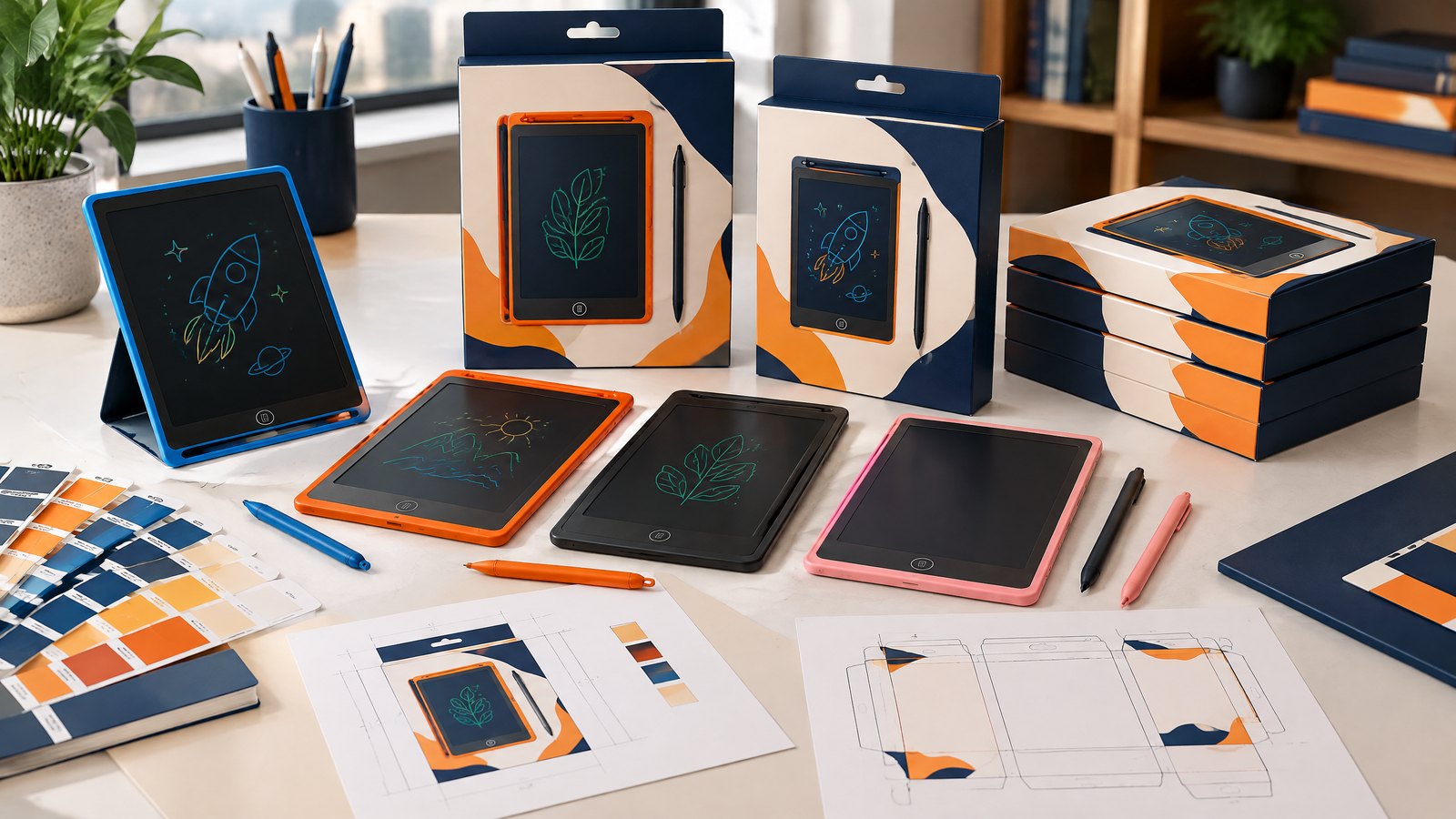
This guide provides a practical B2B decision framework. Final specifications, market obligations, testing scope, labels, packaging and shipment requirements must be confirmed for the exact finished SKU and destination.
LCD Writing Tablets for Montessori Programs: Activity Design, Age Fit, and Buying Criteria
1. Direct answer: what should a Montessori buyer purchase?
A well-specified LCD writing tablet Montessori program starts with a narrow job: a child makes a mark, observes it, erases it independently, and restores the material. It should not be bought as a paper replacement or a screen-shaped novelty. For most early-childhood settings, choose a low-distraction, battery-operated board with a tethered stylus, positive erase action, rounded accessible edges, secure battery access, clear indoor visibility, and a size a child can carry to a mat or table.
Select the activity before the hardware. A compact board can support line control, symbol formation, number practice, or a quick observation sketch. A larger active area can support copying a word, labeling an object, or planning a sequence. Neither is inherently Montessori. The fit comes from a short presentation, a bounded purpose, a child’s independent repetition, and orderly return to the shelf.
The American Montessori Society describes a prepared environment as carefully selected, sequentially presented materials that meet developmental needs, and identifies child-directed work and a complete work cycle as core features.1 An LCD board belongs when it supports that order and concentration. It supplements rather than replaces practical life, sensorial, language, concrete math, paper work, or teacher observation.
For a new SKU, obtain an actual sample in the intended size. Trial it in the target setting, then turn the result into a written specification before bulk approval. Check screen response, erase reliability, stylus retention, battery-compartment security, label position, and pack-out. Treat advertised dimensions, “pressure sensitivity,” and battery-life claims as items to verify against the approved sample.
2. Buyer context: use the Montessori lens, not generic edtech logic
Montessori buyers may be school groups, specialist distributors, education brands, or importers building a preschool line. Their question is not simply whether the device works. It is whether an adult can present it simply, whether a child can use it purposefully, and whether it can sit calmly beside established materials. A Montessori writing tablet supplier should demonstrate product and quality capability; it should not imply endorsement by a Montessori organization without authorization.
AMS places Early Childhood at approximately 2.5–6 years and describes multi-age classrooms.1 A board therefore needs an activity sequence, not one forced lesson. A younger child may follow one curve; an older child may record a phonetic word or a measurement. Separate cards or teacher presentations can differentiate the work while the physical tool remains stable.
Writing readiness is also broader than tracing. An AMI training resource describes written expression as growing from spoken language, sound analysis, symbol association, word building, and physical preparation. Holding an instrument and forming its marks are only part of the process.2 Do not market a reusable board as a shortcut to handwriting or use it to bypass tactile letters, movable alphabet work, practical life, or real objects.
A purchase brief should identify the presenting adult, shelf location, target age grade, sales route, destination markets, and whether the item is a loose classroom tool, retail unit, or kit. These choices influence warnings, pack count, languages, documentation, and traceability. A board covered in permanent icons may look educational but create visual noise and adult-led prompts. A minimal board may suit the room yet need clearer packaging and legal information for retail. Match the configuration to the actual route.
3. Product and use-case explanation: a defined work, not an all-day device
An LCD writing tablet is a pressure-responsive surface on which a stylus or fingertip produces visible marks; an erase function clears the display. It usually needs no app, internet, login, audio, or video. That limitation can be useful: the child attends to hand movement, mark-making, and the work sequence. Yet constructions vary. Confirm whether the exact model has only erase, a lock switch, replaceable battery, magnetic stylus, detachable parts, printed overlay, or stand.
The goal is control of activity, not automated scoring. A presentation can be concise: carry the tablet with two hands, place it on a mat, choose one card, make the marks, compare with the card or another self-checking control, erase, and restore the set. A word card with an answer on the reverse, an object basket, or a simple outline can provide feedback without the device judging the child.
Activity design by readiness
For children who are ready around 2.5–3.5, favor deliberate movement over letter worksheets: one vertical line, horizontal line, curve, geometric outline, or familiar-object sketch. Observe grasp, concentration, and the room’s sequence; do not assign work merely because a package says “preschool.” Keep spoken language, hands-on sensorial work, and practical-life activity central.
For children broadly around 3.5–4.5, isolate one challenge: trace left to right; copy a geometric outline; form an introduced sound-symbol after a sound game; record a known numeral; or sketch an object and dictate its label. Store one card at a time in a labeled envelope. Avoid making a crowded permanent alphabet or game board part of the screen.
For children broadly around 4.5–6 who have received the relevant presentations, use the board for provisional work: create a phonetic word after moveable-alphabet work, copy a known word, label a classified object, write a numeral before matching a concrete quantity, make a map key, or sketch a nature observation. A child can try, revise, erase, and decide whether a permanent record belongs on paper. This protects the difference between practice and publication.
Eight LCD writing tablet activity ideas
- Line and curve trail: trace one path, compare it with the control card, erase, and repeat by choice.
- Sandpaper-letter follow-up: after tactile letter presentation, write a known sound-symbol; do not replace tactile work.
- Object sketch and label: sketch one real object, then use a moveable alphabet or attempt its label.
- Sound-basket record: draw an object from a known initial-sound basket and write only that sound-symbol.
- Number and quantity check: write a selected numeral, then pair it with existing counters, beads, or rods.
- Nature observation: make a quick leaf, seed, or weather sketch; use paper later if a lasting record serves the project.
- Practical-life plan: draw a three-step sequence for table setting, plant care, or snack preparation, then carry it out.
- Message rehearsal: quietly practice a short note before making the final version on paper.
Use the phrase reusable writing board early learning only with a clear age grade, supervision context, and learning boundary. Exclude unsupported claims such as “guarantees handwriting,” “improves intelligence,” or “Montessori certified.” A restrained activity system is more credible than inflated packaging copy.
Email-only CTA — Request a Montessori sample brief: Send target ages, activities, screen-size preference, branding files, destination market, and forecast quantity to info@lcdwritingtablet.com. Request a sample and written specification checklist before confirming bulk production.
4. Specification and decision framework: features that protect the work cycle
Write a decision document rather than accepting a page of generic features. “Good quality” cannot be inspected consistently. “Tether remains secured after the agreed handling check” can. Separate must-haves, preferred options, and features to avoid. Reference the exact revision in the quotation and purchase order.
Screen and erase behavior
State active writing area, external dimensions, panel color, expected contrast, and viewing condition. Do not select by diagonal alone: a too-small surface frustrates word work, while a too-large board can be awkward for a young child to carry. Review a fine stylus line and light child touch in normal indoor light away from glare. Photograph the approved sample under those conditions.
Define how erase works and whether an accidental press clears work. A lock may help an adult preserve an observation long enough to discuss it, but only if its location and operation are clear. Cycle the lock on the sample repeatedly. If a child can access it, decide deliberately whether that reinforces or interrupts independent work.
Stylus, body, and storage
Specify stylus shape, tether or holder, tip, attachment method, and storage location. A tethered stylus reduces classroom losses; a detachable one may better suit a retail concept. Either design needs age-grade and risk review. Inspect for scratching, snagging, loose parts, sharp edges after a drop, and a holder that releases the pen in transport.
The body should be wipeable, rounded, and not needlessly heavy. Test it on the actual shelf, tray, work mat, and bin. Consider a discreet name-label area and a defined lot-code zone. Ask for a physical sample with final material and finish, not only a rendering.
Power and serviceability
Record battery chemistry/model, cover design, fastener, replacement procedure, battery inclusion by market, and the owner of battery service. CPSC notes that battery-operated toys have requirements related to preventing child access during play, labeling, and overheating.3 The necessary testing must match the final age grade, intended use, battery type, and destination.
Have the factory demonstrate battery installation using the final screw, cover, and instructions. Confirm erase behavior at the stated low-battery condition. For retail, the leaflet should identify battery type, adult-only replacement steps, and disposal information as applicable. For schools, agree whether spare batteries are supplied by the site, distributor, or retailer.
A useful baseline may include: specified writing area; reliable erase; agreed lock behavior; secure battery cover; tethered stylus or specified retention; rounded accessible edges; manufacturer/importer and lot locations; localized artwork; and destination-market evidence. Preferred options might be a stand, custom color, or activity cards. Avoid sounds, flashing lights, detachable decorations, permanent cartoon graphics, and app dependence unless the stated concept truly requires them.
For a LCD tablet for preschool handwriting, the key question is not whether the line is bright. It is whether the mark is controllable, legible, and comfortable for the intended activity. Guides should retain discretion to choose paper, pencil, chalkboard, metal insets, or other established materials when they better serve the child.
5. Procurement process: from brief to approved production sample
Start with a one-page RFQ that identifies target countries, channel, target age grade, planned claims, configuration, branding, estimated quantity, and requested incoterm. Attach an activity brief, not only a mood board. The factory can then state which body, display, stylus, battery arrangement, and pack are stock options and which need development.
1. Brief. Build the shelf routine and activity cards first. Define prohibited claims, languages, destination markets, and whether the SKU is a classroom tool, retail unit, or kit.
2. Capability review. Request drawings, proposed bill of materials, sample photographs, package dieline, comparable-construction test history, and a written list of customizable items. Historical reports are background, not proof for a changed final product.
3. Engineering sample. Evaluate writing contrast, erase, lock, tether, battery cover, dimensions, stylus storage, mold finish, and package. Record findings in a dated sheet; issue a revision number after every agreed change.
4. Compliance and artwork plan. Confirm classification and evidence with the importer, competent laboratory, or regulatory adviser. Put age grading, warnings, instructions, markings, economic-operator details, recycling information where applicable, and lot coding into the artwork early.
5. Golden sample and PO. Seal or photograph an approved golden sample. The purchase order should cite its revision, materials, artwork, pack-out, inspection plan, defect definitions, test needs, delivery terms, and remedy for unapproved substitutions.
6. First article and production check. Before full output, compare finished pieces and packaging to the golden sample. Check screen response, erase, lock, stylus retention, screw installation, print legibility, and carton count. An experienced factory keeps a signed first article and approved color artwork at the line so the operator and inspector work against the same reference.
7. Final release. Verify the agreed sample plan, quantity, carton marks, packing list, and critical functions before shipment. Independent inspection can add evidence but does not transfer the importer’s or brand owner’s responsibility.
For an educational LCD writing board OEM project, agree upfront who owns molds, artwork source files, card content, test reports, technical documentation, and corrective-action records. A new housing, overlay, card set, battery arrangement, or claim may change assessment needs even when the base board looks familiar.
6. Quality and receiving controls: inspect it as a classroom object
The quality plan should cover function, appearance, assembly, packaging, traceability, and the actual design. Keep critical defects short and serious: accessible battery under expected use, sharp accessible edge, wrong warning or product artwork, erase failure, insecure stylus assembly, or missing lot identity. Major/minor definitions should reflect the sales channel rather than a copied checklist.
A useful sample test follows the normal work cycle. Take a unit from its intended package; inspect model, label, and lot; remove and return the stylus; draw continuous lines, curves, and small symbols; erase; test lock behavior; inspect for faint zones, persistent ghost lines, scratches, rattles, loose parts, or print defects; then restore the unit. Record viewing condition and battery state. Test stands on the actual classroom table and card/sleeve systems for a child’s ability to identify and restore components.
At receiving, open cartons from the beginning, middle, and end of a shipment. Confirm model, color, language version, barcode, inner-pack count, and carton mark; then sample functional and cosmetic checks. Photograph representative units with the incoming lot record. Quarantine any mixed version or damaged carton until the supplier’s corrective action is clear. This is not laboratory testing; it is protection against wrong versions, missing accessories, and transit damage.
For preschool LCD tablet bulk orders, request spare units, styluses, and batteries per site or carton. A low unit price is not a saving if one lost stylus disables a board. Request service-part SKUs, minimum reorder quantities, lead times, and pack quantities before the first order.
7. Cost, packaging, and logistics: compare landed usability, not only price
Build a landed-cost sheet that separates product, tooling/design, samples, testing/documentation, packaging, inspection, freight, insurance, duty/tax, destination handling, warehousing, recycling/producer-responsibility costs where applicable, and service parts. Give each line an owner and currency. This normalizes a stock OEM offer against an ODM program with custom mold, cards, or pack.
Packaging is a functional product component. A school order may need a compact storage sleeve, lot label, and educator insert. Retail may need shelf artwork, localized warnings, barcode, sealed accessories, and a carton that survives distribution. Require a pack-out drawing with unit orientation, stylus position, inserts, inner and master-carton dimensions, gross/net weight, carton count, and shipping marks.
Request a shipping sample or pack-out photo. In a practical factory example, a quality team compares the first sealed carton with the approved drawing, weighs it, scans its barcode, checks destination code and carton mark, and photographs the open layer arrangement. It can expose a wrong leaflet language, missing stylus, wrong inner count, or weak carton before mass packing.
Use an incoterm only with its named place, handover point, booking party, insurance role, delivery window, document set, palletization plan, and responsibility for inspection/storage/amendment. Battery configuration may affect carrier requirements; confirm the final configuration and paperwork with the forwarder before booking.
EU battery rules have phased requirements under Regulation (EU) 2023/1542 and address batteries through their life cycle.6 For France and Germany, obtain destination-specific advice early on battery, packaging, and electrical/electronic-equipment registrations and take-back duties. Responsibilities can depend on the entity placing the product on the market.
8. Compliance caveats: US, UK, Germany, and France
This is a procurement map, not legal advice or a certificate. The route depends on intended purpose, marketing claims, age grade, construction, battery type, components, and place of sale. Obtain current advice from a competent laboratory or regulatory professional for the final SKU.
United States
If an item is designed, manufactured, or marketed as a plaything for children under 14, it may be a toy under the CPSC framework. CPSC states that ASTM F963 is mandatory for children’s toys and explains battery-operated-toy requirements around access, labeling, and overheating.3 For children’s products subject to CPSC-enforced rules, manufacturers and importers must issue a Children’s Product Certificate (CPC); CPSC also describes tracking-label requirements on product and packaging.3
Do not assume “educational tool” removes toy obligations. Determine final applicable chemical, phthalate, small-parts, mechanical, labeling, battery, and test-laboratory requirements with the appropriate adviser. Align reports, CPC, component declarations, artwork, lot identifiers, and revision history.
European Union: Germany and France
For toys, the EU Toy Safety Directive covers general health and safety plus physical/mechanical, flammability, chemical, electrical, hygiene, and radioactivity risks.4 All toys sold in the EU must carry CE marking, which the Commission describes as the manufacturer’s declaration that essential requirements are satisfied.4 Regulation (EU) 2025/2509 has a transition period and is scheduled to start applying on 1 August 2030; monitor its implementation rather than changing labels prematurely.4
Collect the technical file, risk assessment, relevant test evidence, EU declaration of conformity, traceability plan, manufacturer details, appropriate EU economic-operator information, and final required instructions/warnings. France and Germany may create additional national language, consumer, packaging, or environmental obligations. Have local advisers review the final SKU and sales route, not a generic family report.
United Kingdom (Great Britain)
UK guidance requires manufacturers to keep technical documentation and a declaration of conformity for 10 years, supply product/manufacturer identification, and ensure continuing production remains conforming.5 GB importers must check the manufacturer’s assessment and documentation and provide their identifying details as required.5 Great Britain marking-recognition rules and timelines can change, while Northern Ireland follows a different framework. Recheck the route just before artwork approval and shipment.5
Across markets, a logo on a carton is not evidence. Ask which exact version was tested; who is named in the report; which standards/clauses apply; whether the bill of materials matches; whether evidence is current and authentic; and which responsible economic operator holds the technical documentation. Reassess after a design, battery, accessible-component, age-grade, or claim change.
9. Practical buyer table
| Program need | Product/activity decision | Evidence to request | Avoid |
|---|---|---|---|
| Pre-writing control | Compact board; one path card | Child-use sample and mark/erase record | Treating tracing as a whole handwriting curriculum |
| Sound-symbol follow-up | Minimal screen; separate cards | Educator-reviewed sequence | Crowded permanent alphabet graphics |
| Word/caption work | Active area for short words | Normal-light copy test | Choosing by outside diagonal only |
| Independent shelf use | Carryable board; defined stylus home | Shelf/tray trial and retention check | Ignoring restoration and loss risk |
| Retail kit | Localized insert and traceability | Final dieline and translation review | Unauthorised Montessori endorsement |
| US/EU/GB sale | Final classification and documentation plan | Applicable reports, declarations, markings | Generic “tested” or logo-only claims |
10. Frequently asked questions
Is an LCD writing tablet appropriate for every Montessori room?
No. It is suitable only when an adult can place it in a purposeful sequence and the board supports the room’s order, independence, and age mix. Pilot it with intended guides and children. It should never replace tactile letters, movable alphabet work, concrete materials, paper writing, or practical-life preparation.
What age should packaging state?
Determine age grading from the final product, components, intended use, and destination rules, not from a competitor listing. A classroom’s developmental range and retail package age statement are not interchangeable. Review the exact stylus, card, and battery configuration.
Should we choose a lock button?
Only when temporarily preserving work has an activity purpose. Test clarity, location, and durability. A switch that makes a board appear broken to a child can obstruct independence.
Can an OEM/ODM supplier provide cards and private-label packaging?
Often yes, but each added component needs a specification, artwork proof, material review, and age-fit review. Define copyright ownership, translation responsibility, and revisions. Approve a fully packed sample, not the board and package separately.
What factory test matters most?
No single test is sufficient. A repeated write–erase–lock–restore cycle on production-representative pieces reveals usability issues, while safety requirements depend on classification and configuration. The essential management control is traceability from bill of materials and artwork revision through lot, testing, inspection, and shipment.
How do we compare quotations?
Normalize writing area, battery/stylus arrangement, materials, lock feature, branding, pack-out, languages, test scope, inspection, service parts, incoterm, lead time, and payment terms. An offer omitting documentation or replacement-parts planning is not directly comparable to a complete offer.
11. Conclusion and next step
The strongest Montessori-oriented LCD tablet is not the one with the most features. It supports a short, clear activity; lets the child work and restore independently; fits a prepared shelf; and is backed by controlled production. Start with the developmental job, validate the physical sample in the real room, and convert the result into a specification, golden sample, inspection plan, suitable documentation, and transport-ready pack.
Keep one product dossier that connects activity brief, specification, approved artwork, compliance evidence, quality records, lot code, final inspection, and shipping documents. That is a stronger procurement position than broad “educational” or “safe” claims.
Email-only CTA — Build your OEM/ODM request: Email info@lcdwritingtablet.com with target market, age grade, intended activities, preferred configuration, packaging route, artwork needs, and forecast quantity. Request a documented sample-review and production-control plan for the final SKU.
Image plan
-
Purpose: Show a calm, child-led shelf material. Placement: After Section 1. Caption: “A simple LCD writing tablet on a low Montessori shelf with one tracing card and work mat.” ALT text: “Child-sized LCD writing tablet on a Montessori shelf with a single tracing activity card.” AI prompt: “Editorial product photograph, authentic Montessori early childhood classroom, neutral wood shelf, minimalist LCD writing tablet with tethered stylus on a small work mat, one simple line-tracing card, natural daylight, calm uncluttered composition, no logos, realistic documentary style.”
-
Purpose: Explain progressive activity design. Placement: Section 3 after readiness guidance. Caption: “Reusable cards for line control, sound-symbol follow-up, and short-word practice.” ALT text: “Three Montessori-style activity cards beside an LCD writing tablet showing progressive writing tasks.” AI prompt: “Top-down educational flat lay, reusable Montessori activity cards from line paths to sound symbols to short phonetic words, blank LCD writing tablet and stylus, clean natural materials, muted primary accents, photorealistic, no logos.”
-
Purpose: Make OEM specification review tangible. Placement: Section 4. Caption: “Sample-review details: surface, erase control, stylus tether, battery cover, and lot-code zone.” ALT text: “Annotated close view of LCD writing tablet features for OEM quality review.” AI prompt: “High-resolution unbranded LCD writing tablet on a white inspection table, close-up of writing screen, erase button, secure stylus tether, screw-fastened battery compartment, lot-code area, subtle callout markers without words, professional OEM quality-control photograph.”
-
Purpose: Illustrate shipment readiness. Placement: Section 7. Caption: “Final pack-out check before shipment: insert, unit protection, carton marking, and barcode scan.” ALT text: “Quality inspector checking packaged LCD writing tablets and master-carton labels before shipment.” AI prompt: “Realistic export factory quality-control scene, inspector checking unbranded packaged LCD writing tablets in a master carton, verifying multilingual leaflet and carton label with handheld barcode scanner, clean orderly setting, documentary commercial photography, no logos.”
References
Continue with the next sourcing decision.
Use these internal links to compare products, check common buyer questions, review compliance preparation, or send your requirements to the factory.
Turn this sourcing plan into a product brief.
Share your target market, product requirements, packaging preference and estimated volume for a practical OEM / ODM discussion.