This guide provides a practical B2B decision framework. Final specifications, market obligations, testing scope, labels, packaging and shipment requirements must be confirmed for the exact finished SKU and destination.
2. Direct-answer introduction
Effective LCD writing tablet retail packaging makes the product easy to identify, compare, buy, open, use, scan, and replenish—without implying features that the actual tablet or its documentation cannot support. It is a retail tool first and a printed box second. The most useful format lets a shopper understand the screen size, writing purpose, erase method, power configuration, included accessories, and age or use context in seconds. It also gives the retailer a reliable barcode surface, a way to handle the unit without damage, and clean master-carton information for receiving and replenishment.
For a typical non-connected LCD writing tablet, the central packaging decision is not “premium versus economical.” It is whether the pack should demonstrate the physical product through a controlled window or communicate it through graphics and specifications in a closed carton. That choice affects pilferage exposure, carton strength, sustainability, scan performance, instructions, cost, and the amount of proof needed before a marketing claim goes to print.
This guide is written for buyers who need a repeatable specification rather than generic packaging ideas. It treats the retail box, the insert, and the master carton as one system. That matters because a visually appealing display box that scuffs in the master carton, obscures the UPC, or omits an essential setup instruction creates cost after the artwork has already been approved.
The recommendations apply most directly to single-screen LCD writing tablets sold for home, travel, office notes, children’s drawing, point-of-sale notes, or promotional distribution. They do not replace a product-specific regulatory review. A connected, rechargeable, radio-enabled, or child-directed model can require different labeling, documentation, testing, and transport controls. For example, RF devices subject to U.S. FCC equipment authorization must meet the applicable rules before importation or marketing; the FCC’s process includes labeling the product and supplying required compliance information with the user documentation.1
If you are preparing an initial packaging brief or reworking an existing retail box, LcdWritingTablet can review the dieline, product configuration, target market, and carton plan through info@lcdwritingtablet.com before production artwork is released.
3. Who this guide is for
This guide is for private-label brand owners, importers, retail buyers, distributors, promotional-product companies, and procurement teams sourcing LCD writing tablets from an OEM/ODM manufacturer. These teams often own different pieces of the packaging decision. The brand team wants a coherent shelf story. The importer needs traceability, required contact details, and compatible documentation. The retailer needs readable scan data and efficient handling. The operations team needs master-carton dimensions, case counts, and realistic protection. The factory needs approved files, a signed copy deck, and objective inspection criteria.
It is especially useful when the buyer is selecting between an 8.5-inch, 10-inch, or larger LCD tablet but wants packaging to make the intended use clear without re-litigating the entire product assortment. A smaller tablet may be positioned as a compact note or travel item; a larger screen may need a more explicit dimensions panel so a shopper does not infer the usable writing area from the outside box. Packaging must describe the ordered configuration, not a family of possible configurations.
For child-directed products in the United States, packaging is also a traceability surface, not merely marketing space. CPSC guidance says children’s products must carry visible, legible, permanent distinguishing marks on the product and packaging where practicable, including manufacturer/importer or private-labeler identity, production location and date, and batch or run information.2 The exact scope should be confirmed against the intended product and market; it is not safe to copy a children’s-product label onto every adult-use item or to assume it completes all required compliance work.
The guide is not a substitute for a legal opinion, a retailer’s vendor manual, a test laboratory’s report, or shipping advice from a qualified dangerous-goods professional. It gives buyers a decision structure that makes those reviews more efficient. A simple non-radio, coin-cell tablet has a different risk profile from a rechargeable tablet with a cable, and both differ from a talking flashcard machine or a smart electronic badge. Do not reuse the same packaging checklist blindly across those products.
4. Buyer decision framework
Start with the retail mission, not the print finish
Write one sentence that captures the shelf job. For example: “Help a parent identify a reusable drawing tablet, verify its size and erase function, and choose the correct variant without opening the pack.” For an office assortment, it might be: “Make screen size, stylus inclusion, and erase control easy to compare within a compact stationery bay.” This sentence becomes a filter for every panel. If a message does not assist discovery, comparison, compliant identification, setup, protection, or disposal, it may not deserve front-panel space.
Next, decide the order in which a shopper needs information. A dependable hierarchy is: brand; plain-language product name; screen-size designation; one controlled product image or view; the single most important verified function; a concise “what’s included” line; and variant identification. Keep the front panel sparse enough to be read at ordinary shelf distance. Put qualifications, full specifications, support contact, barcode, and operational detail on the back or side.
Choose a visibility strategy: window, closed box, or controlled reveal
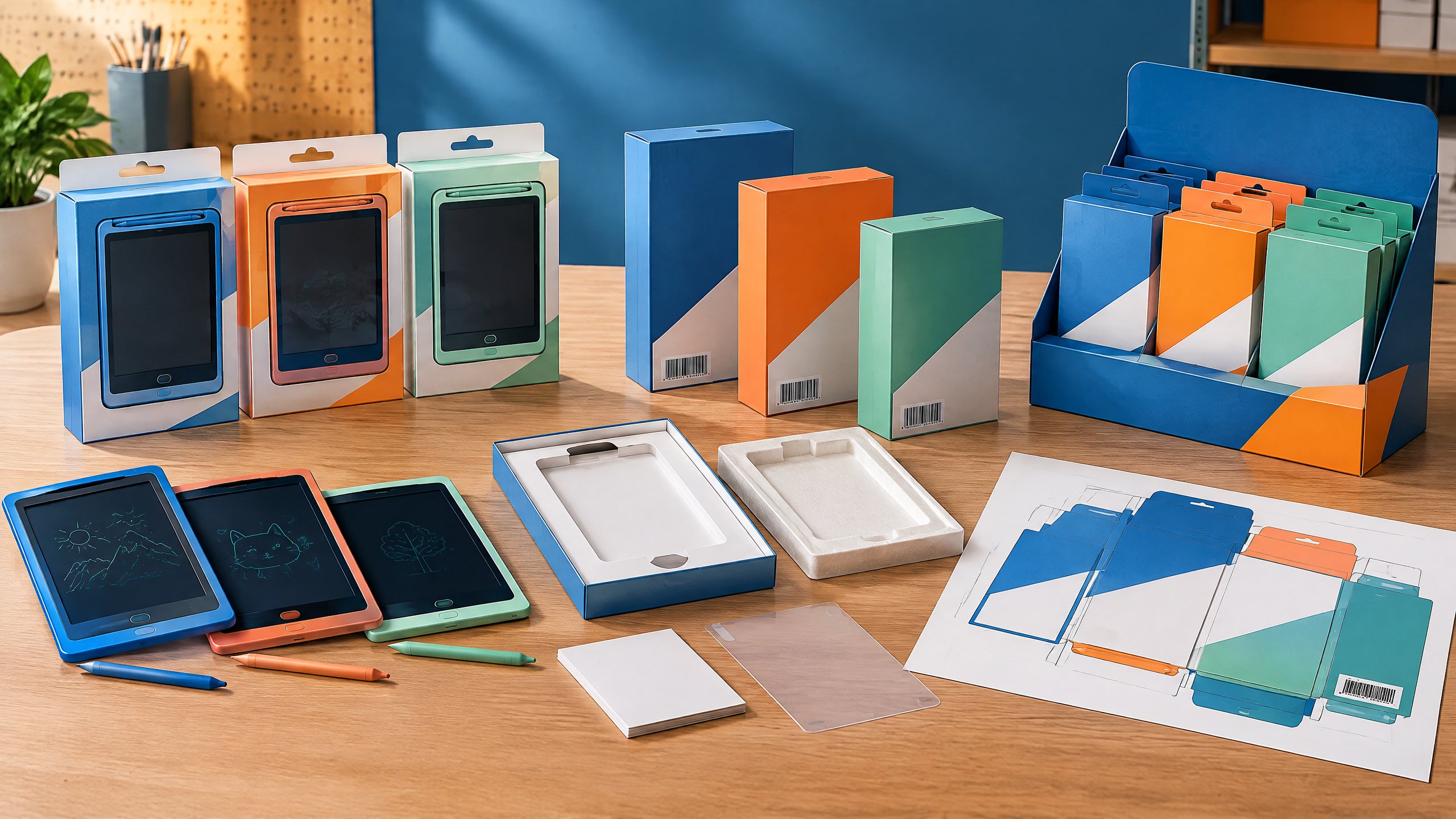
A window box makes the actual tablet’s color, form factor, stylus location, and apparent screen size visible. This can reduce the gap between expectation and product, particularly where color or a distinctive shaped frame drives choice. But a window is not free proof: it can expose the screen to scratches, limit printed information, reduce board continuity, make recycling more complicated when materials are bonded, and offer an opportunity for product removal or accessory loss.
A closed box offers more continuous printable area, better concealment of the product, and often a simpler route to a fiber-based structure. It is usually the stronger default when the artwork accurately depicts the supplied variant and the tablet needs protection from shelf abrasion. Its risk is ambiguity. A closed pack must work harder through true-to-scale dimensions, a clear image, a defined “includes” statement, and straightforward descriptions of how the erase function works.
A controlled reveal—for example, a small die-cut viewing aperture or a front image plus a side color swatch—can be a sensible middle path. It should be selected only after physical samples show that it does not weaken a high-stress panel, interfere with the barcode zone, or allow repeated handling to damage the display.
Control claims before design approval
Treat each claim as a mini specification. “Includes stylus,” “one-touch erase,” “replaceable battery,” and “works with a lock function” can be assessed against a sample and bill of materials. Broader phrases such as “eco-friendly,” “safe,” “unbreakable,” “paperless forever,” “best,” or “educational” require much more careful support and context. A writable LCD display commonly retains a static image until cleared, but the actual behavior, battery type, lock arrangement, and stylus attachment vary by model. Never let a generic product image or copy template override the signed sample.
Environmental language needs the same discipline. The U.S. Federal Trade Commission says its Green Guides are intended to help marketers avoid environmental claims that mislead consumers and explains how claims may need substantiation or qualification.3 Do not print an unqualified “recyclable” message merely because the outer box is paperboard if it has a plastic window, laminate, magnet, adhesive, or insert that changes the real disposal picture. State the material or give local-disposal directions only after the specific pack is verified.
Design the pack and its logistics unit together
A retail box travels in an inner pack or master carton, can be handled by several parties, and may later be shipped individually. The physical system should be decided before the display artwork is frozen. Confirm the box orientation inside the master carton, units per inner pack and case, carton board grade, dividers or trays, void fill, sealing method, shipping marks, gross and net weights, and pallet plan. A packaging change that adds a window, cable, or thick insert can change carton dimensions and crush performance.
For rechargeable configurations, identify the battery classification and transport route before approving the carton. IATA notes that a major battery-transport risk is a short circuit; batteries or battery-powered devices must be separated or protected to prevent terminal damage and short circuits, and a strong rigid outer package is generally required unless the equipment provides equivalent protection.4 The retail box is not automatically the transport package. Confirm the applicable requirements with the responsible shipper or qualified dangerous-goods specialist.
5. Comparison, cost, quality, and specification table
| Packaging approach | Shelf and shopper effect | Quality and operations considerations | Relative cost / material implication | Best fit | Key limitation to manage |
|---|---|---|---|---|---|
| Closed folding carton with printed product image | Strong graphics space; clear variant story when images are accurate | Continuous panels support better carton integrity and clean barcode placement | Often material-efficient; cost depends on board, print, and insert | High-volume retail, mixed colors, product needing abrasion protection | Buyer cannot inspect actual color or finish before purchase |
| Folding carton with PET or similar window | Lets shoppers see color, size, and physical tablet | Window position can reduce board continuity; protect exposed screen and accessory | Added material, converting, and separation burden | Color-led assortment or shaped product where visual confirmation matters | Window may complicate disposal claims and increase pilferage risk |
| Die-cut reveal / partial window | Limited physical visibility while preserving most graphics area | Needs sample-based strength check around the cutout | Moderate added converting cost; may reduce board use locally | Controlled product reveal where full window is unnecessary | Can invite handling and does not show every included item |
| Blister or clamshell with printed card | Maximum product visibility and tamper evidence potential | Heat seals, edges, and opening experience need review; product can be scratched | Often more plastic-intensive; recycling route may be less intuitive | Theft-sensitive small accessories or hanging display systems | Poor sustainability message fit unless the actual materials and recovery route support it |
| Closed carton plus internal molded fiber or paperboard tray | Premium unboxing without external exposure | Tray must immobilize tablet and stylus during vibration and drops | Added fiber and assembly; can replace some plastic inserts | Gift, specialty, or higher perceived-value placement | Do not assume molded fiber alone protects thin screens without testing |
Suggested retail-box specification fields
| Field to lock before artwork release | What the buyer should define | Why it matters |
|---|---|---|
| Product identity | Model code, screen-size designation, color, battery configuration, included items | Prevents artwork from describing a different variant |
| Retail display method | Shelf, peg, counter display, dump bin, e-commerce overbox, or mixed use | Determines hang hole, panel hierarchy, abrasion exposure, and test route |
| Pack format | Closed box, window box, partial reveal, tray, seal, tamper label | Links shelf presentation to protection and material choice |
| Claims matrix | Exact claim, evidence owner, qualification, approved language, market | Stops unsupported claims from entering print files |
| Barcode data | GTIN/UPC or EAN assignment, symbology, size, location, digital proof owner | Avoids scan failures and retailer chargebacks |
| Information set | Instructions, warnings, responsible party, traceability, country/market requirements | Keeps required information readable and version-controlled |
| Master-carton plan | Units per carton, orientation, carton marks, dimensions, weights, pallet pattern | Makes receiving and transport predictable |
| Inspection standard | Approved sample, defect definitions, scan check, drop/vibration plan, sampling approach | Converts visual preferences into measurable acceptance criteria |
The cost column is intentionally relative. Quoting a packaging format without a confirmed dieline, board specification, print coverage, insert, quantity, and assembly method produces false precision. Ask for a quote that separates one-time tooling or plate costs from recurring packaging and assembly costs, and request an estimate for both the retail unit and the master carton. A lower-cost retail box can be more expensive overall if it increases damage, retail relabeling, or the need for an overbox.
6. Product, application, and technical detail
Make the front panel answer the right five questions
For LCD writing tablets, most shoppers need answers to five basic questions: What is it? How large is it? What does it do? What is in the box? Who is it for or where is it used? A concise product name such as “LCD Writing Tablet” is clearer than a promotional name alone. Pair it with the ordered screen-size designation and a front or angled product image. If the product uses a pressure-sensitive LCD writing surface, describe it plainly as a writing or drawing tablet rather than implying it is a tablet computer, digital display, or internet-connected device.
The key functional message should describe the supplied configuration. “Write and erase” is preferable to “endless creativity” when the function is what differentiates the item. If the tablet has a lock switch, state its actual function in precise language, such as “screen-lock control helps prevent clearing,” only if that wording is confirmed on the sample. A lock does not necessarily preserve content through every condition or make the device tamper-proof. If a stylus is included, show it or name it. If it is secured inside the pack rather than attached to the tablet, the packaging should not visually suggest an attachment method the buyer will not receive.
Window versus closed box: a product-protection analysis
A window is most valuable when the actual product resolves an important buying question that a photo cannot: unusual casing color, a distinctive shape, a bundled stylus color, or a material finish. Position the window away from corners, fold lines, hang holes, and the barcode panel. Inside the window, hold the tablet so it cannot shift and rub its screen against the film. A paperboard bridge, tray pocket, or protective interleaf can be more valuable than an extra glossy print effect.
A closed carton is the better choice when display abrasion, shrink, child handling, or simple material separation matters more than direct visibility. In that format, a life-size silhouette or carefully marked product dimensions can reduce uncertainty. Do not use an image that makes an 8.5-inch screen look equivalent to a 12-inch product. State whether the size refers to the LCD writing area, the overall device, or the nominal product designation; those measures can differ.
In both formats, make opening deliberate but reasonable. A trapped tray, small security seal, or tear-strip design may help control shelf tampering. Avoid designs that force a consumer to tear through mandatory text or destroy return-relevant identification. Test the intended opening flow with the actual tablet, stylus, battery protector or cable, and leaflet, not empty packaging.
Barcode placement is a functional design requirement
Assign the GTIN through the brand’s GS1 process and make the retail barcode part of the locked artwork, rather than placing a generic code after print approval. GS1 US recommends a high-resolution barcode image and print, notes that poor scans may lead to manual keying and retailer chargebacks, and generally places checkout barcodes in the lower-right section of the back panel.5 For ordinary retail cartons, reserve a flat, uninterrupted, matte or low-glare area away from folds, edges, seams, windows, and heavy graphic textures.
Use dark bars on a light background and preserve the quiet zones. GS1 cautions against red or reddish bars because red-light scanners may not read them, and it advises against truncating the symbol or resizing barcode artwork by simple scaling.5 The barcode should not compete with safety text, a lot-code sticker, a recycling icon, or a retailer-applied price label. Leave a documented secondary label zone elsewhere if local labeling is expected.
Barcode verification should be done on production-representative material, not only on a digital proof. Check scanability after the actual varnish, laminate, emboss, and carton folding are in place. Verify that a carton packed in a master case still lets warehouse staff identify the correct product using the case marks; retail GTINs and higher-level logistics codes serve different functions and should not be conflated.
Instructions, markings, and claims belong in a controlled information architecture
Use the back panel and an enclosed leaflet for the detail that does not belong on the shelf-facing panel. A minimal quick-start sequence can show: remove the protective sheet if applicable; write with the supplied stylus; use the erase control; use the lock control if supplied; and consult the full instructions for battery replacement or charging. Use simple line illustrations where language load is high, but make sure visual steps match the shipped model.
The leaflet should identify the model, state the included components, give age or supervisory information where applicable, address power handling relevant to the configuration, and provide care and disposal information suitable for the destination market. Where a product is placed on the EU market, WEEE marking rules generally require the crossed-out wheeled-bin symbol and an identification mark, with the product normally carrying permanent, visible, and readable markings; packaging or instructions may be used where the product is too small or marking affects its function.6 This is a product- and market-specific obligation, not a decorative packaging icon.
Likewise, CE marking is not a promotional quality seal. The European Commission explains that CE marking is only for products covered by harmonised EU rules that require it, and the manufacturer is responsible for establishing compliance, documentation, and the declaration of conformity before it is affixed.7 A buyer should keep legal marks, required identities, and marketing claims distinct in the artwork checklist. Never copy CE, WEEE, FCC, test-laboratory, recycling, or certification marks from a competitor box without confirming applicability and authorization.
7. Sample, testing, and quality-control workflow
Build a gated sample path
Start with a packaging brief that includes the actual tablet configuration, pack format, target markets, retailer requirements, draft copy, illustrations, barcode assignment, material preference, and master-carton target. The factory should then create a structural mock-up or white sample before expensive color work. This stage answers physical questions: Does the tablet sit correctly? Is the stylus retained? Can the window show the intended area without screen contact? Is the opening path workable? Is the barcode panel flat?
Approve a pre-production sample with the actual tablet, accessories, retail packaging, leaflet, labels, and master-carton arrangement. It must be evaluated as a complete system, because a box can pass an appearance review yet fail once a cable, battery isolator, protective sleeve, or insert is added. Record the approved revision numbers on the purchase order and retain a sealed or clearly identified golden sample.
Use a claim-and-artwork control sheet
Create one controlled spreadsheet or artwork register with a row for every printed assertion and mark. Include the exact text or icon, product variant, target market, evidence or source file, approver, artwork file version, and location on pack. This prevents an apparently minor copy edit from changing meaning. For example, “battery included” must not remain on a multi-market box if one destination receives a different power configuration; “recyclable packaging” must not remain if a window or laminate was added after the claim was approved.
For children’s products covered by U.S. tracking-label requirements, make traceability practical at receiving and recall level. CPSC says coded information is permitted if the consumer knows whom to contact to interpret it.2 That does not mean an unreadable code is useful. Place lot or date information where it remains legible after carton folding and where it is not routinely covered by a retailer’s price label. Confirm the code format, production-date convention, and response process before shipment.
Test the route, then inspect the result
Use simple internal checks at the concept stage—screen rub, accessory retention, opening, stack, and basic drop observations—to eliminate weak designs. For a formal route-appropriate program, select a method with the test laboratory and retailer. ISTA distinguishes 1-Series screening tests from 3-Series general-simulation tests; the latter model the motions, forces, conditions, and sequences of transport environments.8 For individual parcel shipments, ISTA 3A addresses packaged products up to 150 lb / 70 kg, while ISTA 3F addresses distribution-center-to-retail shipment in mixed pallet configurations for products up to 100 lb / 45 kg.8 A named test is meaningful only when the sample configuration and pass criteria are documented.
At pre-shipment inspection, review at least the following against the signed standard: product model and color; screen condition; stylus and accessory count; function checks based on the approved work instruction; artwork revision; copy legibility; barcode scan; lot/date code; window alignment if used; seals and opening features; pack weight; units per inner and master carton; master-carton marks; and carton closure. Inspect a carton after it has been packed and handled, not only flat. Record defects in categories agreed with the buyer rather than using vague phrases such as “looks acceptable.”
If the model contains lithium batteries, add transport-specific verification to the release gate. IATA’s guidance emphasizes terminal protection, separation from conductive material, cushioning to prevent shifting, and appropriate outer packaging; damaged or safety-defective batteries may be prohibited from air transport.4 Confirm the final product classification, packing instruction, marks, documentation, state-of-charge requirements where applicable, and carrier acceptance with a qualified responsible party. Packaging artwork alone cannot make a shipment compliant.
8. Ordering and implementation preparation
Supply a complete packaging brief to the OEM/ODM team
A purchase order should not say only “custom box.” Include the product part number, colorway, nominal screen-size description, battery configuration, accessory list, intended age or use context, target countries, brand owner or importer identity, and expected retail channel. Attach dielines, logo files, color references, barcode artwork, copy deck, language versions, and any retailer-specific labeling manual. If a retailer has carton-label, pallet, or shelf-ready packaging rules, send the current written specification rather than paraphrasing it in email.
Name one buyer-side owner for final copy approval and one for regulatory/compliance review. This reduces the risk that graphic design, purchasing, and compliance teams each approve a different version. Require a formal artwork proof showing every panel at final size, plus a production mock-up for window position, barcode, and folding. Any change after approval—new feature, color, cable, battery, insert, market, or claim—should trigger a version review, because it can affect the meaning of the pack or the applicable labeling.
Plan cartons, pallets, and replenishment from the beginning
For the master carton, specify item count, inner-pack count if any, orientation arrows when genuinely needed, product code, color/variant, purchase-order reference, country-of-origin information where required, carton dimensions, gross/net weight, and handling marks only where supported by the actual handling requirement. A master carton should help the receiving team identify a retail variant without opening it. Avoid putting fragile claims or special handling labels on every carton as a substitute for adequate protection.
Assess whether the retail box will ship only in a protective master carton, be merchandised directly from a shelf-ready case, or serve as the consumer shipping container. These are different conditions. The EU’s PPWR framework emphasizes smaller, lighter packaging without unnecessary layers or empty space, while also setting recyclability and labeling aims.9 The practical implication is not “use the thinnest box.” It is to remove material that provides no verified protective or operational function, while retaining the strength and fit needed for the real distribution route.
Treat sustainability as an engineering trade-off
A fiber-based closed carton may simplify material separation and reduce plastic use compared with a large clear window or clamshell. However, a board-only box that allows screen damage, needs a larger master carton, or causes additional returns is not automatically the more responsible option. Compare the whole pack system: amount of board and plastic, protective performance, cube efficiency, product damage risk, recycled content where verified, local recovery practicality, inks and coatings, and whether components can be separated by the consumer.
Use precise language. “Paperboard outer carton” is more defensible than “zero-waste packaging.” “Plastic window—separate where local facilities accept it” may be more informative than a broad recyclability symbol. The EU Commission’s packaging page states that the PPWR begins applying from mid-2026 and is designed to make packaging less wasteful, more recyclable, and more clearly labelled, including a goal for recyclable packaging by 2030.9 Market implementation and product-specific obligations still need review; do not turn a policy direction into an unqualified consumer promise.
9. Practical applications and scenarios
Scenario A: stationery retailer, closed carton, multiple screen sizes
A stationery chain is ranging compact and larger LCD writing tablets side by side. The most effective pack family uses a common brand block and color system, then differentiates size with a consistent, plain-language size designation and a clear front image. The back panel lists overall product dimensions, whether the stylus is included, the erase method, and the exact power configuration. A closed carton protects screens from handling and gives the buyer a stable, rear lower-right barcode field. The master carton repeats the variant code and unit count clearly to avoid replenishing the wrong size.
The risk in this scenario is visual overstatement. A single hero image that is reused at different scale makes it difficult to compare products. Use variant-specific artwork, a dimensional diagram, and a copy lock that prevents a feature from appearing on a model that does not have it.
Scenario B: gift or travel line, partial window, color-led choice
A brand is selling a compact drawing tablet in several casing colors as a travel gift. Color is a primary purchase driver, so a partial front reveal is justified. The tablet sits in a fitted tray with a screen-protection interleaf; the viewing aperture reveals the casing color rather than the most vulnerable part of the screen. The carton’s front keeps the product name and verified write/erase function visible, while the back contains opening instructions, included-item details, and the barcode.
The quality focus is the interaction between aperture and structure. The factory should check window edge quality, tray retention, product movement, screen scuffing, carton compression around the opening, and whether a shopper can remove the stylus. The sustainability statement, if any, should identify the material rather than claim the entire pack is recyclable without verification.
Scenario C: retailer counter program, simple information and fast replenishment
A distributor is supplying LCD writing tablets for a counter program where store staff replenish small quantities frequently. The pack uses a compact closed carton with large, readable product identity on the front and a simple, high-contrast variant code on the side. The retail barcode remains on the rear, while master cartons show the buyer’s item code, color, unit count, and purchase-order reference. A small quick-start panel eliminates many basic customer questions: write, erase, lock if equipped, and consult the leaflet for power information.
The operational measure of success is not an elaborate unboxing. It is whether staff can identify the right variant, scan it, and place an undamaged unit on the counter. Avoid glossy dark barcode panels and loose accessories that can rattle or migrate inside the carton.
Scenario D: rechargeable model for a multi-market program
A rechargeable LCD writing tablet may include a charging cable, battery-related instructions, and market-specific information. In this case, freeze the actual battery and charging configuration before copywriting. Do not use a legacy coin-cell box as a starting point. The pack must accommodate the cable without pressing against the screen, and the master-carton plan needs transport review. If any RF feature is introduced, the compliance and labeling path changes; the FCC notes that devices containing RF functions may be subject to authorization procedures before U.S. marketing or importation.1
The right outcome is a controlled, market-specific pack—not a universal box filled with ambiguous icons. Separate SKUs or market artwork versions may be operationally cleaner than attempting to compress every warning, mark, and language into one crowded panel.
10. Detailed FAQ
1. Should LCD writing tablet retail packaging use a window box or a closed box?
Choose a window when seeing the actual color, shape, or finish is essential to the purchase decision and the product can remain protected in a retained tray. Choose a closed box when screen protection, graphic clarity, material simplicity, or pilferage control matters more. Validate either option with a real assembled sample, including its actual accessories and master-carton orientation.
2. Where should the UPC or EAN barcode go on the retail box?
For a typical checkout carton, reserve the lower-right section of the back panel, away from edges and folds, with enough light quiet-zone space and a smooth print surface. GS1 US gives this as a general placement recommendation and advises using high-resolution artwork and printing.5 Always check the retailer’s manual and verify a production-representative sample, because a placement that looks correct on screen may scan poorly after finishing and folding.
3. Can we print “eco-friendly” or “recyclable packaging” on the box?
Do not use broad environmental phrases without substantiation and qualification. Evaluate every component, not only the paperboard: window film, coating, adhesive, insert, seal, and local recovery route can matter. The FTC Green Guides are designed to help marketers avoid misleading environmental claims.3 Prefer accurate, limited material descriptions and local-disposal guidance that has been checked for the target market.
4. What must the instructions tell the customer?
Instructions should enable safe, expected first use of the supplied configuration. For a basic LCD writing tablet, that normally means what is included, how to write and erase, how a lock control works if present, and relevant power or battery instructions. Include model identification and care information. Any market-specific warning, disposal instruction, or compliance information must be reviewed for the exact product and destination; a generic instruction sheet is not sufficient.
5. Do we need a lot code on the product package?
Traceability is prudent for all branded retail programs. For U.S. children’s products, CPSC tracking-label guidance calls for permanent, visible, and legible identifying information on the product and packaging where practicable, including the manufacturer/importer or private-labeler, production location and date, and batch/run details.2 Define a code that production, the buyer, and customer support can interpret, and prevent retailer labels from obscuring it.
6. Is a CE mark required on every LCD writing tablet box sold in Europe?
Not automatically. CE marking may be used only for products covered by harmonised EU rules that require it; the manufacturer must establish compliance with all applicable requirements first.7 Some electrical or electronic products may fall under relevant rules, but applicability depends on the exact product. Confirm the legal framework and placement with a qualified compliance professional. Do not add a CE mark as a general European-market decoration.
7. How should rechargeable-tablet cartons be prepared for air freight?
Start by confirming the exact battery and shipment classification with the responsible shipper or a dangerous-goods professional. IATA guidance stresses prevention of short circuits, terminal protection, cushioning, and strong rigid outer packaging unless the equipment affords equivalent protection.4 The master carton and shipment paperwork, not just the consumer retail box, must be prepared for the applicable transport rules.
8. What packaging tests are worth requesting before a large order?
At minimum, review an assembled production-equivalent sample for screen scuffing, product movement, accessory retention, barcode scans, carton closing, and label placement. Select additional drop, vibration, compression, and route simulation based on the distribution model and retailer requirement. ISTA 3-Series tests are general simulations of transport environments, while specific procedures address parcel, retail, and other distribution conditions.8 Request the test method, sample configuration, pass criteria, observations, and final report rather than a vague statement that the packaging was “tested.”
11. Conclusion and final email-only CTA
Effective LCD writing tablet retail packaging is a managed system of product truth, shelf communication, scan reliability, documentation, physical protection, and end-of-life clarity. The strongest brief starts with the shopper’s decision, then locks the actual product configuration and claims before graphics begin. It uses a window only where direct product visibility adds more value than it removes in protection and material simplicity. It treats the barcode as an operational component, not decoration; gives the consumer an honest quick-start path; and validates the retail pack inside the master carton that will move through the real supply chain.
For buyers, the practical standard is straightforward: approve packaging only when the pack shown in the sample, the product in the box, the claims in the copy, the barcode in production, and the carton plan for shipment all match. That discipline avoids a common failure mode in private-label sourcing—an attractive retail carton that introduces uncertainty at checkout, in a compliance review, or after the first transit damage claim.
For a packaging brief, dieline review, or production-sample discussion for LCD writing tablets, contact LcdWritingTablet by email only at info@lcdwritingtablet.com.
References
Turn this sourcing plan into a product brief.
Share your target market, product requirements, packaging preference and estimated volume for a practical OEM / ODM discussion.