This guide provides a practical B2B decision framework. Final specifications, market obligations, testing scope, labels, packaging and shipment requirements must be confirmed for the exact finished SKU and destination.
2. Direct-answer introduction
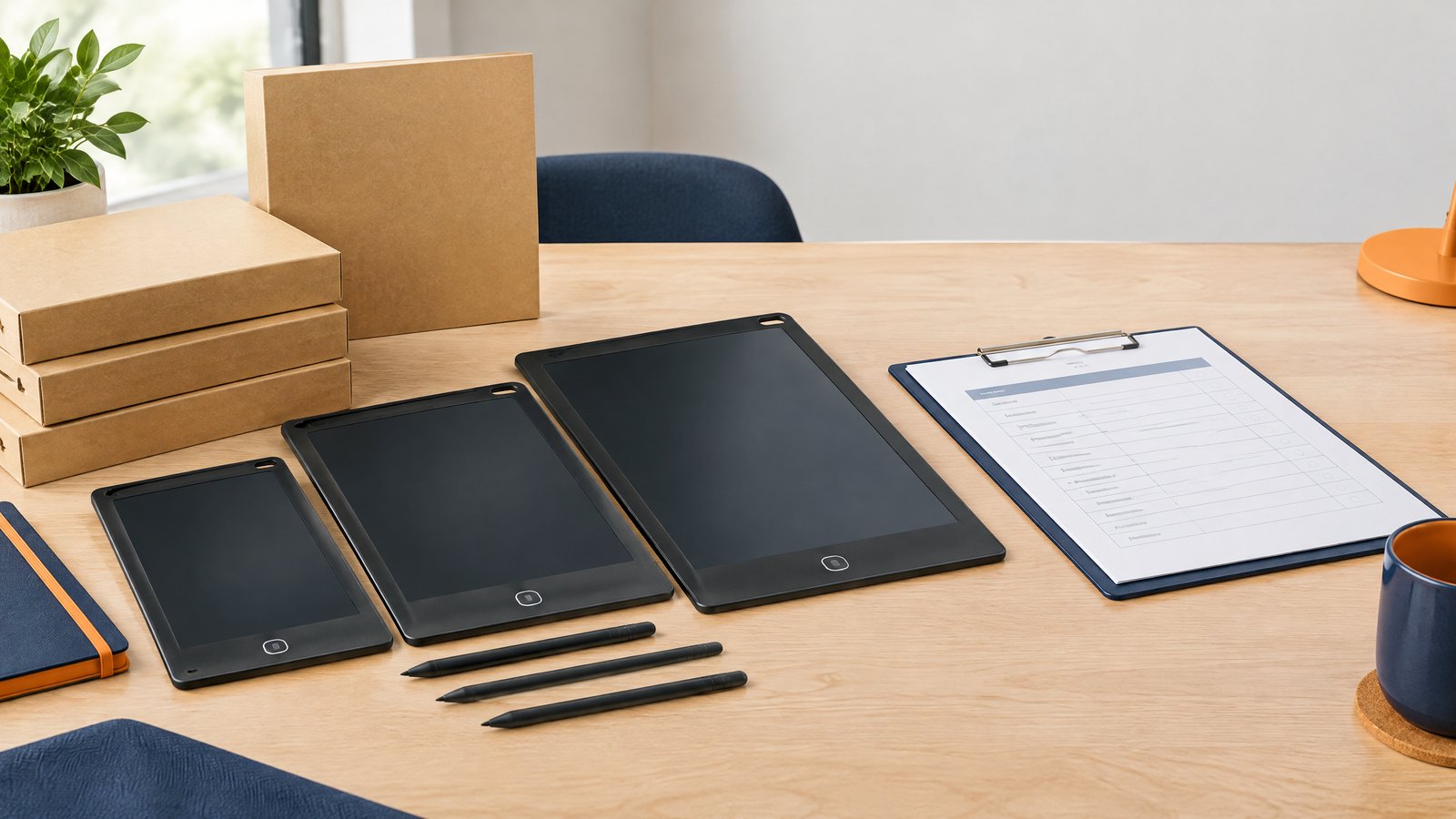
Yes—an LCD writing tablet can be a good promotional gift when the recipient has a recurring reason to jot, sketch, plan, or leave a short message, and when the program is designed around that use. It is particularly credible for employee welcome kits, meeting packs, client events, travel programs, field teams, family-oriented brand activations, and desk-accessory campaigns. Its appeal is not that it replaces every notebook. Its appeal is that it offers an instantly usable, erasable writing surface in a compact branded object.
The procurement mistake is to buy only by screen size and unit price. An LCD writing tablet promotional gift succeeds or fails on a much broader brief: who receives it, whether the logo remains legible in ordinary use, whether the packaging suits shelves or travel, whether one simplified SKU can serve the campaign, and whether the delivery plan leaves time for proofs, samples, inspections, and freight contingencies. A tablet that writes cleanly but arrives with inconsistent logo color, crushed retail boxes, unclear battery documentation, or an unsupported “eco-friendly” claim can create more campaign risk than value.
This guide is written for buyers sourcing from LcdWritingTablet, a Shenzhen OEM/ODM manufacturer of LCD writing tablets, talking flashcard machines, and smart electronic badges. It does not assume that every model, claim, or market requirement applies to every project. A basic non-connected writing tablet, a coin-cell version, and a rechargeable or connected device are different procurement cases. The buyer should approve the final model specification and regulatory path for the destination market before production.
A sound brief has a simple aim: deliver a branded tool that a recipient can understand in seconds, carry without fuss, and use more than once. That means specifying the use case before the decoration, the package before the freight quote, and the acceptance criteria before the production deposit.
3. Who this guide is for
Corporate marketing, HR, and events teams
This guide is for teams that need a practical branded item rather than an elaborate consumer-electronics launch. A marketing manager may be preparing conference handouts. An HR team may be assembling an onboarding kit. An events agency may need an object that earns attention at registration yet remains useful after the event. For these buyers, the most important decision is usually not “What is the biggest screen?” It is “What will a busy recipient do with this item in the first week?”
A compact tablet can be suitable for a to-do list, a tabletop message, a meeting sketch, a child’s travel activity, or a quick note in a hotel room. Those uses give the brand repeated, low-friction visibility. They do not make the tablet an archive, a secure notetaking system, a medical device, or a guaranteed learning aid. The campaign copy should keep that distinction clear.
Promotional-product distributors and agencies
Distributors benefit from a brief that can be priced and executed consistently. The end client may request a logo, gift box, insert, and country-specific labeling without understanding how each change can affect artwork approval, packaging validation, assembly, or lead time. This guide offers a way to turn an informal request into a controlled sourcing package. It is especially relevant when the distributor will receive and inspect goods before onward distribution.
Procurement, sourcing, and brand-protection teams
Procurement teams should use the guide to reduce ambiguity between the approved sample and mass production. A promotional electronics order can have several points of variation: bezel color, writing panel, erase function, stylus retention, battery configuration, logo method, insert copy, carton markings, and shipment terms. A simplified configuration makes defects easier to identify and creates a clearer basis for inspection.
Buyers serving more than one market
A global campaign requires early separation of product configuration, destination-market obligations, and marketing copy. In the United States, classification as a children’s product depends on intended use and on how the product is presented, including packaging and promotion; a product used around children is not automatically a children’s product, but marketing can materially affect the analysis.1 In the European Economic Area, CE marking belongs only on products covered by the relevant EU rules, and it is the manufacturer’s declaration of conformity—not a general safety badge or a mark of origin.4 Local counsel, an importer, or a qualified compliance partner should confirm the final requirements for the actual model and market.
If you are comparing a campaign brief or requesting a specification worksheet, use the first project checkpoint to email info@lcdwritingtablet.com with the destination country, intended recipient, quantity range, in-hands date, logo file format, and whether the package will travel individually or display at retail. That information allows an early feasibility discussion without promising a production schedule before the specifications are known.
4. Buyer decision framework
Start with the recipient moment, not the product catalog
Define the moment when the item earns its place. For an executive meeting kit, a restrained tablet with a discreet mark and a protective sleeve may be more appropriate than a colorful retail carton. For a public family event, a clearly understood display card and practical stylus storage matter more. For a trade-show giveaway, the goal may be an invitation to write a message or scan a campaign landing-page code on the insert; the item should not depend on a lengthy demonstration.
Write a one-sentence use case that can be tested: “Recipients will use this at the desk for quick reminders,” or “Parents will keep this in a travel bag for short activities.” If the statement feels implausible, the program should change before logos or packaging are ordered. The tablet is a promotional object, not an all-purpose substitute for a tablet computer, notebook, or whiteboard.
Decide the value proposition and the claim boundary together
The strongest corporate-gift message is usually concrete: reusable writing surface, compact note board, quick sketch tool, or event take-home. Avoid claims such as “eliminates paper,” “zero waste,” “eco-friendly,” “improves learning,” “safe for all ages,” or “lasts forever” unless the buyer can substantiate the precise claim for the specific model and market. The U.S. Federal Trade Commission’s Green Guides explain that environmental marketing must avoid misleading consumers and address how consumers are likely to interpret the claim.8
A more defensible expression is: “A reusable writing tablet for quick notes and sketches.” If a campaign wants to discuss a specific environmental attribute, identify the exact attribute—such as the measured recycled content of a stated packaging component—and retain supporting records. Do not let a paperboard box create an unqualified environmental claim for the complete electronic product.
Use a four-part gate before issuing a purchase order
A buyer can make the decision more reliable by releasing the project only after four linked gates are closed.
Gate one: fit. Approve the recipient, intended use, price envelope, destination countries, and campaign claim. Confirm whether any presentation or age grading could make the item a children’s product. CPSC advises that intended use, labels, packaging, promotion, consumer recognition, and age-determination guidance are relevant to that evaluation.1
Gate two: configuration. Freeze one base model, one main body color, one decoration location and method, one package format, one language set, and one battery configuration where possible. Every additional option increases reconciliation work and the chance of mixed components.
Gate three: evidence. Approve the digital artwork proof, physical pre-production sample, packaging mock-up, applicable test or compliance documents, product instructions, carton marks, and inspection checklist. Evidence must correspond to the finished configuration, not merely a similar item from a supplier’s catalog.
Gate four: delivery. Confirm the production-ready date, inspection window, cargo-ready date, shipment method, forwarder booking cut-off, customs responsibility, and required in-hands date. The shipping plan needs reserve time. A courier estimate is not a contingency plan for an overseas corporate-gift launch.
Score the project before committing
Use the following decision questions. If two or more answers are uncertain, keep the project in sampling rather than moving to production.
| Decision question | Low-risk answer | Warning sign | Buyer action |
|---|---|---|---|
| Is the recipient use clear? | A specific repeated note, sketch, or travel use is stated. | The item is selected only because it is “different.” | Rework the campaign concept. |
| Is the brand visible in use? | Logo is placed on a stable bezel or package panel and remains readable. | Mark competes with the writing area or may be covered by a hand. | Request placement artwork at actual size. |
| Is the SKU controlled? | One approved configuration and one source of truth exist. | Several colors, inserts, batteries, and logo variants are open. | Simplify before sampling. |
| Is the claim supportable? | Copy describes observed product function without broad promises. | Copy implies environmental, educational, or safety outcomes. | Remove, qualify, or substantiate the claim. |
| Is the date protected? | Proof, sample, inspection, freight, and customs buffers are scheduled. | Production starts against a fixed event date with no reserve. | Change method, quantity, or event plan. |
5. Comparison, cost, quality, and specification table
The right promotional tablet is the one with the fewest avoidable variables for the intended use. “Lowest cost” can be misleading when a low unit price creates extra artwork rounds, expensive air freight, retail damage, rework, or a missed event. Instead of asking for an unqualified price, request an all-in comparison by frozen configuration. It should separate product, decoration, individual packaging, master carton, sampling, applicable testing or documentation, inspection, freight terms, and destination duties where applicable.
| Specification area | Recommended default for a corporate-gift program | Cost and quality effect | What the buyer should state in writing |
|---|---|---|---|
| Product platform | A basic, non-connected LCD writing tablet matched to the use case | A simpler platform reduces configuration and support risk; it is not automatically exempt from all market requirements. | Model or approved sample reference; destination markets; intended user. |
| Display and writing behavior | Screen size and line visibility approved from a physical sample | Larger formats, color effects, or unusually demanding visual expectations can change price and reject criteria. | Actual sample sign-off; acceptable line visibility, erase behavior, dead-pixel or blemish criteria if relevant. |
| Battery approach | One declared battery configuration for the order | Battery type affects instructions, labeling, transport documents, and replacement expectations. | Battery chemistry/type, installed or supplied separately, replaceability, and documents required. |
| Logo method | One-color or carefully approved multi-color mark on the bezel or rear housing | More colors, large coverage, special finishes, and multiple locations increase decoration complexity. | Vector artwork, Pantone or approved color standard, position, size, orientation, and tolerance. |
| Individual packaging | One shelf-ready retail pack or one travel-protective gift pack, not an untested hybrid | Inserts, windows, sleeves, and fragile display features affect packing speed, cube, and damage exposure. | Dieline, materials, language, barcode/QR placement, required warnings, and drop-test plan. |
| Insert and instructions | Short, accurate multilingual insert only where required | Extra languages and changing copy can delay release and cause version mix-ups. | Final copy, translation owner, country allocation, artwork version code. |
| Cartonization | Carton count chosen for handling and destination | Small cartons can increase handling; heavy or weak cartons can increase damage risk. | Units per inner/master carton, gross-weight ceiling, carton artwork, pallet requirements. |
| Quality inspection | Approved-limit inspection plus functional checks aligned to the use case | Inspection is a costed control, but catches visible and functional defects before export. | Inspection level, sample plan, critical/major/minor defect definitions, rework decision authority. |
| Delivery plan | Cargo-ready gate before event distribution | Accelerated transport can add cost and still leave customs or capacity risk. | In-hands date, incoterm, ship mode, inspection date, forwarder contact, document owner. |
How to compare quotes fairly
Send every supplier the same request-for-quotation sheet. Avoid comparing a fully branded, packed, inspected, delivered offer with a bare product ex-works figure. Ask each bidder to identify what is excluded, what requires final artwork, what depends on a minimum order, and what may change after a physical sample. If any quote includes a regulatory term, ask which product version, test report, standard, date, laboratory, and report holder it refers to. A logo on a device does not transfer legal responsibility automatically.
Do not treat a named standard as a decoration on a quote. For example, an ISTA procedure may be useful only when the selected procedure matches the distribution environment. ISTA describes 1-Series procedures as screening tests and 3-Series procedures as general simulations of transport hazards; neither label alone proves every field shipment will arrive undamaged.7 The practical question is whether the actual retail pack, master carton, pallet pattern, and route were in the test scope.
6. Product, application, and technical detail
What an LCD writing tablet is—and is not
A typical LCD writing tablet uses a pressure-sensitive display surface to show a written or drawn mark. A stylus or fingertip may be used depending on the model. A dedicated erase function clears the displayed marks. Most basic versions are designed for transient writing rather than storage, sharing, backlighting, connectivity, or high-precision graphic work. Buyers should verify the actual model’s functions from a physical sample rather than assuming features from the category name.
That limitation is commercially useful. The product is easy to explain and does not require account creation, pairing, data transfer, software updates, or content management when a non-connected model is selected. It is therefore well suited to a low-support campaign. It is not suitable when the campaign promise requires saved notes, synchronized content, accessibility features beyond those confirmed for the model, or a guaranteed operating period.
Logo execution that still feels like a gift
The most durable logo decision is typically to keep the mark away from the active writing area. A bezel placement creates a clear product-brand relationship without disrupting the function. A rear-housing mark may work for a more understated corporate item. A mark on a stylus, loop, sleeve, or box can support the brand system, but should not be the only visible identifier if the product will be used without its package.
Approve logo execution in layers. First, review vector artwork and a dimensioned placement drawing. Second, inspect a physical decorated sample under normal lighting. Third, check whether the logo is level, centered, color-consistent, fully cured or adhered as applicable, and free from edge lifting, smearing, pinholes, or unwanted gloss variation. The acceptance standard should describe observable conditions, not a vague instruction to make it “premium.”
The tablet’s writing surface deserves its own protection. Do not place a large decoration where it may reduce writing space or distract from line visibility. Avoid campaign copy that tells recipients to write directly over printed instructions. If the tablet has a protective film at shipment, specify whether the film is intended for removal by the factory, distributor, or recipient; an unplanned film can make the product appear cloudy at an event.
Shelf-ready packaging versus travel packaging
Shelf-ready packaging is designed for recognition and clean presentation. It may feature a front panel, product view, concise benefit statement, brand color, barcode space, and controlled instructions. It is appropriate for retail-oriented rewards, showroom displays, event stores, or a gift that will be handed over in a polished setting. The risk is that a visually ambitious box may be more vulnerable to scuffing, corner crush, or variable assembly if it has not been properly validated.
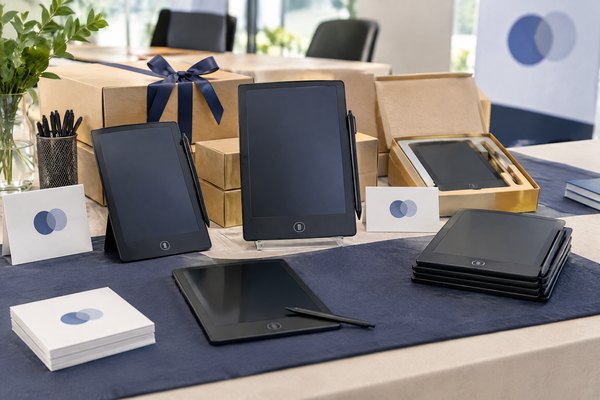
Travel packaging is designed first to protect the item through hand luggage, event bags, mailers, or a welcome-kit box. A protective sleeve, compact box, or simple wrap with a clear insert can be more useful than a retail window. For a distributed kit, the outer kit may be the branded presentation layer while the tablet’s own pack stays simple and protective. Decide which layer is expected to carry the campaign narrative; duplicating it across several layers can add cost and create outdated copy when campaign details change.
A packaging brief should answer five questions: What does the recipient see first? How is the tablet restrained? Where is the stylus stored? Which surface carries legally required or approved copy? What transit route will the finished pack survive? For parcel or retailer fulfillment, examine a relevant distribution test plan. ISTA identifies its 3-Series as general simulation testing, with procedures for environments such as parcel, retail, and international direct import; the correct procedure depends on the route, not on a generic “ISTA tested” request.7
Simplify the SKU deliberately
A promotional program is often stronger with one hero SKU. Choose one body color, one screen size, one logo position, one standard insert, one pack style, one carton configuration, and one battery version. The benefit is not only a simpler quote. It reduces line-change error, mixed-language packs, missing accessories, wrong logo placements, and warehouse allocation mistakes.
When more than one version is necessary, use a controlled matrix: assign each SKU a code, color reference, packaging artwork version, destination, and carton mark. Do not rely on a color name alone. “Blue” can describe a housing, logo ink, insert accent, or carton print, each with a different approved reference. The purchase order should tie each code to an approved sample or technical drawing.
Battery, connectivity, and market-risk distinctions
Never assume that a small battery has no delivery consequences. For lithium-powered tablets, the product and battery configuration can affect transport classification, carrier acceptance, packing instructions, and documentation. IATA explains that lithium batteries installed in equipment fall within specified UN classifications, and—except for stated button-cell exceptions—manufacturers and subsequent distributors of relevant cells, batteries, and equipment must make the UN 38.3 test summary available.6 The buyer should obtain the test summary and have the appointed forwarder confirm the current shipping treatment before cargo booking.
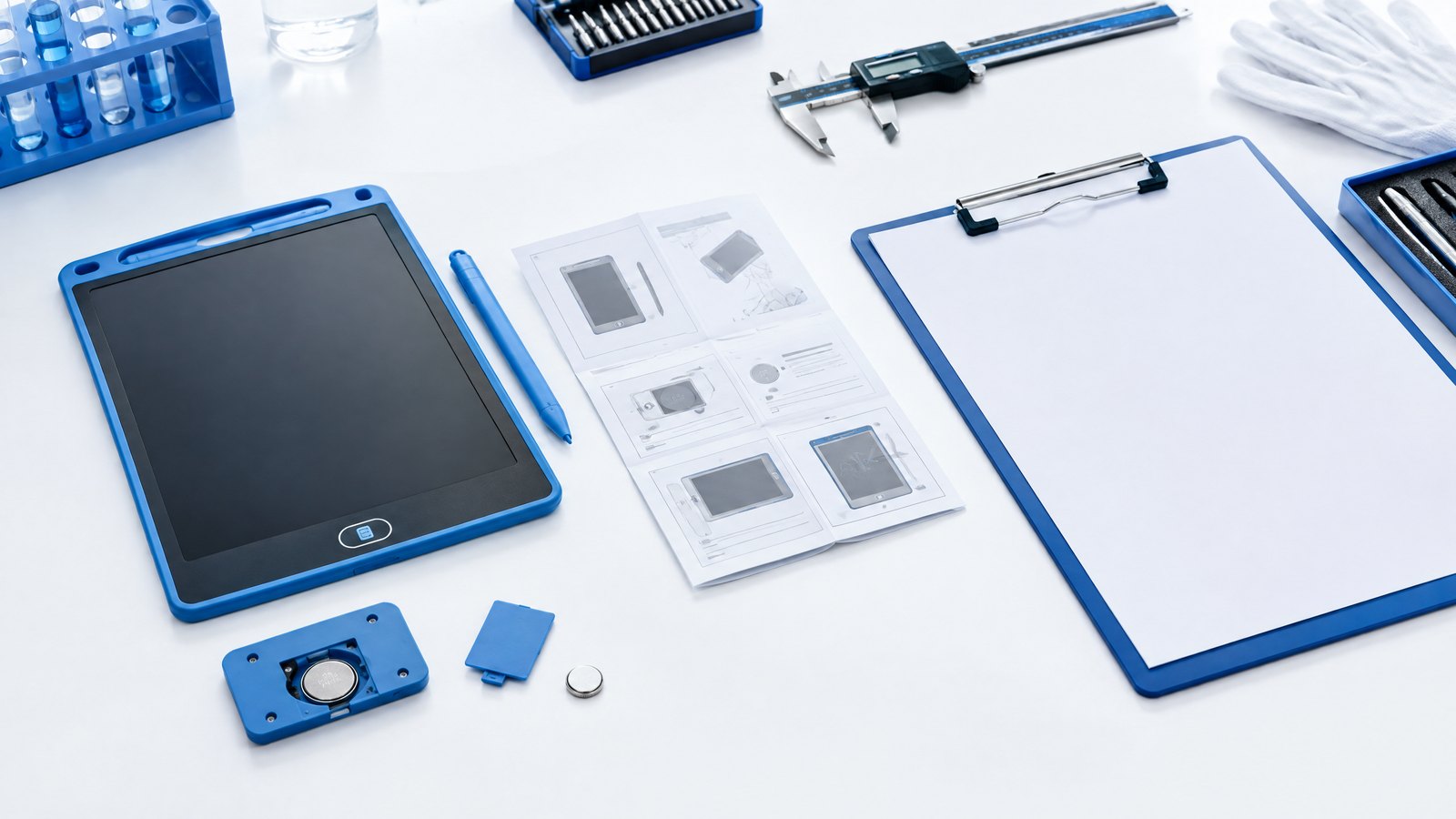
If a model contains a replaceable button or coin cell and is intended for the U.S. market, the buyer should review the product against the applicable CPSC requirements rather than relying on an old sample. CPSC states that applicable requirements include secured access, warnings on the overall product package, warnings on the product when practicable, instructions, and certification obligations; its guidance links these requirements to 16 CFR Part 1263 and ANSI/UL 4200A-2023.2 Age-related presentation matters as well. A product marketed primarily to children may trigger a different compliance analysis.1
If a promotional device adds Bluetooth, Wi-Fi, or other radio functionality, the sourcing case changes. FCC guidance says RF devices require the appropriate equipment authorization procedure before they are marketed, imported, or used in the United States, depending on their device category and applicable rules.3 For European markets, assess the actual product against the applicable EU requirements and technical documentation; do not apply a CE mark merely because it is expected by a retailer. The European Commission emphasizes that CE marking is compulsory only for products covered by the relevant rules and is not an authority’s general safety approval.4
7. Sample, testing, and quality-control workflow
Turn the brief into an approval pack
A good workflow begins with a single approval pack. It should include the product code, annotated product photographs or drawing, final logo files, color references, decoration locations, packaging dielines, insert copy, languages, battery declaration, destination markets, carton marks, inspection criteria, and delivery gates. Assign a version number to every artwork item. The factory, buyer, agency, and third-party inspector should work from the same pack.
Start with an unbranded functional sample if the product itself is not yet known. Confirm writing feel, visibility, erase behavior, stylus fit, housing feel, edge finish, battery compartment approach, and packaging concept. Then request a decorated pre-production sample that represents the agreed configuration. A digital proof can confirm layout; it cannot fully confirm tactile finish, logo registration on a textured surface, screen appearance, or pack assembly.
Test the right risks at the right time
During sample review, run ordinary-use checks rather than theatrical demonstrations. Write lines and small characters across the usable area. Confirm that erase behavior matches the accepted sample. Check stylus retention or storage after repeated insertions. Inspect the battery-compartment closure where applicable. Open and close the package, inspect corners and print, and test how the product is removed. Photograph the approved conditions so that the inspection team has an objective reference.
Where a buyer commissions third-party testing or requests existing reports, the report should be traceable to the actual product configuration. Review the model identifier, date, laboratory, standard, test scope, sample description, and any exclusions. A test report for a different battery, casing, wireless module, or intended market may not answer the risk question. For EEA-bound goods, the manufacturer’s conformity assessment, technical file, declaration of conformity, and CE marking duties must be tied to the rules that actually apply.4
Packaging validation should be proportionate. A hand-delivered executive gift may need a robust fit check and outbound-carton inspection. A mailed campaign may need a route-appropriate transit test. An item placed inside a larger welcome kit needs to be checked as part of the final kit, not only in its individual box. ISTA cautions by design through its test categories: screening, partial simulation, and general simulation have different purposes.7 Ask for the procedure, sample condition, test report, and failure criteria if transit testing is claimed.
Conduct pre-shipment inspection against a usable checklist
The inspection specification should define a sample plan and defect severity before the inspection, including the buyer’s remedy if a critical issue appears. Critical defects normally include conditions that present a safety, legal, or campaign-stopping concern. Major defects may include a nonfunctional erase control, wrong logo, missing stylus, visibly damaged screen, incorrect pack language, or wrong battery configuration. Minor defects should be defined narrowly; a broad minor category can hide a pattern that makes a gift look poorly finished.
The inspector should count cartons, verify SKU allocation, compare product and package against the approved sample, test a defined sample of functional units, check logos and printed copy, review accessory presence, examine carton marks, and record photographs. The buyer should receive the report while corrective action is still practical. Inspection after the goods are already on the way is evidence, not control.
8. Ordering and implementation preparation
Build the calendar backward from the in-hands date
Begin with the date the recipient must receive the gift, then work backward through local distribution, customs clearance, port or airport handling, freight transit, cargo-ready date, pre-shipment inspection, production, pre-production sample approval, artwork release, and initial model selection. Include decision deadlines for the buyer, not only factory activity. An unsigned proof or delayed insert translation can move the entire critical path.
Do not publish an event distribution date from an indicative lead time alone. Production time starts only after all production inputs are approved, and logistics time changes with season, capacity, port conditions, carrier acceptance, destination handling, and customs. If the project uses lithium batteries, coordinate with the forwarder early; IATA’s guidance distinguishes batteries contained in equipment from other classifications and requires availability of the relevant test summary in many cases.6
Use a purchase order that can be inspected
The purchase order should attach or reference the frozen approval pack. At minimum it should state: legal buyer and seller; product code; quantity and allowed over/under-delivery; unit and total price; currency; payment milestone; approved sample reference; artwork versions; pack and carton configuration; battery specification; destination-market documents requested; quality plan; inspection rights; incoterm; ship mode; document list; and the latest cargo-ready date. The buyer should also identify who may authorize substitutions. Without that authority line, a practical packaging or component question can turn into an unrecorded change.
For a program with multiple ship-to locations, decide whether goods will be consolidated before distribution or sent directly from the manufacturing region. Consolidation can simplify final kit assembly and quality checks, but it adds a handling step. Direct shipment may reduce handling, but it makes destination allocation, customs, import responsibility, and local delivery more complex. The right choice depends on the program’s control point, not simply on the freight rate.
Maintain a risk register, not just a production tracker
A simple register should name each risk, owner, trigger, mitigation, and decision date. Typical triggers include unapproved logo proof, unverified label copy, missing battery test summary, late approval sample, test finding, carton damage, carrier space change, customs-document discrepancy, and change in event quantity. Review the register weekly once the project is committed.
The most effective mitigation is scope control. One logo version and one pack often protect the date more effectively than emergency air freight. If a late change is unavoidable, document whether it changes product, decoration, packaging, documentation, or freight classification, then reissue the affected approval item. “Small” changes are a common source of mixed production.
9. Practical applications and scenarios
New-hire and employee-recognition kits
For onboarding, the tablet works best as a compact desk or meeting item inside a broader kit. The package can carry a welcome note and a concise instruction, while the product carries a subtle employer mark. The use case is practical: quick reminders, meeting prompts, or personal planning. Avoid presenting it as a productivity system or as a replacement for company-approved recordkeeping tools.
The lowest-risk specification is one neutral body color, one logo position, one language, a simple protective pack, and a centrally assembled kit. Put employee-specific information on a separate card rather than printing variable data on every product box. This preserves the hero SKU and makes last-minute personnel changes less disruptive.
Trade-show and conference activation
At a conference, an LCD writing tablet can work as a take-away tied to a short interaction. A host may invite attendees to write one priority, sketch an idea, or create a photo moment. The item should be immediately useful after the booth visit, not merely a prop. A small product card can explain the erase action and point to a campaign page, subject to the event’s lead-capture and privacy rules.
Use a travel-friendly pack for this scenario. Attendees may place it in a tote, suitcase, or laptop bag. Test the complete giveaway configuration—tablet, stylus, card, and any band or sleeve—rather than inspecting loose products only. Keep the giveaway claim factual: “Write, erase, repeat” is clearer than an unsupported sustainability promise.
Client meeting and account-based marketing gifts
For a high-value client meeting, discretion can matter more than a large mark. A rear-housing logo, clean sleeve, and short personal note may feel more considered than a retail-style front panel. The tablet is most relevant when it supports the meeting setting: shared ideation, a bedside reminder, or an easy note surface during travel.
This scenario benefits from a smaller, carefully finished order but is vulnerable to visual inconsistency. Approve the actual logo execution, not only a digital rendering. If the gift is mailed individually, validate the outer mailer and any protective elements as a final system. Do not use a presentation box as if it were a shipping carton unless it has been designed and evaluated for that route.
Family-friendly brand or travel campaigns
A tablet may be a sensible activity item for a hotel, airline-adjacent, leisure, automotive, or family brand campaign. But the recipient and age positioning must be unambiguous. Marketing, package art, and copy can influence whether the product is considered primarily intended for children in the United States.1 A buyer should not try to solve an age-classification question with a vague “for everyone” label while imagery and campaign language primarily target children.
For a travel campaign, a retained stylus, protected screen, concise instruction, and appropriate battery approach are practical priorities. Do not make aviation, safety, or regulatory claims unless they have been specifically reviewed for the model and route. The item may travel well in ordinary use, but transportation acceptance and documentation are separate procurement questions.
10. Detailed FAQ
Are LCD writing tablets good corporate gifts for every audience?
No. They are most appropriate when the recipient can use a quick, erasable surface for notes, sketches, reminders, or short travel activities. They are a poor fit when recipients need saved files, software integration, formal note retention, high-precision drawing, or a luxury technology statement. Test the use case with a sample group or internal stakeholders before a large order.
What should be on the logo artwork brief?
Include the vector logo, approved colors, product-facing orientation, exact position, maximum dimensions, decoration method if selected, the allowed tolerance for placement, and a photo or drawing of the approved location. Also state which logo version applies to each SKU and package. Require a digital proof before a decorated sample, then approve the physical sample under ordinary viewing conditions.
Should we choose shelf-ready or travel packaging?
Choose shelf-ready packaging when the product will be displayed, sold, presented as a polished standalone reward, or needs a strong front-of-pack explanation. Choose travel packaging when it will be carried away at an event, placed in a welcome kit, or mailed. In both cases, specify the full protection system. A beautiful individual carton can still fail in transit if it is not supported by the correct outer carton and pack-out.
How can we keep the promotional SKU simple without making it generic?
Use one hero configuration and express campaign variation through a removable insert, a card, or an outer kit rather than by changing the tablet itself. Keep the same body color, product model, logo location, battery configuration, and basic pack. This makes procurement easier while preserving space for campaign-specific storytelling in lower-risk printed components.
What claims can we make about reuse and sustainability?
Use factual, narrow wording that you can support for the actual product. “Reusable writing tablet for quick notes” describes an observable function. Broad claims such as “eco-friendly,” “paper-free,” “zero waste,” or “sustainable” can imply benefits that exceed the available evidence. The FTC’s Green Guides are designed to help marketers avoid environmental claims that mislead consumers; substantiation and qualification matter.8 Confirm country-specific advertising requirements for the destination market.
Do coin-cell models create extra sourcing work for the United States?
They can. CPSC guidance describes requirements for consumer products containing or designed to use button or coin batteries, including battery access, warnings, instructions, and certification, with the precise obligations dependent on the product and its classification.2 State the actual battery configuration in the request for quotation. If the presentation primarily targets children, assess the children’s-product rules separately.1
Does a non-connected LCD tablet avoid every FCC or CE issue?
No. A non-connected device may have a different regulatory profile from a wireless product, but compliance cannot be determined from a category label. The FCC notes that many electronic products can be RF devices or subject to specific equipment-authorization rules, and the applicable procedure depends on the device and its functions.3 In the EEA, CE marking applies only when the product is covered by the relevant EU requirements; it is not a general mark to apply automatically.4 Confirm the final model, functions, documentation, and market with qualified compliance support.
What should be checked during pre-shipment inspection?
Check the SKU and carton count; tablet functionality; erase behavior; screen and housing appearance; stylus presence and fit; battery configuration; logo placement and color; packaging assembly; required insert and warning copy; barcode or QR accuracy; master-carton marks; and photos against the approved pre-production sample. Define defect categories and the buyer’s remedy before inspection, not after a result is issued.
How much time should we allow for delivery?
Allow time for more than production. The schedule must include artwork and sample approvals, applicable documentation review, packaging validation, pre-shipment inspection, booking, export handling, transit, customs, local delivery, and a contingency buffer. The exact duration depends on the frozen product, order quantity, shipment method, origin, destination, season, and carrier capacity. Treat a requested in-hands date as a planning constraint, not as proof that every option is feasible.
11. Conclusion and final email-only CTA
An LCD writing tablet is a good promotional gift when it is specified as a reusable, branded utility item with a credible recipient moment. The most dependable programs do not chase every option. They use a clear use case, a logo that does not compromise the writing surface, a packaging format suited to presentation or travel, one controlled SKU, factual gifting claims, and a calendar that protects approval and inspection gates.
For LcdWritingTablet buyers, the practical standard is simple: approve the exact product-and-pack configuration that will ship, confirm the relevant market and battery requirements for that configuration, and do not release production until product, artwork, quality criteria, and freight plan point to the same result. This approach does not eliminate procurement risk, but it makes risk visible early enough to manage it.
To turn a campaign concept into a specification-ready inquiry, email info@lcdwritingtablet.com with the intended recipient, use case, destination market, quantity range, desired in-hands date, logo artwork, and whether the finished gift needs shelf-ready or travel packaging.
References
Turn this sourcing plan into a product brief.
Share your target market, product requirements, packaging preference and estimated volume for a practical OEM / ODM discussion.