This guide provides a practical B2B decision framework. Final specifications, market obligations, testing scope, labels, packaging and shipment requirements must be confirmed for the exact finished SKU and destination.
Introduction
An LCD writing tablet looks simple from the outside: a pressure-sensitive writing surface, a frame, an erase button, a stylus, and a battery compartment. For an importer, however, a shipment can contain many separate quality risks. The screen may write but erase inconsistently. The stylus may be missing from a percentage of boxes. The logo may be printed in the wrong position. The retail box may use an older warning or barcode. The approved sample may include a lock function that is missing from the production batch.
These problems are rarely solved by asking a supplier to “check the quality.” Quality must be translated into a model-specific inspection brief that a factory team or independent inspection company can actually follow. The brief should connect the approved sample, product specification, packaging artwork, battery configuration, defect limits, and shipment release decision.
This guide explains a practical inspection workflow for importers, distributors, retailers, school suppliers, and e-commerce brands. It is not a legal compliance opinion and it does not replace a qualified laboratory or testing partner. Its purpose is to help buyers ask better questions and create clearer evidence before a container, pallet, or parcel leaves the factory.
The short answer: what should be checked before shipment?
Before shipment, inspect the exact production model against an approved sample and controlled specification. Check quantity, model identity, writing and erase functions, lock operation, screen appearance, battery compartment, stylus and accessories, logo and cosmetic quality, packaging, warning and barcode information, carton markings, and sampling-based defect limits. Record the result with photographs and a signed inspection report, then release the shipment only when open issues have a documented decision.
1. Quality control starts before production
Many shipment defects are specification defects in disguise. If the buyer and supplier never agreed on the exact model, size, battery, accessory list, or packaging revision, the inspection team cannot fairly decide whether the production unit is correct.
Create a controlled product specification
The specification should include, at minimum:
- model name and internal model number;
- writing area and overall dimensions;
- screen type and color behavior;
- frame and silicone material or finish;
- erase-button and lock-button functions;
- battery type, battery compartment design, and included battery policy;
- stylus type, color, retention method, and quantity;
- logo method and approved position;
- accessory and insert-card list;
- retail-pack dimensions, artwork revision, barcode, languages, and warnings;
- inner-pack and master-carton quantity;
- destination market and agreed shipping marks.
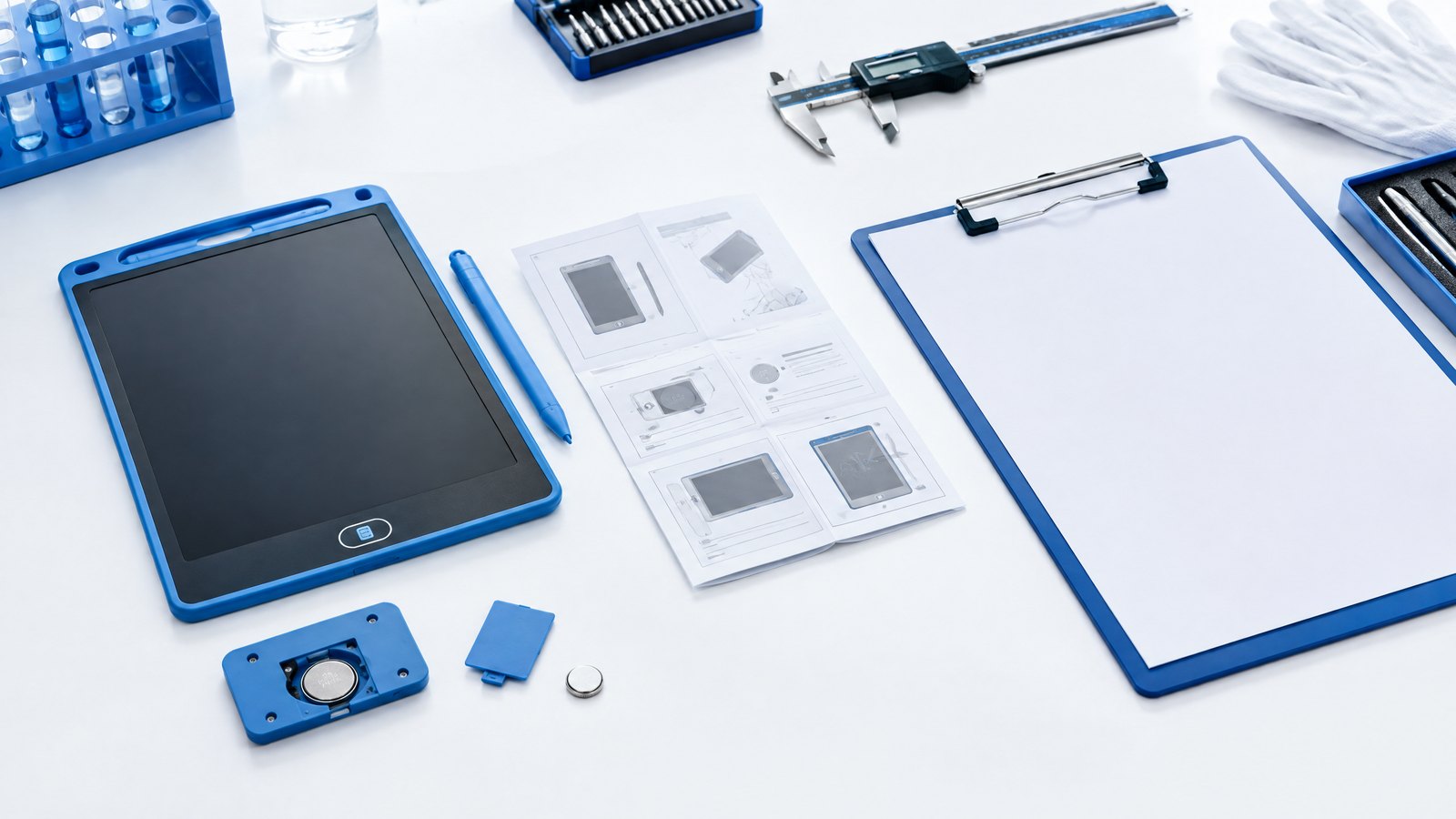
Attach photographs of the approved sample. A good visual reference shows the front, back, side profile, buttons, stylus, battery cover, logo area, and complete package. Do not rely on a product-rendering image if the production sample is available.
Separate “must pass” from “nice to have”
Critical functions should not be mixed with cosmetic preferences. For example, an erase button that fails is a functional defect. A small variation in a non-visible internal surface may not be. The buyer, supplier, and inspection company should agree on defect categories before the inspection begins.
2. Use three quality checkpoints instead of one final visit
Checkpoint 1: pre-production sample approval
The pre-production sample is the first practical check that the factory understood the brief. Test the writing response, erase response, lock function if included, screen appearance, frame finish, stylus, battery compartment, logo, and packaging mockup. If changes are needed, record them in writing and identify the new sample revision.
Checkpoint 2: production-line or first-article check
Once production begins, inspect a small number of units early enough to correct a process problem. This is useful for logo alignment, color matching, button fit, screen bonding, packaging assembly, and accessory packing. A first-article check is more valuable when it occurs before the factory has packed the entire order.
Checkpoint 3: pre-shipment inspection
The final inspection confirms whether the completed and packed order is consistent with the approved specification. It should include a random sample from finished cartons, quantity verification, function testing, packaging checks, carton condition, and a review of open corrective actions.
The LcdWritingTablet factory information describes a workflow that includes automated or factory testing, optical erasure checks, and an AQL-based final inspection approach. Buyers should request the exact inspection scope and report format for their model instead of assuming that a general factory statement covers every product configuration.
3. Product-function inspection checklist
Writing response
Use the supplied stylus and, if the design allows it, a finger or comparable writing instrument to check the pressure-sensitive area. Review line continuity, visibility, dead zones, irregular marks, and whether the writing surface responds consistently near the edges. A tablet that works in the center but has a weak edge area may create complaints in drawing or handwriting applications.
Erase response
Press the erase button according to the product instructions. Confirm that the screen clears as intended and that the button does not require excessive force or repeated pressing. If the model includes an erase lock, check both locked and unlocked states. Record any unit that writes correctly but fails to erase completely.
Screen appearance
Inspect the screen for scratches, pressure marks, bubbles, visible contamination, uneven color, cracks, and bonding defects. The visual standard should be agreed in advance, especially for multi-color or transparent models where customers may notice variation more easily.
Frame, buttons, and structure
Check the frame for sharp edges, sink marks, flash, cracks, loose components, uneven seams, and color mismatch. Press each external button and check the return action. For silicone frames or bumpers, inspect for incomplete molding, tearing, oil marks, poor adhesion, and inconsistent fit.
Stylus and accessory count
Verify the presence, finish, color, and fit of every stylus. If the product uses a magnetic clip, holder, slot, or loop, confirm retention. Count manuals, tracing cards, stickers, cables, or other accessories against the approved packing list. Missing low-cost accessories can still create a high customer-return rate because the product feels incomplete.
4. Battery and power checks
Battery requirements depend on the exact model. Coin-cell products, rechargeable products, and products shipped without a battery may require different inspection and documentation steps.
Coin-cell or button-cell models
Confirm the battery model, polarity marking, compartment fit, cover, screw, and opening method. The buyer should not assume that a screw cover alone proves compliance. In the United States, the CPSC states that consumer products containing or designed to use button cell or coin batteries can be subject to performance and labeling requirements under 16 CFR part 1263, including battery-compartment security, warnings, and instructions. Review the CPSC guidance for the applicable product category and confirm the exact configuration with a qualified compliance professional.
During factory inspection, check that the battery compartment matches the approved sample, the screw is present and secure, the cover cannot be removed by the intended child user, and the packaging/manual warning version is correct. If the product configuration changed after testing, ask whether the change requires additional review.
Rechargeable models
For Type-C rechargeable models, inspect the port, cable if included, charging indicator, charging response, and physical protection around the port. Confirm that the battery and charging components match the approved specification. A pre-shipment inspection is not the same as laboratory battery-safety testing; it confirms production consistency, not complete regulatory conformity.
Battery documentation
Ask for the battery model, supplier information where appropriate, test documents, and transport information required for your shipment. Keep the paperwork connected to the exact product revision. Do not attach one battery report to multiple unrelated models without checking applicability.
5. Logo, color, and cosmetic control
Private-label buyers should inspect branding as a controlled production feature. Compare the production logo with the approved artwork for position, size, color, sharpness, adhesion, and orientation. Check several areas of the batch rather than one unit at the top of a carton.
For Pantone or custom-color projects, compare the production color with the approved color reference under an agreed lighting condition. Plastic, silicone, print ink, and packaging board may not look identical even when the numerical color reference is the same. If the brand depends on close color matching, request a physical color sample before production and use it as the visual standard.
Cosmetic inspection should also cover scratches, fingerprints, dust, glue marks, molding lines, deformation, uneven gaps, and damaged protective films. Define what is visible at normal retail distance and what is acceptable only in a hidden area. This prevents subjective arguments after the order is packed.
6. Packaging and carton inspection
Packaging should be checked at both the individual-unit level and the master-carton level.
Individual retail package
Confirm the box or bag matches the approved artwork revision. Check product name, model, age statement, warnings, language, barcode, importer details, accessory list, and country-of-origin information where applicable. Verify that the barcode scans if the buyer has a scanner or marketplace requirement.
Check the fit of the tablet, stylus, manual, and accessories. Packaging that looks correct but allows the tablet to move during transport may still create scratches or broken buttons. If the package includes a window, inspect the window bonding and the visible product position.
Master carton
Check carton dimensions, gross and net weight, carton quantity, shipping marks, barcode labels, orientation arrows, and palletization or stacking instructions. Photograph the final carton markings. For Amazon FBA or other fulfillment programs, compare the physical carton with the latest routing and label requirements supplied by the buyer or platform.
Shipment condition
Inspect for wet cartons, crushed corners, broken straps, exposed product, and mixed models. Record pallet count and carton count. A quantity discrepancy is not a cosmetic issue; it affects receiving, invoice reconciliation, and inventory planning.
7. Define defects and sampling clearly
An inspection report becomes useful when it explains how many units were checked, which tests were performed, how defects were classified, and who made the release decision. A buyer may use an internal standard, an independent inspection company, or an agreed AQL plan. The important point is to define the method before shipment.
Typical categories include:
- Critical defect: a safety or fundamental product issue that should stop release until resolved.
- Major defect: a functional, structural, labeling, or packaging problem likely to cause a return or make the product unsuitable for sale.
- Minor defect: a smaller cosmetic or packing deviation that does not affect core use but may be tracked against an agreed limit.
The exact limits should be agreed by the buyer and inspection partner. Do not copy an AQL number from another product without considering the product risk, market, customer, and contract terms.
8. What a useful inspection report should contain
Request a report that includes:
- purchase-order number, model, and quantity;
- inspection date and factory location;
- production status and carton count;
- sampling plan and number of units checked;
- function-test results;
- battery and accessory results;
- cosmetic and logo findings;
- packaging, barcode, warning, and carton findings;
- defect photographs with clear descriptions;
- corrective-action status;
- pass, fail, or conditional-release decision;
- signatures or approval records.
A report should be understandable by the operations team receiving the goods, not only by the person who visited the factory. Keep it with the approved sample photos and specification revision so the evidence can be used for future reorders.
9. Common quality-control mistakes
Inspecting the product but not the packaging
Packaging errors can block marketplace receiving, create customer confusion, or expose the product to transport damage. Inspect both.
Testing one unit and generalizing to the batch
One good unit proves only that one unit worked. Sampling and carton selection matter.
Approving by photo only
Photos are useful but do not prove erase response, button feel, battery fit, or actual print quality. Approve a physical sample whenever practical.
Changing specifications after testing
Changing the battery, housing material, screen, button, firmware, or packaging may change the applicable evaluation. Record changes and ask whether a new review is necessary.
Treating certification as a quality inspection
A certificate or laboratory report does not replace production inspection. It may support a compliance decision, but the batch still needs to match the tested and approved configuration.
Frequently asked questions
When should a buyer arrange a pre-shipment inspection?
Arrange it after most products are complete and packed but before the shipment is released. The exact timing depends on the supplier's production schedule, the inspection method, and whether corrective action can still be completed before the shipping window.
Can a factory perform all inspection internally?
Yes, many factories perform internal testing and final QC. Buyers should still request the inspection criteria, records, photographs, and corrective-action process. For higher-risk, first-time, or high-value orders, an independent inspection may add useful separation.
What is the most important test for an LCD writing tablet?
There is no single test. Writing response, erase function, screen appearance, battery compartment, accessories, packaging, and labeling all matter. The most important checks depend on the model and sales market.
Should I test 100% of the tablets?
Some functions or production steps may be checked at 100% by the factory, while a buyer or third-party inspector may use sampling for the final inspection. The method should be agreed in the purchase-order quality plan. Critical issues should never be hidden by an overly small sample.
Does passing a factory inspection prove regulatory compliance?
No. A factory inspection checks production against an agreed standard. Regulatory compliance depends on the applicable laws, product configuration, destination market, testing, labeling, technical file, and responsible-party obligations. Confirm those requirements with a qualified partner.
Conclusion
Pre-shipment quality control is most effective when it begins before production. Define the model, battery, functions, accessories, artwork, packaging, and defect criteria in a controlled specification. Approve a physical sample, check the first production units, and use a documented final inspection before release.
For LCD writing tablets, small details matter: an erase button that does not clear the screen, a missing stylus, a loose battery cover, an outdated warning, or a carton with the wrong quantity can turn a low-cost product into an expensive customer-service problem. A clear inspection workflow gives the buyer and factory a shared reference for solving those issues before the shipment leaves.
CTA
Need a model-specific QC plan? Contact the LcdWritingTablet factory with your model, target market, order quantity, packaging requirements, and inspection standard. Ask for the product specification, sample process, and shipment inspection checklist before production begins.
Turn this sourcing plan into a product brief.
Share your target market, product requirements, packaging preference and estimated volume for a practical OEM / ODM discussion.