This guide provides a practical B2B decision framework. Final specifications, market obligations, testing scope, labels, packaging and shipment requirements must be confirmed for the exact finished SKU and destination.
2. Direct answer: what does an LCD writing tablet importer have to do?
LCD writing tablet importer responsibilities extend beyond paying duties or collecting a supplier test report. The responsible business must make sure the exact product entering a market is properly identified, supported by the applicable evidence, traceable by lot, correctly labelled and capable of fast correction if a safety issue emerges. Which requirements apply depends on the destination, the tablet’s features and how it is marketed. A simple adult note board is not assessed exactly like a product sold as a children’s plaything; a button/coin cell, radio function or charging circuit can change the analysis.
In the United States, the importer of record must use reasonable care to enter, classify and value merchandise and provide information needed to show other applicable legal requirements are met. CBP says records generally must be retained for five years. 1 2 For a CPSC-regulated product, the domestic manufacturer or importer issues a General Certificate of Conformity (GCC) for applicable general-use rules, or a Children’s Product Certificate (CPC) for applicable children’s-product rules. A CPC is based on testing by a CPSC-accepted third-party laboratory. 3 4 Since 8 July 2026, importers of most regulated consumer products must electronically file certificate data with CBP through the PGA Message Set. 3
In the EU, the Shenzhen factory is ordinarily a non-EU manufacturer. The EU business that first places the tablet from a third country on the Union market is the importer for the applicable EU rules. Under the General Product Safety Regulation (GPSR), that importer must check safety and specified manufacturer/product information before placement, refuse non-conforming goods and cooperate on corrective action. 5 Electrical and electronic equipment (EEE) can also trigger sectoral obligations, including RoHS. 6 For product categories covered by Regulation (EU) 2019/1020, an appropriate economic operator established in the EU must be identifiable. 7
This guide assumes a conventional battery-powered LCD writing tablet with an LCD surface, plastic housing and stylus. It does not assume a particular age grade, battery, wireless feature, test result or certification. It is procurement guidance, not legal advice. Confirm the final classification, applicable rules and country-specific registrations for the actual SKU with qualified customs and compliance advisers.
Before approving an OEM/ODM design, send the target market, intended age grade, planned claims, battery type, sales channels and brand owner details to info@lcdwritingtablet.com. A controlled brief helps align the product file, labels and sample before production is released.
3. Who this importer-responsibility guide is for
This guide is for private-label owners, procurement managers, distributors, educational suppliers and e-commerce teams buying LCD writing tablets from a Shenzhen OEM/ODM manufacturer for resale in the US, the EU or both.
It matters most where one business performs several roles. A brand owner may also be the US importer of record, EU importer, retailer and online seller. A broker, forwarder, marketplace or factory can support the process but does not automatically take over the buyer’s public-law duties.
Create a one-page role map for every destination and SKU. Name the legal manufacturer shown on the product, brand owner, US importer of record, EU importer, Article 4 economic operator where applicable, WEEE/battery producer where applicable, listing owner and the party authorised to stop shipment. Store this map with the product record and update it if the route to market changes.
Keep two concepts separate:
- Legal requirements are duties set by customs, product-safety, EEE, waste or marketing law.
- Buyer best practices are contractual controls that prevent mismatch: a locked bill of materials (BOM), written change notices and retained reference samples.
A test report is not automatically a certificate; a CE mark is not an approval certificate; a marketplace upload is not a legal assessment. Confirm the issuer, scope, product identity and legal role of every document.
4. Buyer decision framework: assign the role before you buy
Step 1: define the product identity, not just the product name
“LCD writing tablet” is a category, not a regulatory identity. Control the model number, brand SKU, intended user and age grade, intended claim, display size, housing and stylus design, battery type and compartment, optional functions, accessories, package, instructions and destination. Photograph the product, battery compartment, labels, package and master-carton marks.
Lock claims at the same time. “Toy,” “for kids,” “ages 3+,” “non-toxic,” “safe for children” and origin claims can change the compliance analysis or require substantiation. CPSC defines a toy as an object designed, made or marketed as a plaything for children under 14 and treats ASTM F963 as mandatory for children’s toys under 16 CFR part 1250. The third-party test/CPC regime applies to products intended primarily for children age 12 or younger. 8 Do not let a supplier’s age icon determine the legal position.
Step 2: build an applicability matrix by SKU and destination
The matrix should identify the rule, reason for applicability, responsible signatory, evidence, label consequence and a “not applicable—reason” field. It prevents a generic report from being reused for a changed battery or an unrelated model.
For US sales, decide whether the tablet is a general-use consumer product, children’s product or toy; identify its battery type; and check whether an applicable CPSC rule exists. A non-toy consumer product containing a button/coin cell may be subject to 16 CFR part 1263, based on ANSI/UL 4200A-2023. CPSC describes requirements for secure battery access, warnings and instructions. The toy exception depends on qualifying as a toy and meeting the relevant ASTM F963 battery-accessibility and labelling requirements. 9
For EU sales, start with GPSR and then assess the relevant harmonisation legislation. GPSR has applied since 13 December 2024 and is a safety net for consumer-product risks not addressed by sectoral law. 10 A battery-powered tablet commonly needs an EEE assessment. RoHS requires importers to check, before placement, the applicable conformity assessment, technical documentation, CE marking, accompanying documents and manufacturer information. 6 Assess additional rules when the design calls for them, such as EMC, radio equipment or toy rules. Never apply a CE mark merely because a customer expects one.
Step 3: appoint the real EU economic operator
For covered EEE, Regulation (EU) 2019/1020 provides an order of roles: EU manufacturer, EU importer, authorised representative with an appropriate written mandate, or—if none of those is established in the Union—a fulfilment service provider for products it handles. The operator must make documentation available, respond to reasoned authority requests, notify risk and cooperate on corrective action. Its identity and contact details must appear on the product, package, parcel or accompanying document. 7
Under GPSR, the importer must check product safety, product identification and manufacturer contact information before market placement. 5 Do not rely on an unverified “EU representative” statement. Obtain the legal entity’s full details and mandate, then state in the operating agreement who holds each document and answers authorities.
Step 4: make the commercial route match the role map
Incoterms allocate delivery risk and cost; they do not remove legal obligations. The PO should name the US importer of record, the EU importer, the party shown on labels and the party responsible for each country’s EPR obligations. “DDP” is not a compliance strategy.
Step 5: create correction capability before launch
EU market surveillance includes investigation, withdrawal, recall and sanctions to stop non-compliant goods. 11 Before stock reaches a warehouse, establish a stop-sale, trace-and-notify process linking each customer SKU and shipment to a production lot, BOM revision and document version.
5. US and EU importer responsibilities: comparison, cost, quality and specification table
| Control point | US importer responsibility | EU importer/economic-operator responsibility | Evidence to control | Cost and quality effect |
|---|---|---|---|---|
| Identity | Exercise reasonable care over description, classification, value and origin. 1 | Verify safety and specified product/manufacturer information before placement. 5 | SKU sheet, photos, BOM revision, age grade, origin | Avoids wrong entry data and document mismatch |
| Traceability | Children’s products need permanent, legible tracking information on product and packaging where practicable. 12 | Product needs a visible type, batch, serial or other identifier; manufacturer information is required. 5 | Lot-code system and label artwork | Supports targeted action rather than broad stock loss |
| Certificate path | Use GCC or CPC only when applicable; a CPC requires applicable CPSC-accepted third-party testing. 3 4 | Use DoC, technical file and CE only where a relevant EU act applies; RoHS controls apply to EEE. 6 | Applicability matrix and reports for exact configuration | Testing and review cost rise with variants |
| Battery | Assess button/coin-cell scope and required warnings, instructions and certification. 9 | Assess EEE/battery duties and local producer/EPR duties. 13 | Battery data sheet, compartment drawing, artwork | Battery changes can invalidate evidence |
| Operator identity | Importer of record remains accountable even if a broker files entry. 1 | Importer and Article 4 operator details must be displayed as applicable. 6 7 | Confirmed legal names and contacts | Prevents relabelling and release delays |
| Online sale | Keep claims true and supported; do not make an unqualified US-origin claim for China-made goods. 14 | Display required manufacturer, product, operator and safety information in distance-sale offers. 5 | Listing template and archive | Reduces listing suspension and misinformation |
| Records/action | Retain entry support generally five years. 2 | Keep supply-chain and technical evidence as required; investigate complaints and cooperate on correction. 5 6 | Product record, contact tree, lot distribution file | Shortens authority and recall response |
The table is a planning tool, not a product-specific legal opinion. Budget should account for the number of configurations, battery variants, countries, languages, testing scope, artwork revisions, registrations and post-market administration.
6. Product and technical detail: turn the tablet into a controlled compliance object
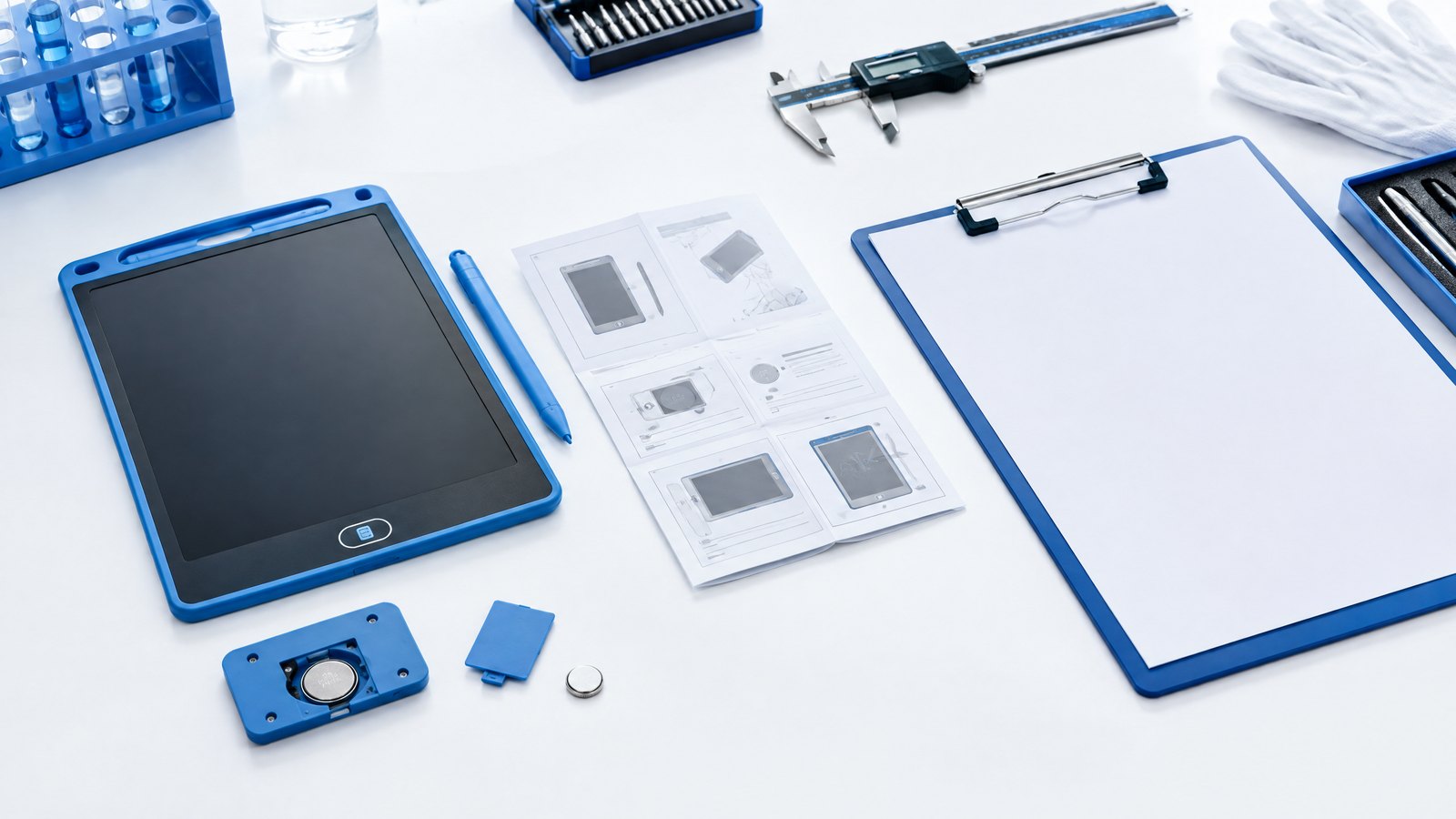
A writing tablet may look simple, but its technical file should be exact. Typical controls include an LCD writing surface, erase function, lock feature, battery, circuit, housing and stylus. The relevant risk and documentation profile can change if you add a USB charging port, Bluetooth, an app, a supplied spare battery or a revised enclosure.
| Technical field | Define in the specification | Importer value |
|---|---|---|
| Form and revision | Model, brand SKU, dimensions, colour and engineering revision | Ties reports and listings to the actual good |
| Construction | Housing resin, display, stylus, fasteners, coating/printing | Supports material and change control |
| Function | Writing, erase, lock, memory, connectivity or app function | Determines claims and possible regulatory scope |
| Power | Chemistry, size, quantity, installed/supplied status, compartment and replacement method | Drives battery safety, shipping and EPR analysis |
| User and information | Age grade, toy status, foreseeable use, warnings, languages and disposal copy | Keeps labels, instructions and listings consistent |
| Traceability | Product/lot code, production coding and importer/operator fields | Enables a lot-specific response |
For a children’s SKU, assess age grade, accessible edges, components, coatings and battery compartment against the actual intended use. ASTM F963 covers hazards that may arise in normal use and foreseeable abuse and includes battery-operated toy provisions. 16
For EU EEE, the manufacturer prepares technical documentation, carries out internal production control, draws up an EU declaration of conformity (DoC) and affixes CE marking once conformity is demonstrated. It retains the documentation and DoC for 10 years. 6 The importer should request the signed DoC, the exact model it covers and an undertaking that the technical file will be provided to authorities on request. A factory ISO 9001 certificate, if it has one, describes a quality-management system; it is not product compliance proof. 17
7. Sample, testing, factory and quality-control workflow
Control the configuration before commissioning testing. A test on a polished sample may not cover later changes to the battery door, pigment, PCB, screw, supplier or warning artwork.
Gate 1: write a compliance brief
Give LcdWritingTablet the target markets, role map, age grade, claims, features, battery, brand, packaging languages and online channel. Ask which factory information is available and which decisions require independent laboratory, importer or EU-operator input. This is buyer best practice, but it documents assumptions early.
Gate 2: approve a golden sample by revision
Record the BOM revision, battery make/type, closure, display, stylus, artwork, instruction and packaging against a configuration ID. Require written notice and buyer approval for any change before mass production.
Gate 3: obtain only the evidence the matrix requires
A US children’s product subject to CPSC rules needs a CPC based on applicable CPSC-accepted lab results. A general-use product subject to an applicable CPSC rule uses a GCC based on testing or a reasonable testing program. 3 4 If the tablet is a children’s toy, identify the applicable ASTM F963 sections rather than commissioning an undifferentiated report; CPSC says applicability is product-specific. 8
For an EU EEE SKU, check that technical documentation and the DoC cover the exact product and relevant legislation. RoHS also requires series-production procedures and attention to design or standard changes. 6
Gate 4: release production by lot
Compare the production sample with the golden sample and artwork master. For US children’s products, tracking marks must be visible, legible and permanent, and make the required information ascertainable. 12 For EU sales, confirm readable identifiers and instructions/safety information in the language required by each Member State of sale. 5
Gate 5: preserve a batch record pack
For each lot, retain the PO, final specification, quantity, lot, final photos, inspection result, battery data, artwork, relevant certificates/declarations, test references, shipping papers and destination allocation. Retain a sealed production reference sample for each materially distinct configuration as a best practice. The factory can provide evidence and cooperate; the assigned importer or operator retains the final market-release decision.
8. Ordering and implementation preparation
Use the PO, specification annex and quality agreement as one control system. Attach the approved configuration register; “LCD writing tablet, black” is not a sufficient production definition.
- No substitution. Specify model/revision, BOM, battery, artwork, intended markets and languages. Require written approval before a material, supplier, battery, tool, process, factory or mark changes.
- Document schedule. Request draft label/instruction artwork, report list, declarations or certificates as applicable, lot-code format, packing information and final photos early enough to correct errors.
- Role and label matrix. State the US importer of record, EU importer, Article 4 operator where relevant, product manufacturer and listing owner. Do not print a legal entity that has not accepted its role.
- Traceability and incident process. Require lot-to-carton/shipment mapping, record handover, rapid safety-complaint notice, sample retention and named stop-ship contacts.
- Listing release check. Compare the physical unit, package, instructions and listing to the approved identity. GPSR distance-sale offers must visibly show manufacturer identity and postal/electronic contact address, product identification, responsible EU operator information where the manufacturer is outside the EU, and required warnings or safety information. 5
Do not copy US copy into EU listings. An EU online offer is product information, not merely marketing. In the US, origin claims must also be substantiated. FTC states that an unqualified Made in USA claim requires a reasonable basis and an “all or virtually all” US-made product; a China-manufactured tablet should not carry that claim because the brand is American. 14
For a factory-side document request list or model-specific identity sheet, contact info@lcdwritingtablet.com. Obtain independent advice for decisions assigned to your importing entity.
9. Practical importer scenarios
Scenario A: US adult note board with a coin cell
A US brand markets a tablet for household notes, not as a toy. It still needs accurate entry information and a five-year record set. If its battery and product scope bring it within 16 CFR part 1263, the buyer must address compartment design, warnings, instructions and the relevant GCC basis—not rely on generic “CE/FCC/RoHS” paperwork. 2 9
Lesson: a non-toy claim does not remove battery obligations.
Scenario B: EU “ages 3+” learning product
An EU distributor imports a China-made tablet labelled and promoted as a learning toy into several Member States. It must assess toy status, EEE/RoHS duties, Article 4 operator coverage, product/batch identification, required languages and local EPR. Under WEEE, an entity established in a Member State that places EEE from a third country on that market is a producer; distance sellers have related rules. 6 7 18
Lesson: “EU” is not one language, one listing or one producer-registration filing.
Scenario C: battery change after approval
A buyer replaces CR2025 with CR2032 while retaining the same housing. Reassess the compartment, warnings, instructions, reports, shipping evidence, battery duties and product identity before release. Update the BOM and artwork, confirm a representative sample and replace any document that no longer covers the configuration.
Lesson: a component change is a compliance change until cleared.
Scenario D: marketplace complaint about a battery cover
The listing owner should identify the lot, preserve the complaint, alert the importer and supplier, inspect stock and suspend the offer where appropriate. GPSR importers must investigate alleged dangerous-product complaints and keep relevant supply-chain parties informed in a timely way. 5
Lesson: respond with a traceable investigation, not an untracked replacement.
10. FAQ: LCD writing tablet importer responsibilities
1. Is the buyer always the importer?
No. In the US, the importer of record has CBP reasonable-care obligations. In the EU, the entity established in the Union that first places a third-country product on the market is generally the importer for the applicable product rules. Put the answer in the contract and label plan. 1 5
2. Does CE marking prove EU compliance?
No. CE marking applies only when relevant EU harmonisation legislation requires it. For RoHS EEE, the manufacturer prepares the technical file and DoC; the importer checks the required elements before placement. Verify scope and exact product identity, not a generic CE image. 6
3. Do US tablets always need a CPC?
No. A CPC is for a children’s product subject to applicable CPSC children’s-product rules. A general-use product subject to an applicable CPSC rule may need a GCC instead. Intended use, age targeting and the actual rule control the answer. 3 4
4. Must every tablet be tested to ASTM F963?
No. ASTM F963 is the mandatory toy-standard framework for US children’s toys, but the product must first be a toy and only the applicable sections should be assessed. 8
5. What traceability should appear on the product?
US children’s-product tracking marks must make required manufacturer/importer/private-labeler, production and batch/source information ascertainable. GPSR requires a product identifier and manufacturer contact information; EEE rules may also require importer details. Use one validated code system for the strictest applicable SKU. 12 5 6
6. Can an EU fulfilment centre be the economic operator?
Potentially, but only where the Regulation (EU) 2019/1020 role order permits it and it accepts the role. Do not assume a warehouse has done so; obtain written confirmation that it can hold and provide the documentation. 7
7. What must an EU online listing show?
GPSR distance-sale rules require clearly visible manufacturer identity/contact details, product identification and, when the manufacturer is outside the EU, the responsible EU operator’s identity/contact details, plus required warnings or safety information. 5
8. Who handles WEEE and battery registration?
The answer depends on the business’s producer status and country of sale. WEEE includes an EU-established entity placing third-country EEE on its national market and distance sellers in its producer definition. The Batteries Regulation likewise covers batteries incorporated in appliances. Confirm registration, authorised-representative and reporting routes in each sales country. 18 13
11. Conclusion: make importer accountability part of the specification
The strongest way to manage LCD writing tablet importer responsibilities is to make identity, evidence and traceability part of the controlled product specification. Assign the legal roles before ordering, lock the configuration, match documents to that configuration, control labels and listings, and preserve a lot-level record pack.
For the US, focus on customs reasonable care, correct CPSC certificate path where applicable, children’s-product tracking labels and certificate eFiling. For the EU, focus on GPSR safety duties, an EU-established economic operator where required, RoHS/EEE documentation and CE process where applicable, traceability, online-offer information and country-level EPR planning. 1 3 5 6 7
LcdWritingTablet can support factory-side OEM/ODM coordination around a controlled specification and document-request process. For a destination-specific brief, email info@lcdwritingtablet.com with the target country, product concept, age positioning, battery, brand entity and planned sales channel.
References
Turn this sourcing plan into a product brief.
Share your target market, product requirements, packaging preference and estimated volume for a practical OEM / ODM discussion.