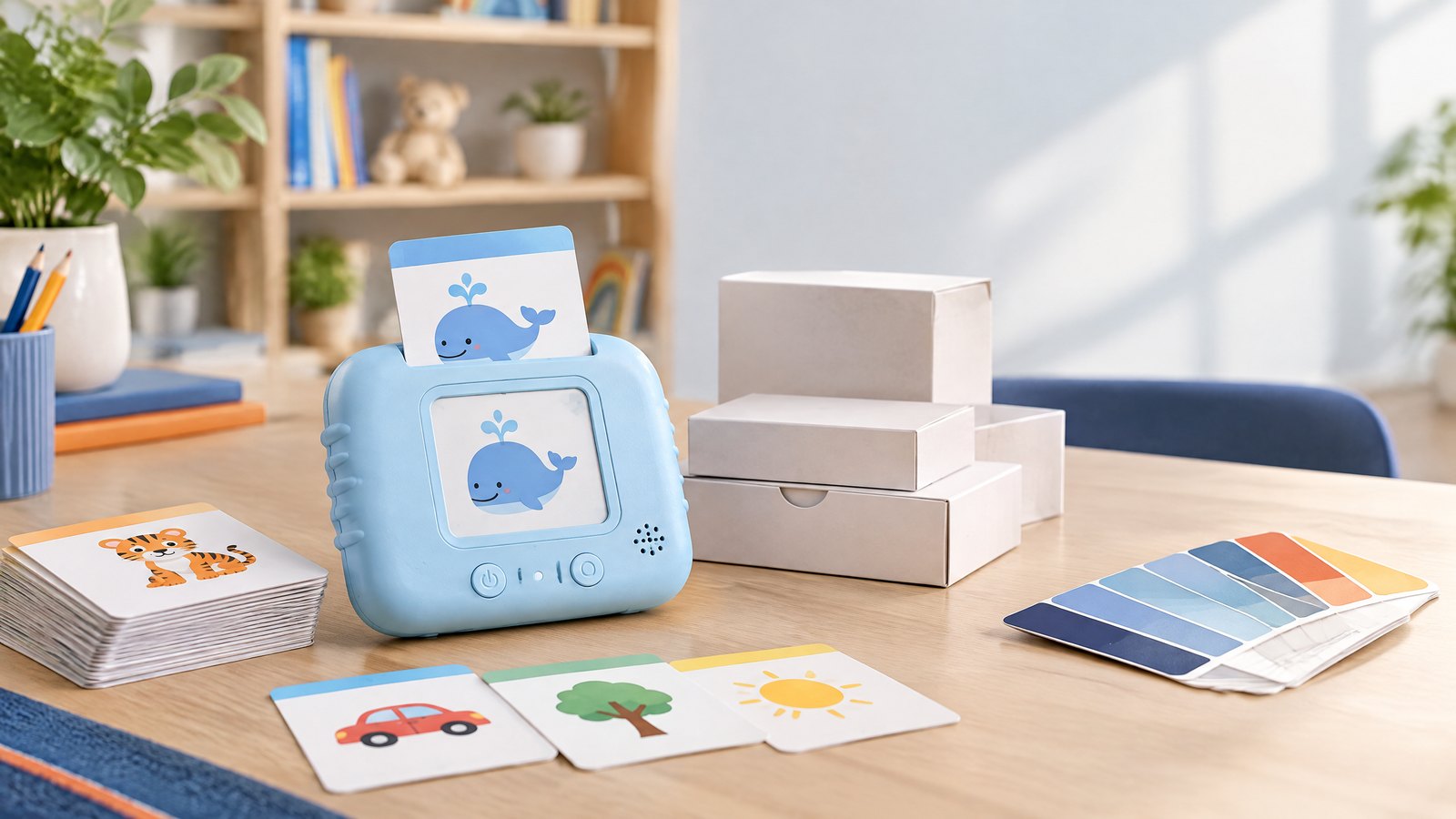
This guide provides a practical B2B decision framework. Final specifications, market obligations, testing scope, labels, packaging and shipment requirements must be confirmed for the exact finished SKU and destination.
2. Direct-answer introduction
Buyers can validate an LCD writing tablet’s durability before launch by converting the intended user journey into a written, repeatable test plan; applying that plan to production-representative samples; defining pass/fail criteria before testing; and preserving evidence that links every result to the exact approved build. The plan should cover unboxed handling, repeated writing and erasing, stylus attachment and retention, housing and seam integrity, battery-door operation, packaged distribution, and the actual environments in which the product will be used.
A tablet that survives a bench drop may still develop a loose battery door, fatigued stylus loop, poor clearing response, or parcel-shipping damage. An isolated prototype-drop video therefore cannot substantiate a broad durability claim. Record conditions, sample identity, inspection results, and a decision rule.
This guide treats LCD writing tablet durability testing as buyer control, not a generic promise or implied certification. It does not assert a LcdWritingTablet product result, certification, or regulatory status. Legal, safety, transport, and marketplace obligations depend on the configuration and country of sale.
For children’s products, durability work has a safety dimension as well as a cosmetic one. U.S. use-and-abuse methods are designed to expose potential hazards from normal use and reasonably foreseeable damage, and they apply the most stringent relevant age group where age ranges span groups.1 EU toy rules likewise address physical and mechanical, electrical, chemical, and other safety risks.2 A durability plan must therefore be aligned with the product’s intended use and applicable route to market—not used as a substitute for compliance assessment.
Need a test-request checklist tied to your tablet size, battery configuration, channel, and target market? Email info@lcdwritingtablet.com with the intended use, destination market, and packaging route.
3. Who this guide is for
This guide is for B2B decision-makers who must decide whether an LCD writing tablet is ready for a branded, retail, institutional, promotional, or e-commerce launch. It is particularly useful when the buyer is comparing an ODM base model with a modified housing, stylus, logo treatment, color, package, battery-door design, or accessory set.
The roles that should sign off
- Product and brand teams define users, use occasions, accessories, and the evidence-backed meaning of “durable.”
- Sourcing locks the approved BOM, revision, packaging, and corrective-action responsibility into order documents.
- Quality and inspection teams execute objective checks and verify production matches tested samples.
- Packaging/channel teams map parcel, retail, and pallet hazards.
- Compliance/legal teams determine children’s-product or toy status, applicable requirements, and launch claims. U.S. children’s products subject to CPSC requirements may need certification; EU toys must meet applicable safety obligations.32
Assumptions and boundaries
The advice below assumes a non-connected tablet with a writing surface, housing, erase control, stylus or holder, and a battery arrangement. Adjust the matrix if a feature is absent. It does not prescribe a universal drop height, cycle count, force, sample quantity, packaging protocol, or regulatory test method. Select those values from intended use, applicable standard, risk assessment, and damage tolerance.
Labeling, marketing, expected users, and foreseeable use all matter. Never represent an internal test as compliance with a named standard unless the full applicable procedure was performed and its report supports that statement.
4. Buyer decision framework
A reliable launch decision is a chain: define → freeze → challenge → inspect → compare → decide → control change. If any link is missing, results can be hard to interpret or impossible to reproduce.
Step 1: Convert the product promise into failure modes
Start with user behavior. Map each touchpoint to component, failure effect, severity, test, acceptance criterion, owner, and evidence file. Examples: a stylus loop tears and loses the stylus; erase is partial; a battery door no longer secures. Separate cosmetic from functional and safety-relevant failure. Define “unacceptable”—for example crack, detached part, exposed sharp edge, failed erase, unreadable marking, or stated cosmetic limit.
Step 2: Establish the configuration under test
Record the exact item being challenged: model and revision, screen size, housing resin/color, screen construction, stylus material, attachment design, fastener or latch design, battery type and supplier where relevant, artwork, inner pack, retail carton, master carton, inserts, and date/lot identification. Photograph each sample before testing, including the battery-door area and product markings.
If a tool, screen film, housing wall, battery supplier, or carton insert changes after testing, assess retesting. Transport evidence may also depend on the exact battery type. Apart from specified button-cell exceptions, IATA says a UN 38.3 test summary applies to batteries shipped alone or in equipment and must be available on request.4
Step 3: Set acceptance criteria before the first test
Write the pass/fail statement before a sample is dropped or cycled. Use four layers:
- Safety and retention: no detached or loosened component, accessible sharp edge, exposed battery, or hazardous condition after the applicable evaluation.
- Core function: writing, clearing/erasing, and control actions perform as defined in the approved functional specification.
- Usability: the stylus can be removed, held, and returned as intended; a user can operate the battery door with the intended method; no new interference prevents normal use.
- Appearance and pack condition: damage stays within a pre-agreed defect standard for the intended channel; required markings remain legible; packaging still protects the product.
For products intended for young children, the safety evaluation after challenge must be informed by the applicable requirements. CPSC guidance, for example, says toys for children under eight must not have hazardous accessible edges before and after use-and-abuse testing.3 That does not make every tablet a toy or turn this guide into a compliance determination; it is a reminder to make the safety review explicit.
Step 4: Use a risk-based test sequence
Use a meaningful sequence: baseline; handling; erase cycles; stylus/holder; battery door; housing; packaged distribution; final inspection. Keep unused samples where needed. U.S. use-and-abuse rules generally require a previously untested sample for each method.1 State the orientation rule, document each event, and retain failures with event number, images, suspected cause, and disposition.
Step 5: Make the launch decision auditable
Choose: pass/release; conditional pass with defined correction; fail/redesign/retest; or defer for missing evidence. A conditional pass names the affected component/lot, re-test scope, owner, date, and required evidence.
Claims must match evidence. The FTC says advertising claims must be truthful, non-deceptive, fair, and evidence-based.5 Prefer “tested to the buyer’s named protocol on this configuration” over “unbreakable,” “childproof,” or “drop-proof.” Review market-specific wording with qualified counsel and laboratories.
5. Comparison, cost, quality and specification table
The following is a planning matrix, not a set of factory specifications or quoted prices. “Cost effect” describes the usual decision trade-off—more evidence, fixtures, iterations, or protective material can add time or cost—and must be quoted for the specific project. It should never be used to infer a LcdWritingTablet capability or a pass result.
| Test area | What a buyer specifies | Example measurable acceptance gate | Evidence to retain | Cost / quality decision |
|---|---|---|---|---|
| Unboxed drop / impact | Sample identity, conditioned state, defined orientations, surface, height/energy, number and order of impacts | No safety-relevant breakage or detached part; writing and erase function meet approved baseline; damage within agreed cosmetic limit | Setup photos/video, event log, before/after photos, functional check sheet | A higher challenge can reveal weak corners or seams, but is not automatically the right market test |
| Erase-cycle endurance | Actuator method, rate, pause, environmental condition, inspection intervals, end-point | Each sampled unit continues to clear as specified; no unacceptable partial clearing, control failure, or housing damage | Cycle counter/log, actuator setup, screen images at intervals, final functional record | Better repeatability may require a fixture; consumer use should be represented separately |
| Stylus and retention | Stylus material/revision, tether/slot/loop geometry, insertion/removal and bend/pull actions | Stylus remains usable; holder retains it as specified; no sharp or loose part; tablet still operates | Force or cycle records where used, photos, video, inspection result | The lowest-cost attachment is not necessarily the lowest total return risk |
| Housing, seam and controls | Target points: corners, display edge, seam, erase key, fasteners, logo/markings | No crack, opening, loose control, exposed internal part, or loss of function beyond buyer limits | Point map, event record, dimensional/visual inspection, function test | Reinforcement, resin, wall design, and assembly choices should be compared against the intended hazard |
| Battery door | Door/latch/screw revision, intended opening tool, open-close cycles, post-challenge operation | Door closes and remains secured as designed; battery remains retained; no stripped feature, crack, or loss of intended access control | Pre/post video, cycle log, close/retention inspection, battery identity record | The requirement is safety- and market-sensitive; escalate early if children may use the product |
| Retail-pack and master-carton distribution | Actual ship mode, parcel vs. pallet flow, packout, carton count, conditioning, product damage tolerance | Product and pack meet pre-set damage limits after the selected procedure; markings/contents remain correct | Test report, package IDs, packout photos, final inspection, deviation record | Test the shipping configuration actually sold, not an idealized carton |
| User scenario validation | Representative user, task, duration, environment, cleaning/carrying/storage actions | No critical usability failure; observed issues are triaged against approved criteria | Script, observer notes, anonymized findings, follow-up actions | Complements lab tests; it does not prove regulatory compliance or population-level reliability |
| Change-control confirmation | Proposed post-test change to tablet, battery, stylus, or packaging | Risk assessment says prior evidence remains applicable, or defined re-test is completed | Engineering-change record, revised BOM/drawing, comparison photos, re-test link | Saves avoidable rework and prevents relying on evidence for the wrong revision |
Select packaging procedures from actual distribution. ISTA distinguishes screening 1-Series from 3-Series general simulations of transport hazards.6 It recommends understanding shipping, handling, and storage, then defining damage tolerance before testing.7 Parcel and unitized replenishment flows are not equivalent.
6. Product and technical detail
What is being stressed in an LCD writing tablet
An LCD writing tablet is a system, not only a screen. Durability depends on interactions among the display stack, front cover or bezel, housing halves, internal supports, erase control, battery contacts and door, stylus, stylus holder, fasteners or welds, and the packaging that restrains those parts in distribution. Test the interfaces, where concentrated stress and repeated handling tend to reveal problems.
Writing and erasing. Record baseline response, write in multiple zones with the specified stylus, operate erase as intended, and inspect for residual marks or non-clearing regions. A fixture should have validated tip, travel, force, rate, and contact pattern; user checks still reveal grip and misuse patterns.
Stylus and retention. Test the stylus and its slot, loop, tether, clip, or other retention feature. Define “retained”: secure in ordinary carrying, retained after a stated drop sequence, or simply storable when deliberately inserted.
Housing and display perimeter. Inspect corners, joints, display edges, screw bosses, battery-door interface, and erase control. Record cracks, seam opening, loose parts, rattles, control travel, display readability, function, and whether cosmetic damage meets the approved limit.
Battery door and power path. Test the approved door, latch/screw, contacts, battery, labels, and intended opening method. Check opening, permitted battery replacement, re-closing, retention after handling, and post-drop condition. For a child-directed product, review this design and its age grade, labeling, and target-market pathway early. CPSC identifies battery-operated toys as an area with labeling and instruction requirements; verify applicability for the item.3
Choose the right kind of drop evidence
A buyer-specific unboxed drop challenge is useful for engineering learning, but it should be described accurately. If the product is a toy for children over 36 to 96 months and the relevant U.S. regulation applies, 16 CFR 1500.53 specifies an impact method for certain toys under 10 lb: four drops from 3 ft ± 0.5 in in random orientation onto the defined impact medium, with examination after each drop.8 That is not permission to call every commercial tablet compliant after four drops, nor is it necessarily the correct test for every market or age grade. It illustrates why surface, orientation, sample condition, and inspection timing must be written rather than improvised.
7. Sample, testing, factory or quality-control workflow
A seven-gate workflow before production release
Gate 1 — Quality brief. Issue a controlled brief: market, users/age grade, claims, configuration, distribution, baseline, tests, criteria, evidence, and decision owner. A quotation or sample description is not a substitute.
Gate 2 — Representative samples. Uniquely identify samples and record revision, materials, lot/date if available, and package version. Reserve specimens by block. Label prototype-tooling or manual-assembly limits; an engineering sample does not prove mass production.
Gate 3 — Baseline and conditioning. Photograph all sides, screen, stylus, attachment, battery-door area, and packaging. Record initial function and cosmetic condition. State ambient conditions and any conditioning. Where a named regulatory procedure is used, follow that procedure rather than mixing convenient elements. For example, 16 CFR 1500.50 calls for specified preconditioning for its use-and-abuse methods and says the relevant test starts shortly after removal from that atmosphere.1
Gate 4 — Controlled challenge. Log operator, equipment, time, sample, event, orientation/force point, and observation. Retain erase counter output and interval images; define stylus action/location, housing point map, and intended battery-door tool. Never replace a failed specimen without recording it.
Gate 5 — Inspection and function. Inspect safety/retention, function, usability, cosmetics, and markings after each relevant event. Retest writing and erase after structural challenges. For child-directed builds, address loose parts, accessible sharp edges/points, and battery access as applicable.3
Gate 6 — Packaging validation. Test the exact product/package and distribution path; record packout, closure, labels, restraint, and dimensions. ISTA advises representative samples, contemporaneous records, and actual-shipment monitoring where possible.7 Use separate investigation packs if intermediate opening is prohibited.
Gate 7 — Review and release. Report scope, traceability, procedure, deviations, results, images, nonconformities, corrections, and sign-off. Change control must link evidence to the final configuration and claims. Confirm laboratory scope and standard version where independent work is needed.
Minimum evidence pack buyers should request
Ask for the following as a coherent file set, not scattered screenshots:
- approved drawing/BOM and revision list;
- test brief with pre-set acceptance criteria and named decision maker;
- sample and package identifiers tied to the tested configuration;
- raw logs/counter output, setup photographs, and unedited or indexed video where available;
- before/after photographs at sufficient resolution to assess the stated conditions;
- functional check sheets, including writing and erase results after structural tests;
- packaging report that states the procedure/version, distribution assumptions, deviations, and product/package damage criteria;
- battery documentation appropriate to the exact battery and shipment, including requested UN 38.3 test-summary evidence where applicable; and
- corrective-action and change-control records, with retest results where required.
Evidence should be understandable months later by someone who was not present. A short video without sample IDs, conditions, and acceptance criteria is supporting material, not a complete test record.
8. Ordering and implementation preparation
Put durability requirements into the order package before production, not into an email after the deposit is paid. Attach the controlled product specification, approved artwork, BOM/revision, golden sample reference, packaging specification, inspection checklist, test plan, acceptance criteria, and escalation route. State which document wins if specifications conflict.
Launch-ready questions to settle
- What is the exact intended use, user age range, and target market? Is the product marketed as a toy, learning tool, office aid, promotional item, or another category?
- Which functions are launch-critical: clean erase, screen readability, stylus retention, battery-door security, cosmetic appearance, or all of these?
- What constitutes a major versus minor cosmetic defect for the sales channel? Define zones, viewing conditions, and allowable condition rather than relying on subjective words such as “nice.”
- Will units move as individual parcels, retail-ready cases, or palletized master cartons? Are e-commerce fulfillment centers, international transfers, or retail shelf handling involved?
- Who may approve a deviation, who pays for rework/retest, and what happens if the approved materials or package change?
- What may marketing say at launch, and which report or evidence file substantiates each claim?
Buyers should also plan time for interpretation and re-test, not only test execution. A failure can be valuable if it appears before inventory exists; concealment is expensive after launch. Where claims or regulatory eligibility are unclear, use a qualified laboratory or counsel in the destination market. Product-testing evidence supports a decision; it does not replace the importer’s or brand owner’s legal responsibilities.
For a buyer-side durability brief template or to align an OEM/ODM sample with your proposed channel test plan, contact info@lcdwritingtablet.com. Please include the destination market, intended users, tablet configuration, and whether units will ship by parcel or bulk freight.
9. Practical applications and scenarios
Scenario A: Children’s learning-tablet launch
A brand intends a tablet for home and travel use by children. The risk map emphasizes drops from hand height, stylus loss, rough handling of the housing, and battery access. The buyer establishes the applicable age grade and compliance pathway first, then creates an internal durability sequence that does not conflict with the required safety evaluation. After each structural challenge, the team checks for detached parts, sharp edges/points, screen and erase operation, stylus retention, and battery-door condition. The final evidence package distinguishes the internal robustness study from any accredited third-party compliance work.
Scenario B: E-commerce parcel program
An online seller wants low return rates from individually delivered units. The likely weak point is not only the tablet; it is movement inside the retail carton, corner compression, or loss of the stylus in transit. The buyer documents the actual packout and tests the complete shipped configuration, selecting a packaging approach that matches parcel distribution rather than pallet transport. ISTA identifies its 3A procedure as applying to individual packaged products delivered through parcel systems, subject to selection of the current procedure and proper test setup.6 The buyer predefines acceptable product and package damage, then opens the final pack only at the stipulated inspection stage.
Scenario C: Branded corporate or promotional distribution
For logo-treated units and bulk event distribution, emphasize marking legibility, stylus control, repeated demonstration use, carton packout, and hurried handoff. Do not call one configuration “rugged” when evidence only covers basic handling.
Scenario D: Post-sample design change
If production substitutes a stylus holder, open change control: identify the material/geometry change, assess links to retention and drops, and revalidate the affected block. Evidence must state what was tested and what changed.
10. FAQ
1. Is a drop test alone enough for LCD writing tablet durability testing?
No. It does not establish erase endurance, stylus retention, battery-door behavior, package protection, or usability. It needs a defined surface, height/energy, orientation rule, sample condition, event count, criteria, and configuration traceability. Use it as one test block.
2. What is a sensible pass criterion after a tablet drop?
Write one before the test: no defined safety-relevant damage; no loose or detached component; the tablet completes baseline writing and erase checks; the battery door remains secured as designed; and appearance remains within the buyer’s documented threshold. The exact criterion and test severity must match intended use and any applicable standard. Do not substitute an arbitrary internal criterion for a regulated method where that method applies.
3. How should a buyer test repeated erase use?
Freeze the mechanism and baseline, then define action, fixture/tool, rate, total events, pauses, condition, inspection intervals, and failure. Inspect multiple zones and retain cycle data/images. A fixture improves repeatability; add user checks for hand angle, handling, and control use.
4. What should be checked on the stylus and holder?
Check writing, insertion/removal, carrying retention, post-drop condition, breakage, sharpness, and safety/customer impact if a component detaches. Identify the exact attachment design; separate and tethered styluses have different risks.
5. Why is battery-door testing important if the tablet works?
A working tablet can still have a failed battery door: a weakened latch, stripped feature, crack, or drop-loosened door affects retention, usability, and safety review. Test the approved arrangement and align transport evidence to the exact battery/product; IATA says test-summary obligations generally extend to batteries in equipment.4
6. Which packaging test should we ask for?
Ask first how the unit will travel: individual parcel, mixed LTL load, full pallet, retail replenishment, air or ground, and any special climate/storage exposure. Then choose a current, relevant procedure with the laboratory or packaging specialist. ISTA says selection depends on knowledge of the real distribution environment and distinguishes screening from prediction goals.7 Never claim an ISTA result unless the named procedure was completed as required and the evidence supports the claim.
7. How many samples should be tested?
There is no universal answer. Set number and allocation from the standard, test type, risk, product maturity, evidence, and acceptance plan. Use separate specimens when required or when one challenge masks another; document the count, selection, and rationale. Do not present a small engineering exercise as statistical reliability proof.
8. Can a supplier test video replace a third-party report?
A video can show setup and behavior, but is not automatically independent, complete, or standards-compliant. Pair it with sample IDs, configuration, conditions, procedure, logs, criteria, and post-test inspection. Use an appropriate third party when required by rules, customer, marketplace, or risk.
9. What should change after a failed test?
Contain and document the failure, identify affected configurations, investigate material/geometry/assembly/package causes, correct under change control, and re-test the affected risk. Preserve the original record; a visual check on a replacement sample is not closure.
11. Conclusion and final email-only CTA
Plan durability validation before claims, packaging, and production materials are hard to change. Freeze the configuration, set measurable criteria, test drop/erase/stylus/housing/battery-door/packaging/user scenarios, and retain reproducible evidence. Handle safety and compliance alongside commercial quality, especially for child-directed products and batteries.
LcdWritingTablet can help structure an OEM/ODM durability request around the intended configuration and launch route. Email info@lcdwritingtablet.com with your market, user, revision, battery arrangement, packaging flow, and launch date.
References
Footnotes
-
Electronic Code of Federal Regulations, 16 CFR § 1500.50 — Test methods for simulating use and abuse of toys and other articles intended for use by children. Accessed September 30, 2026. ↩ ↩2 ↩3
-
European Commission, Toy Safety in the EU. Accessed September 30, 2026. ↩ ↩2
-
U.S. Consumer Product Safety Commission, Toy Safety Business Guidance. Accessed September 30, 2026. ↩ ↩2 ↩3 ↩4
-
International Air Transport Association, IATA Guidance Document for Lithium Batteries and Sodium-ion Batteries, 2026 (PDF). Accessed September 30, 2026. ↩ ↩2
-
U.S. Federal Trade Commission, Advertising and Marketing. Accessed September 30, 2026. ↩
-
International Safe Transit Association, Test Procedures. Accessed September 30, 2026. ↩ ↩2
-
International Safe Transit Association, Selecting & Using ISTA Test Procedures. Accessed September 30, 2026. ↩ ↩2 ↩3
-
Electronic Code of Federal Regulations, 16 CFR § 1500.53 — Test methods for simulating use and abuse of toys and other articles intended for use by children over 36 but not over 96 months of age. Accessed September 30, 2026. ↩
Turn this sourcing plan into a product brief.
Share your target market, product requirements, packaging preference and estimated volume for a practical OEM / ODM discussion.