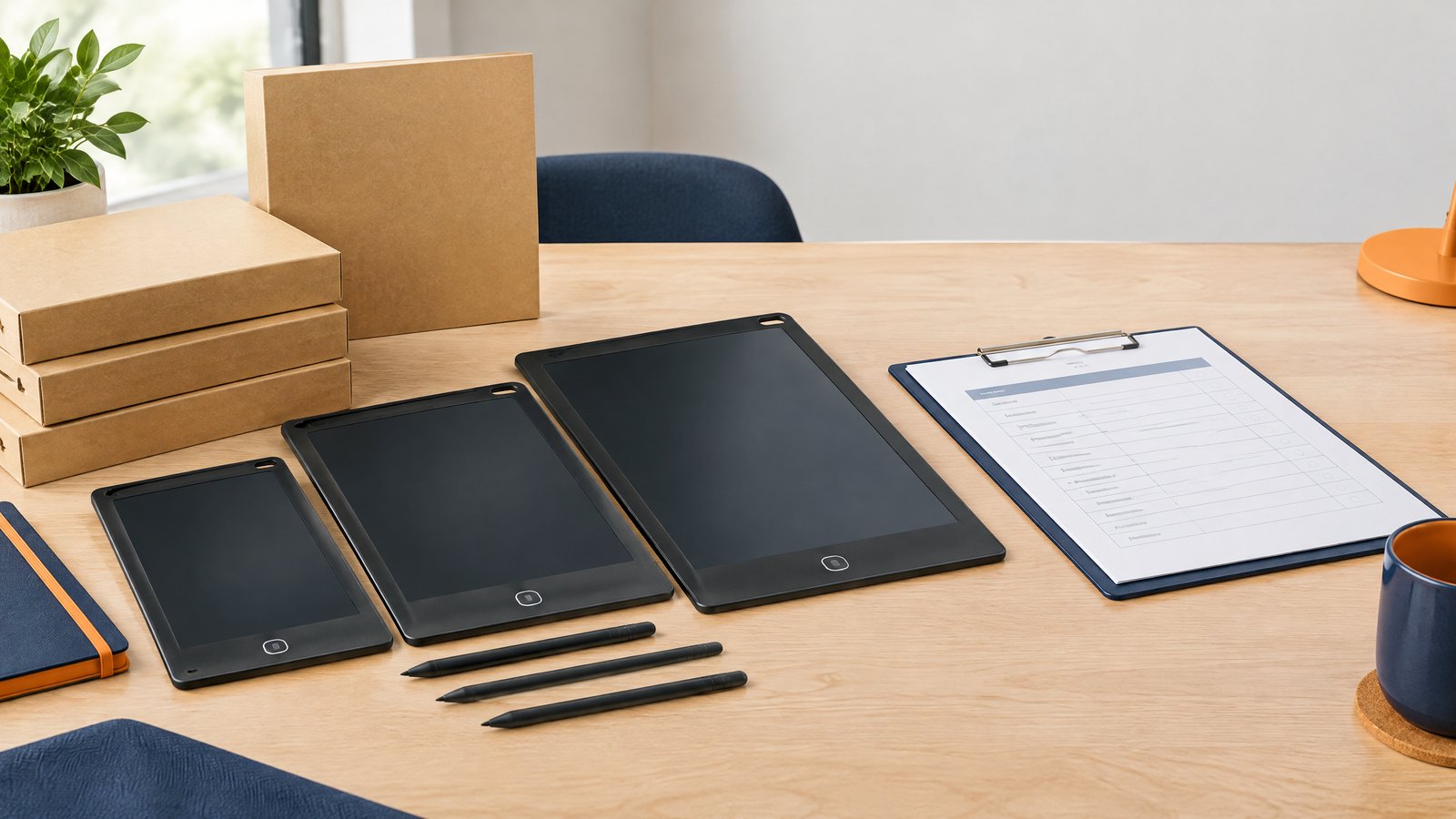
This guide provides a practical B2B decision framework. Final specifications, market obligations, testing scope, labels, packaging and shipment requirements must be confirmed for the exact finished SKU and destination.
2. Direct answer: what does LCD writing tablet CE CPC preparation require?
LCD writing tablet CE CPC preparation is not one certificate request. It is a controlled evidence process that begins with the exact product configuration and ends with market-specific declarations, labels, and records that identify the same finished item. For a children’s LCD writing tablet, buyers normally need to determine whether the product is a toy or children’s product, map its physical, chemical, electrical, and battery-related risks, choose applicable requirements, test the final representative configuration, and then issue or obtain the right declaration for the destination market.
For the EU, CE marking is the manufacturer’s legal declaration that a product covered by applicable EU harmonisation legislation meets the relevant requirements. It is not an approval stamp from an EU authority, proof of origin, or a generic quality badge. For toys, the current framework requires a safety assessment, a conformity-assessment route, technical documentation, an EU Declaration of Conformity (EU DoC), CE marking, traceability, instructions, and applicable warnings. 1 2
For the United States, a Children’s Product Certificate (CPC) is the written certification that a children’s product complies with every applicable CPSC-enforced children’s product safety rule. It must be based on testing by a third-party, CPSC-accepted laboratory when such testing is required. A CPC is not the laboratory’s certificate; it is the responsible manufacturer’s or importer’s certification, supported by the laboratory report and other records. 3 4
The key procurement rule is therefore simple: never buy “CE + CPC” as a supplier claim. Buy an evidence package that matches the actual model, materials, age grading, battery arrangement, artwork, market role, production date, and claims. A report for an earlier version with a different shell resin, screen construction, stylus, battery door, coating, or intended age may be informative, but it is not automatically evidence for the unit you will place on the market.
This guide assumes a passive LCD writing tablet with a writing surface, housing, stylus, erase control, and a power source where applicable. It does not assume a particular model, material, certification, or result. Requirements vary by design, intended use, sales channel, and destination; confirm the final matrix with a qualified compliance professional and the responsible economic operator before release.
Need an evidence-ready specification sheet for a proposed children’s LCD writing tablet? Send the destination countries, target age, artwork, battery design, and intended claims to info@lcdwritingtablet.com. LcdWritingTablet can use those inputs to discuss an OEM/ODM documentation request without representing that any unreviewed configuration is compliant.
3. Who this guide is for
This guide is for B2B brand owners, importers, distributors, retailers, licensing buyers, and procurement teams sourcing a children’s writing tablet from a Shenzhen OEM/ODM supplier for the EU, U.S., or both. It is most useful where private-label artwork, age representations, bundled items, or intended claims can change the evidence needed.
It is less suitable for an adult/general-use memo board, a connected radio device, or a product sold solely outside the EU and U.S. The product name does not decide status; intended use, design, age grade, presentation, and likely use do.
In the U.S., a children’s product is one designed or intended primarily for children 12 or younger. CPSC considers the manufacturer’s reasonable statement, packaging/display/promotion/advertising, consumer recognition, and its age-determination guidance. A label by itself does not settle the question. 5 For the EU Toy Safety Directive, a toy is a product designed or intended, whether or not exclusively, for play by children under 14. 6
A colourful “draw-and-play” tablet for ages 3+ is likely to require both analyses. A small “14+” label will not reliably override young-child imagery or play-oriented promotion. Document the intended-use decision before requesting tests.
4. Buyer decision framework: build the evidence before you buy the order
Step 1: Freeze the commercial identity of the product
Create a controlled product identity record before requesting a quotation. Give it a buyer SKU and manufacturer model number, then record variants, dimensions, materials/colour/coating, stylus/accessories, hardware, battery/access method, packaging/manual, age grade, warnings, market, and claims.
Attach version-controlled drawings, BOM, colour/material callouts, golden-sample photos, packaging, labels, manual artwork, and listing copy. This lets the report, declaration, factory lot, and listing identify one article.
Buyer best practice: open a compliance review when a change can alter safety, composition, electrical behaviour, accessibility, consumer representation, or identification. A new pigment, coating, stylus tip, magnet, battery supplier, battery-door screw, packaging insert, or age claim can require a coverage decision, revised testing, or revised documents.
Step 2: Classify by use and market, not by a single document name
Build a two-column matrix: EU toy status and EU legislation; then U.S. children’s-product status and applicable CPSC rules. CE and CPC answer different legal questions and do not substitute for each other.
For an EU toy, the manufacturer performs a safety assessment covering chemical, physical, mechanical, electrical, flammability, hygiene, and radioactivity hazards, as well as potential exposure. The manufacturer then uses an appropriate conformity-assessment procedure. Where harmonised standards cover all relevant safety requirements and are applied, internal production control/self-verification may be possible. In other defined cases, an EU notified body performs an EC-type examination. 1 A commercial test laboratory is not automatically a notified body, and a notified-body certificate is not automatically needed for every toy.
For a U.S. children’s toy, 16 CFR part 1250 requires each toy to comply with applicable provisions of ASTM F963-23. CPSC notes that the federal third-party testing and CPC requirements apply to products designed or intended primarily for children 12 or younger; a toy for a genuine 13+ audience may still be within ASTM F963’s toy scope but not require CPSC third-party testing or a CPC on that basis. 4 7 15
Step 3: Turn hazards into an applicability matrix
Ask the laboratory or compliance advisor to map every product feature to a requirement, a decision rationale, the needed evidence, and the final certificate citation where relevant. Do not order a vague “toy test.” A well-written scope names the actual configuration and distinguishes applicable, not applicable with rationale, and to be confirmed.
For a conventional tablet, the review commonly considers physical/mechanical features (edges, points, small parts, fasteners, stylus retention); battery-operated toy provisions; chemical risks from accessible materials and finishes; labelling/instructions; and market-specific traceability. A lanyard, magnet, removable accessory, rechargeable pack, separate button cell, radio module, or bundle may change the scope. These are examples, not a fixed recipe: each CPC citation and each exclusion needs a written rationale.
Step 4: Match the right evidence to the right market document
Use four matches: identity (model, photos, variants and accessories); technical (materials, construction, battery, age grade and current edition); scope (actual clauses and samples); and document (correct product, responsible party, rules and testing facts). A family report with a different screen, stylus, pigment, or battery door is a lead—not final proof—until coverage is confirmed or the changed configuration is tested.
Step 5: Assign accountability in the purchase order
Responsibility does not transfer automatically. EU toy manufacturers perform conformity assessment, maintain the technical file/DoC and affix CE; importers must check these steps and retain the DoC. 1 For a finished U.S. import, the importer is normally the certifier. 8 In the PO, assign file ownership, declaration/CPC issuance, records, artwork, traceability, change notices, testing, and authority responses by actual legal role.
5. Comparison, cost, quality, and specification table
| Preparation path | What the buyer must specify | Core evidence output | Cost and lead-time drivers | Quality gate before production |
|---|---|---|---|---|
| EU toy / CE route | Toy use, age grade, product configuration, applicable EU markets, labels/instructions, full hazard inventory | Safety assessment, technical documentation, applicable test evidence, EU DoC, CE/traceability/warning artwork | Number of material families, hazard complexity, applicable laws, need for a notified-body route, translations, and retesting after changes | Approved technical file and artwork match the locked BOM and golden sample |
| U.S. children’s toy / CPC route | Whether primarily intended for 12 or younger, ASTM F963 applicability by feature, production location/date, certifier and records contact | CPSC-accepted-lab reports where required, CPC citing 16 CFR part 1250 and applicable ASTM sections, traceability plan | Number of applicable ASTM clauses, material groups, battery/accessory features, lab scope, sample availability, retest triggers, and certificate-data readiness | Test reports and CPC identify the exact finished product; production marks link to the listed batch/run |
| EU + U.S. dual-market route | Separate market roles, CE and CPC identities, age/claim presentation, shared and non-shared sample sets | Two market-specific document sets linked to a common evidence index | Parallel scopes, distinct test methods/requirements, duplicated samples, artwork variants, and change-control coordination | No cross-market shortcut: each declaration is complete on its own terms |
| Battery or feature change after testing | Old/new BOM, photos, reason for change, battery/access method, packaging/manual effect, planned production date | Change assessment, lab confirmation, revised/added testing if needed, amended declarations/artwork | Engineering changes, re-sampling, test queue, new warnings, destroyed packaging inventory, and production hold risk | Written release states exactly what evidence remains valid and what was updated |
No price range is given because cost and timing depend on the sample, market, laboratory scope, and redesigns. The objective is complete, correctly scoped evidence, not the lowest test quotation.
6. Product and technical detail: what must be visible in the evidence file?
The file should describe the finished system: screen, housing, bezel, erase control, stylus/cord, fasteners, decoration, battery compartment, electronics, magnets if present, packaging, manual, and accessories.
Build a component-to-evidence map
Use a BOM cross-reference with each item’s part number, material/supplier, colour, revision, location, accessibility, sample ID, and report page. This is crucial for material families: a report on black ABS does not necessarily cover a red masterbatch, metallic coating, soft-touch layer, or printed panel. Support any “same material” conclusion with controlled BOM and supplier information.
Do not overlook battery architecture
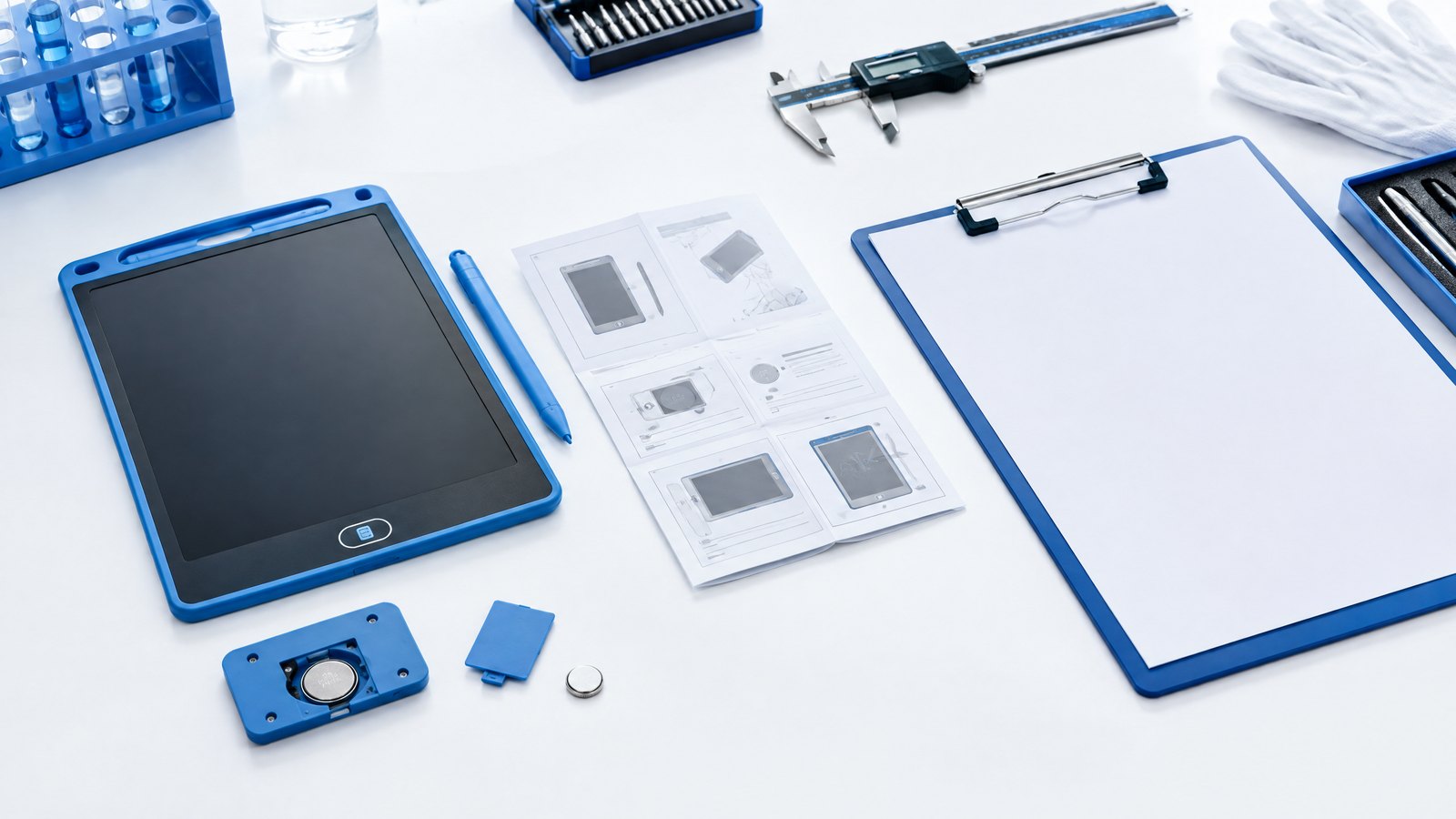
Battery configuration is a compliance decision, not only an engineering choice. Record battery type, quantity, chemistry, replaceability, compartment design, opening method, retention hardware, polarity marking, and whether the battery is included or separately packed. Align the product, packaging, and instructions with the decided configuration.
For a U.S. toy using a button/coin battery, toy-specific battery-operated provisions govern where the toy meets the applicable ASTM F963/16 CFR part 1250 requirements; a separately packed battery can add packaging considerations. 9 Do not copy warnings from another model—confirm the route for this arrangement.
Treat presentation as a technical input
Age grade, use statement, illustrated child, retailer category, product name, and educational or play claim belong in the evidence file because they help establish intended use. The CPSC explicitly considers representations in packaging and advertising, including images, not merely the printed age label. 5 For the EU, warnings and safety information must be appropriate to the toy and must accompany it. 1
A buyer should therefore lock listing content alongside packaging artwork. A late decision to call a general writing board “a toddler’s first drawing toy” can alter the classification discussion and undermine the testing rationale already used.
7. Sample, testing, factory, and quality-control workflow
1. Start with an evidence brief, not a report request
Send a controlled brief with the identity record, markets, age/use statement, BOM, drawings, photos, proposed labels/manual, packaging, and accessories. Ask the lab to list each proposed test/rule, rationale, sample quantity, edition, acceptance/accreditation status, exclusions, and deliverables.
For U.S. CPC support, select a lab listed by CPSC for the specific rule or ASTM F963-23 clause. Acceptance is scope-based. 10 For EU testing, assess technical competence and scope, but do not call an ordinary report a “CE certificate.” Where third-party EU assessment is required, verify a notified body in NANDO. 1
2. Submit representative, production-intent samples
Submit production-intent units with final materials, pigments, printing, hardware, battery compartment, electronics, accessories, and packaging. Give each sample an ID, photograph it, and preserve shipping/chain-of-custody records. For platform variants, compare every difference against the hazard/material map and obtain the lab’s documented grouping or worst-case rationale.
3. Review reports for evidence quality, not just “pass”
Before mass production, check the report against the identity record: model/SKU, photos, sample/test dates, edition, individual clauses, results, exceptions, lab identity, and authorisation. Reports should distinguish tested conclusions from untested features. For U.S. toys, the CPC should cite 16 CFR part 1250 and individual applicable ASTM F963 sections, not merely the standard name. 11
4. Connect factory control to the tested construction
Buyer best practice: require an approved BOM and written compliance review before substituting a resin, pigment, ink, coating, stylus material, fastener, battery, PCB, supplier, or process. Tie incoming material and lot records to the BOM revision. During production, inspect evidence-sensitive features against the golden sample; this does not replace statutory testing but helps keep production aligned with it.
For U.S. children’s products, tracking marks must be visible and legible, permanently affixed to the product and packaging to the extent practicable, and allow identification of the manufacturer/importer or private labeler, production location/date, and batch/run or other identifying information. Tracking labels are not themselves a CPC test rule, but they are vital to traceability. 12
5. Release documents only after the production version is known
For an EU toy, prepare the EU DoC after the conformity basis and technical documentation are complete. Annex III of the Toy Safety Directive specifies, among other elements, the unique toy identification; manufacturer or authorised representative; sole-responsibility statement; traceable object identification with a clear colour image; relevant EU legislation; standards/specifications; notified-body details where applicable; and signature, place, and date. 6
For a U.S. CPC, include the seven required elements: product identification; each applicable children’s rule; certifier details; records contact; manufacture date/place; testing date/place; and third-party CPSC-accepted lab details. CPSC requires the CPC and supporting reports to be in English. 3 Current 16 CFR part 1110 requires imported finished-product certificate data to be eFiled through the prescribed process at entry; coordinate the live entry data with the importer/broker before shipment. CBP confirms that CPSC eFiling applies to commercial products sold online and shipped to U.S. consumers. 8 15
8. Ordering and implementation preparation
Put compliance obligations in the purchase order and launch plan. The following is buyer best practice, not a legal substitute.
- Compliance kickoff: Confirm country list, importer/brand roles, product classification, target age, sales claims, and decision owner.
- Configuration lock: Approve the product identity record, BOM, drawings, colour/material specifications, battery design, packaging, manual, labels, and listing copy.
- Scope approval: Obtain a written laboratory applicability matrix. Resolve uncertainties before samples are tested.
- Representative testing: Submit sample-controlled, production-intent units and retain a buyer reference sample.
- Evidence review: Verify reports, risk assessment/technical documentation, declaration drafts, and traceability plan against the approved configuration.
- Artwork release: Check CE location where relevant, EU operator information, U.S. tracking data, age grade, warnings, instructions, barcode/SKU, and claim substantiation.
- Production change control: Require written notification and compliance review before changes; separate old/new material or artwork stock.
- Pre-shipment evidence pack: Index the approved reports, declarations, records contact, lab details, lot mapping, final artwork, packing information, and any broker data needed for import.
Define file ownership, named contacts, response time, document language/access, confidential BOM treatment, and material-change obligations in the contract. Keep an evidence index showing document number, model/BOM revision, market, rule, sample, lot coverage, owner, issue date, and change status.
For long-range EU planning, Regulation (EU) 2025/2509 applies from 1 August 2030 and will require a toy digital product passport. 13 It is not today’s replacement for the EU DoC; follow the rules applicable when the product is placed on the market.
9. Practical applications and scenarios
Scenario A: A standard 8.5-inch children’s doodle tablet for EU and U.S. retail
A non-connected, 3+ tablet with a stylus, coin battery, and cartoon packaging needs a dual-market brief—not a request for “EN 71 and CPC.” Map the stylus/battery, accessible materials, decorations, and 3+ claims. Common BOM data may support both files, but EU and U.S. declarations are not interchangeable.
Scenario B: One colour change becomes a compliance change
A pearlescent purple housing and metallic logo are not automatically covered by a report for blue ABS. Submit the revised material data, obtain a documented coverage decision, update photos/BOM/declarations as needed, and hold that version until the decision is recorded.
Scenario C: A writing tablet repositioned as a school-supply item for ages 14+
A “14+” sticker alone does not make a product general use. Document user, design, packaging, photos, store category, and advertising; child-oriented cues and play value can still support a children’s-product classification. 5
Scenario D: A retailer asks for “CE certificate” and “CPC certificate”
Respond with the EU DoC and relevant evidence for the EU, and the CPC with supporting reports for the U.S. Explain that CE and CPC are responsible-party declarations, not generic government approvals. 2 3
Scenario E: Marketing wants a “paper-saving” claim
A reusable tablet may invite environmental messaging, but FTC guidance requires competent and reliable scientific evidence for product or packaging environmental claims. 14 Define the claim, retain substantiation, and keep it separate from safety declarations.
10. FAQ
1. Is CE certification the same as a CPC?
No. CE marking is the EU manufacturer declaration within the toy conformity, technical-file, EU DoC, marking, traceability, and warning framework. A CPC is the U.S. certifier’s written statement for each applicable CPSC rule, supported by required testing. 1 3 A dual-market product can need both.
2. Can LcdWritingTablet issue the CPC for our U.S. private-label order?
The responsible certifier must be determined from the actual legal role. For imported finished products, 16 CFR part 1110 normally assigns the importer as the finished-product certifier. 8 A manufacturer can provide reports, product data, and draft inputs, but the buyer should not assume the factory’s document transfers the importer’s legal responsibility. Confirm ownership and signing authority in writing before the order is released.
3. Does every children’s LCD writing tablet need exactly the same tests?
No. Scope follows features, age/use, materials, accessories, battery arrangement, and market. Magnets, cords, rechargeable packs, separate coin cells, or connectivity can change it. U.S. toys must meet all applicable ASTM F963-23 provisions. 7
4. Can we use a supplier’s old test report for our branded version?
Possibly as supporting information, not automatic final evidence. Compare final model, BOM, colours/coatings, accessories, battery, age, edition, market, scope, labels, and production date. Obtain written coverage or new testing where it does not represent the finished SKU.
5. Is a laboratory’s ISO/IEC 17025 accreditation enough for U.S. CPC testing?
No. A CPC test lab must be CPSC-accepted for the applicable rule or scope; verify it in CPSC’s directory. 10 ISO/IEC 17025 accreditation does not replace required CPSC acceptance.
6. Do labels and warnings need to be tested by a CPSC-accepted laboratory?
CPSC’s toy guidance says certain toy labelling and instructional-literature requirements exist, while labelling requirements do not require compliance assessment by a CPSC-accepted third-party laboratory. 4 That does not make labels optional. Review the actual wording, placement, age grade, instructions, and traceability requirements as part of artwork release and ensure the CPC cites applicable safety rules correctly.
7. What should an EU Declaration of Conformity identify?
The EU DoC must identify the toy and give Annex III information: manufacturer/authorised representative, a traceable object with clear image, EU legislation, standards/specifications, notified-body data where applicable, and signature/date. 6 A generic “LCD tablet CE certificate” is weak evidence.
8. Can we say “CE approved,” “CPC certified,” or “eco-friendly” in our listing?
Avoid imprecise claims. CE is not EU approval; a CPC is the responsible firm’s compliance certification, not an award. 2 Environmental claims need competent and reliable scientific evidence. 14
9. What are the most common preparation mistakes?
The recurring errors are testing before BOM/claims are frozen; asking for generic “CE/CPC”; relying on an unmatched family report; missing CPSC scope; treating a report as a declaration; omitting applicable ASTM clauses; losing lot linkage; changing a battery/material/artwork without review; and using unsupported claims. A controlled identity record and change gate prevent these failures.
11. Conclusion: make the evidence fit the tablet you will actually sell
A buyer’s strongest compliance position is a clean, inspectable chain: intended use and target age lead to classification; classification leads to a feature-based applicability matrix; the locked configuration leads to representative testing; testing and risk assessment support the correct EU DoC and/or CPC; and traceability marks plus factory change control keep production tied to that evidence.
For EU toys, CE is a manufacturer declaration backed by conformity work, not a purchasable badge. For U.S. children’s products, the CPC is the responsible certifier’s statement backed by evidence, not a laboratory substitute. Keep files market- and model-specific and revision-controlled.
For an OEM/ODM discussion focused on your final configuration and documentation inputs, email info@lcdwritingtablet.com. Include the target market, age grade, product photos or drawings, battery specification, material/colour plan, packaging artwork, and intended claims so the preparation scope can be reviewed against the actual tablet.
References
Turn this sourcing plan into a product brief.
Share your target market, product requirements, packaging preference and estimated volume for a practical OEM / ODM discussion.