This guide provides a practical B2B decision framework. Final specifications, market obligations, testing scope, labels, packaging and shipment requirements must be confirmed for the exact finished SKU and destination.
2. Direct-answer introduction
A custom-color LCD writing tablet becomes low-risk when the color is treated as a controlled product specification, not as a visual request in an email. The buyer should define the resin family, color reference, masterbatch or pre-coloured resin route, surface texture, permitted color difference, logo treatment, part coverage, sample approval method, and change-control rules before mass production. The approved physical sample must then become the reference for every production lot and repeat order.
For a custom color LCD writing tablet OEM project, “Pantone blue” alone is not enough. A printed fan-deck swatch, a plastic chip, a screen-printed logo, and a textured injection-moulded housing can all look different even when they use the same nominal color name. Resin grade, pigment dispersion, wall thickness, mould temperature, gloss, texture, ambient light, and the black or white area beside the color all influence perceived appearance. A color is commercially reliable only when those variables have an agreed home in the specification.
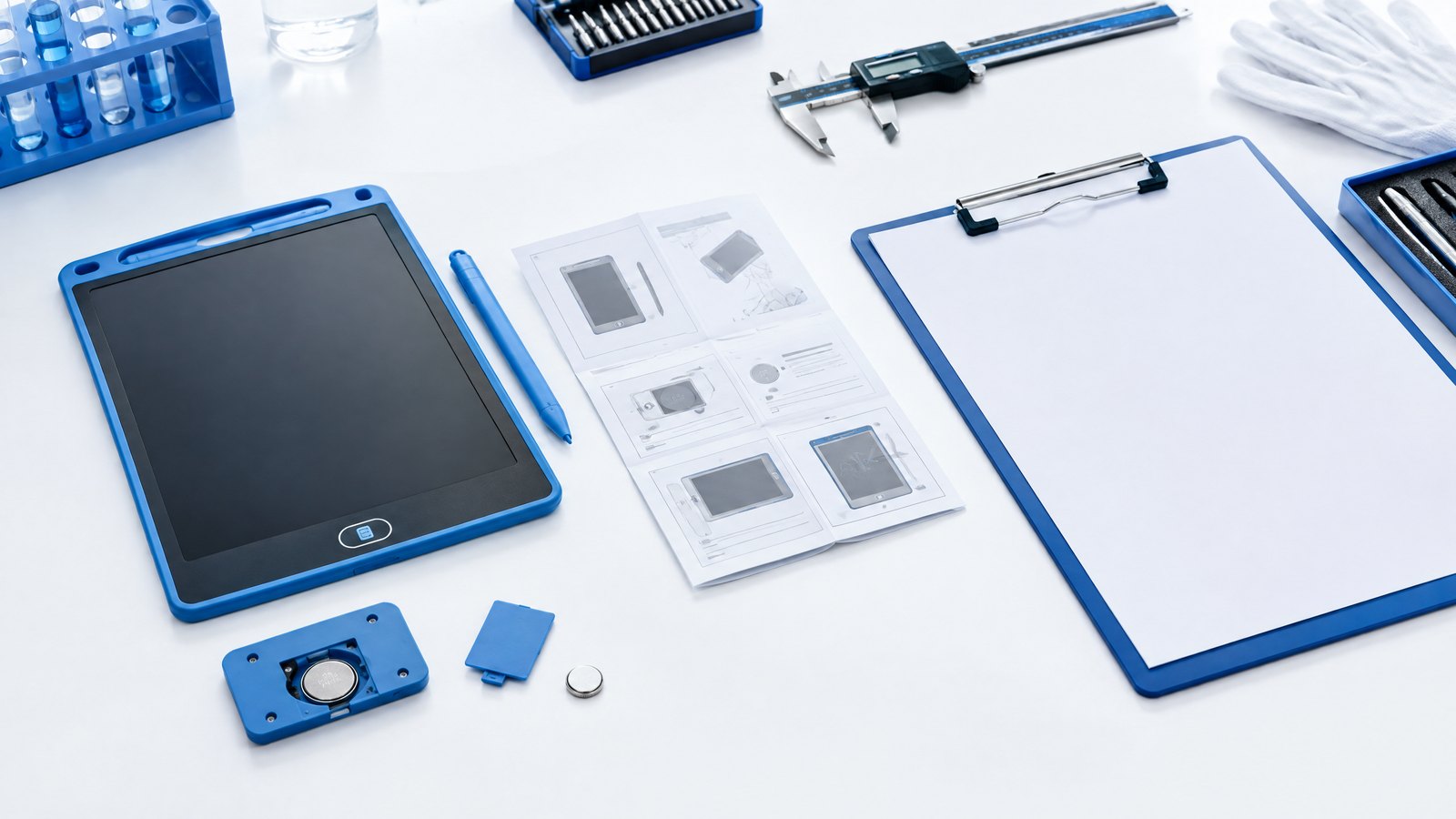
This guide assumes an established LCD writing tablet platform: an injection-moulded front and rear housing surrounding a pressure-sensitive writing display, with an erase function and a stylus or stylus holder where the selected platform includes one. It does not assume that every size, battery architecture, writing film, button arrangement, or housing resin is interchangeable. A color program is safest when it begins on a defined base model and does not quietly change functional parts.
The practical objective is simple: make the first approved housing reproducible. That means establishing one reference standard, separating color approval from logo approval, locking the bill of materials (BOM), and inspecting each shipment against clearly stated criteria. This approach reduces avoidable rework, commercial disputes, and repeat-order drift. It does not eliminate normal manufacturing variation, and it does not turn a Pantone reference into a guarantee that every material or finish will match perfectly.
3. Who this guide is for
This guide is for brand owners, promotional-product distributors, education suppliers, corporate-gifting teams, retailers, and import teams that need a branded LCD writing tablet in a non-stock housing color. It is especially useful when a buyer wants a recognizable brand hue, a matte or textured feel, a contrasting logo, or continuity across replenishment orders. It also applies when one buyer is managing several stock-keeping units (SKUs), such as different tablet sizes or battery versions, that must remain visually coordinated.
It is not a substitute for product-specific regulatory review or for an industrial designer’s tolerance analysis. If the finished product is designed or intended primarily for children aged 12 or younger in the United States, the responsible domestic manufacturer or importer must determine the applicable children’s product safety rules. CPSC explains that covered children’s products require third-party testing and a written Children’s Product Certificate based on testing by a CPSC-accepted laboratory. A housing color or resin change should therefore be reviewed in the context of the actual product, age grading, claims, and market—not assumed to be administratively neutral. 5
The guide is also deliberately narrower than a general sourcing article. It does not decide whether an LCD tablet is right for a school, compare screen sizes, or explain packaging design. Its subject is appearance control within OEM development: how a buyer turns one desired color into moulded parts that can be approved, inspected, and repeated.
4. Buyer decision framework
Start with the appearance brief, then convert it to a manufacturing brief
A productive brief has two layers. The first is the brand intent: “a warm, muted green that feels premium beside an off-white logo.” The second is the manufacturing definition: front housing in a named polymer grade and finish, matched to a physical plastic color standard, with a stated measurement method and visual acceptance condition. The first tells a design team what success looks like; the second tells purchasing, moulding, printing, and inspection teams what must remain stable.
Use the following order of decisions. First, freeze the base model and identify every colored part. Second, choose the color reference. Third, choose the resin and colorant route. Fourth, define surface texture and logo. Fifth, approve a production-representative sample. Finally, create a repeat-order control file. Reversing this sequence creates common errors: approving an attractive color on the wrong resin, confirming a logo before the housing finish is known, or ordering production before a reference sample exists.
Select the right color reference for plastic
A Pantone code can communicate creative intent, but the reference format matters. Pantone describes Plastic Chips as standards for visualizing, communicating, specifying, and controlling color for plastic and mixed-material products; its chips are polypropylene and include glossy and matte finishes in tiered thicknesses. 1 When the requested visual target is plastic, a physical plastic chip is generally a stronger starting reference than a screenshot or a printed swatch.
That does not mean the chip will duplicate the final housing. A Pantone Plastic Chip has its own polymer, thickness, and surface. The tablet may use another resin and another mould finish. State this limitation in the approval record: the chip sets the intended hue family, while the approved moulded plaque or approved housing is the final manufacturing standard. If no plastic chip is available, use an agreed physical reference and record its source, date, condition, and viewing requirement. Do not approve solely from a phone photo; exposure, white balance, compression, and surrounding colors make it unsuitable as a release standard.
Choose a color-control method appropriate to the risk
There are two complementary methods. Visual approval asks whether a representative part is commercially acceptable beside the physical standard under an agreed light source and viewing condition. Instrumental control records color coordinates from a calibrated measurement setup, then compares production parts with the approved standard. ISO/CIE 11664-4 defines the CIE 1976 Lab* color space, including lightness, chroma, hue, and methods to calculate color-difference distances. 2
Instrumental data should support, not displace, visual judgment. ASTM D2244 states that purchaser and seller should agree both the permissible tolerance and the calculation procedure; it also notes that gloss and texture can affect the relationship between a measured difference and commercial acceptability. 3 Therefore, a buyer who specifies a ΔE limit should also specify the color-difference formula, instrument geometry if relevant, illuminant/observer setting, measurement locations, and whether the requirement applies to each part, a lot average, or both. An unqualified “ΔE ≤ 1” is not a usable production instruction.
Decide whether the color is a platform color or a limited variant
A platform color is intended for replenishment and may be used across several orders or models. It deserves a locked resin/mould/finish/colorant recipe, a retained approved sample, and a written change-notification rule. A limited variant may accept a simpler process if the buyer understands that a future remake could need a new approval. The economic decision is not merely about order quantity. It is about the cost of a mismatch after products have reached retail, an event, or a fulfillment network.
A strong rule is: do not spread a new brand color across multiple tablet sizes, battery variants, or accessory colors until it is proven on the first defined platform. A color that looks correct on a thick, smooth 10-inch rear housing may appear different on a thin, textured stylus or a smaller 8.5-inch frame.
Buyer rule: Approve the color on the same resin, surface finish, nominal wall-section range, and production process intended for sale. A close-looking mock-up is useful for design discussion, but it is not the golden sample.
If you are preparing a controlled development brief, LcdWritingTablet can review the base model, color reference, part coverage, logo artwork, and required approval evidence by email at info@lcdwritingtablet.com. Include the intended market and whether the color is a one-time variant or a repeat-order program.
5. Comparison, cost, quality, and specification table
The most economical color route is not automatically the least risky. The table compares common routes for a tablet housing. “Relative cost” is directional because resin availability, color difficulty, order quantity, approved supplier requirements, and waste allowance affect the commercial quote.
| Route | What is controlled | Typical strengths | Primary risks to manage | Relative development cost | Best fit |
|---|---|---|---|---|---|
| Existing stock resin color | Existing resin grade and stock color | Fastest route; fewer formulation variables | May not meet brand hue; future stock shade can change | Low | Non-critical or close-to-stock color |
| Natural resin + custom masterbatch | Base resin, masterbatch supplier/code, dosage, process window | Flexible; can provide a repeatable recipe when inputs are locked | Dispersion, dosage, drying, regrind, and processing variation can change appearance | Medium | Brand color with repeat-order potential |
| Pre-coloured compounded resin | Resin compound grade and color compound | One supply input; useful for difficult or high-consistency colors | Lead time, minimums, resin-lot management, and approval still matter | Medium to high | High-volume or tightly controlled platform color |
| Paint, coating, or secondary finish | Substrate, coating system, cure, surface preparation | Can achieve effects that moulded color cannot | Adhesion, abrasion, coverage at edges, repairability, and additional process variation | High | Effect finish, not a default substitute for moulded color |
A concise specification table should sit in the purchase order, technical pack, or controlled artwork package. It must identify the decision, not only the target color.
| Specification item | Minimum release information | Why it prevents production risk |
|---|---|---|
| Base model and revision | Model code, screen size, housing tool revision, battery version, stylus configuration | Stops a color approval from being used on a look-alike but different product |
| Colored parts | Front housing, rear housing, erase key, stylus, lanyard, trim; identify exclusions | Prevents assumed “all-over color” coverage |
| Resin | Polymer family, grade, approved supplier or equivalency process, virgin/regrind rule | Resin changes can alter shade, gloss, flow, and strength |
| Color reference | Pantone Plastic Chip code or physical standard ID; photos are supplementary only | Creates a shared target that survives staff turnover |
| Colorant route | Masterbatch or compound supplier, code, let-down ratio/range, approved substitution rule | Converts color into an auditable input |
| Finish and texture | Gloss/matte intent; mould texture standard/code or approved texture plaque; location | Texture changes light scatter and perceived color |
| Visual approval | Viewing light, distance, part orientation, reference sample, accept/reject authority | Avoids subjective approval under inconsistent light |
| Instrumental control | Device/method, formula, tolerance, test locations, frequency, action on failure | Makes color data comparable across lots |
| Logo | Artwork revision, process, ink color, size, placement, contrast requirement, adhesion test | Keeps brand readability distinct from housing shade |
| Traceability and change control | Lot ID, retained sample, documents, notice and reapproval rules | Protects repeat-order continuity |
Cost signals buyers should recognize
Deep black, white, and some saturated or light pastel colors can create distinct production challenges, but no universal premium applies. A difficult shade may require more development trials, tighter process management, a special compound, or a higher scrap allowance. Metallic, pearlescent, translucent, glow, and soft-touch effects add further variables and should be treated as separate material-and-finish projects rather than ordinary color selections.
Do not ask a supplier to remove cost by allowing “equivalent color masterbatch” without a reapproval path. The saving is small only until the equivalent produces visible shade drift, inconsistent flow marks, or an unsupported compliance file. Instead, request a transparent comparison: development sample cost, colorant or compound minimum, expected lead-time impact, and what evidence will be supplied for repeat orders. The buyer can then decide knowingly whether a platform color warrants the control level.
6. Product, application, and technical detail
Pantone is a target; masterbatch is the production input
Masterbatch is a concentrated additive mixture introduced into a base polymer at a defined ratio during moulding. It is not a color guarantee by itself. The same masterbatch can yield a different result when the base resin, thickness, temperature profile, residence time, moisture condition, or percentage of regrind changes. Treat the masterbatch code and intended let-down ratio as controlled BOM items. If the factory uses pre-coloured compound instead, record the compound grade, color code, supplier, and lot traceability in the same way.
For an LCD writing tablet, the base polymer must be selected for the housing’s functional requirements first. The product may need snap fits, thin walls, a stylus holder, screw bosses, a battery door, or an erase-button feature. A brand should not choose a resin merely because it makes the easiest color. Changing from the approved resin family to match a shade can change shrinkage, warpage, impact behavior, screw retention, and moulding conditions. That is an engineering change requiring validation, not a cosmetic adjustment.
Specify whether regrind is prohibited, permitted within a stated maximum, or permitted only from internally controlled material of the same color and resin. If regrind is allowed, add a rule for how it is identified and blended. Regrind can be sensible in controlled manufacturing, but it can affect appearance if ratio, thermal history, or material segregation is not managed. No rule is safer than an assumed rule.
Texture, gloss, and wall thickness change what the eye sees
A smooth gloss surface reflects light more directly. A matte or grained surface scatters it, which can make a color look lighter, duller, or less saturated. Deep texture may also cause pigment to appear non-uniform around curves or ribs. Likewise, thick and thin zones can differ in visual density, particularly with translucent or effect colors. These are physical appearance effects, not necessarily defective moulding.
The buyer should identify the finish with more precision than “matte.” Use one of the following: an agreed mould-texture code with a controlled physical plaque, a specified gloss range measured by an agreed method, or a signed production-representative sample. When both front and rear shells are visible together, inspect their seam and side-by-side appearance. A small variation that is tolerable on separate components can look unacceptable where the parts meet.
Texture must also be compatible with the logo. A fine screen-printed logo can lose crispness or adhesion on a deep grain. Laser marking may provide a durable mark on some materials but can produce a different perceived color, a shallow mark, or low contrast depending on resin and additives. Neither method should be assumed from a digital rendering. Build logo process selection into the sample stage.
Design logo contrast for the actual housing, not a white artboard
Logo readability depends on contrast, edge sharpness, size, position, surface texture, and gloss. Request the artwork in a controlled vector format and identify the exact revision. Then approve the mark on the final-color housing under the same viewing conditions used for the color. A black mark can look weak on a very dark, matte housing; a white mark can look grey or incomplete on rough texture; a shiny ink can create glare even when its nominal color is right.
Avoid vague instructions such as “make it highly visible.” Define the ink or marking color, print area, location datum, orientation, minimum legible feature, and acceptable print defects. If logo durability matters, state the test method, number of cycles or condition, and pass criterion before sampling. A logo adhesion test without an agreed method and criterion becomes an argument rather than a quality check.
Material control is also market control
A custom-colored tablet remains electrical and electronic equipment if it depends on electric current to perform an intended function; the EU RoHS Directive defines EEE in that way and applies to covered categories subject to its exclusions. 4 The European Commission notes that RoHS restricts ten substances in EEE, including certain heavy metals, flame retardants, and plasticisers. 4 A new pigment, masterbatch carrier, coating, ink, or resin supplier can therefore affect the material evidence needed for the finished market configuration.
This is not a claim that every color change automatically requires a full re-test or that one standard answers every market requirement. It is a control principle: the importer and manufacturer should assess the change against the applicable market obligations, technical file, and customer requirements. The European Commission’s RoHS information also makes clear that the framework sits alongside other chemicals and safety requirements. 4 Buyers should request a materials change record and preserve the evidence that supports the relevant product version.
Variant control stops “almost the same” from becoming a new product
A tablet can have several legitimate variants: screen size, colored shell, erase-lock feature, battery type, stylus design, retail pack, or logo. The risk starts when their codes are not connected. Use a variant matrix that maps each sellable SKU to its base model revision, housing tool, resin/colorant specification, logo artwork revision, package version, market, and approval sample ID.
Do not use a generic phrase such as “blue tablets” in a purchase order. Use a unique internal color name and revision, for example, “Brand Azure / Tablet Model X / Housing Spec C-03 / Artwork A-02.” The name need not be customer-facing; it exists to prevent a later buyer, factory planner, or third-party inspector from selecting a similar-looking but unapproved formula.
7. Sample, testing, and quality-control workflow
Stage 1: Establish the reference before tooling or production release
Start with a change-controlled development pack. It should include the base model revision, a physical color reference, color application map, resin and colorant route, finish requirement, logo artwork, expected markets, and acceptance plan. If the project requires a new tool or new texture, also record the tool revision and texture location. Hold a short internal review before sampling: can each requested color be measured? Does the logo fit the texture? Is the reference available to both parties? Are front and rear shells expected to match exactly or only to appear harmonious as an assembly?
A color drawdown or small moulded plaque is useful to narrow the formula. It should never be mistaken for final approval if it lacks the final wall thickness, texture, or geometry. Move from plaque to production-representative housing sample as early as possible. Assemble the sample with its display, erase mechanism, button, stylus, and any visible accessories. This exposes issues that a flat plaque cannot: part mismatch at the seam, logo interference, sink marks, flow lines, and the visual effect of the dark display against the colored bezel.
Stage 2: Approve one golden sample and one specification record
The golden sample is the buyer-approved physical unit or approved housing set that represents the intended sellable product. It must be identified with model, revision, color code, date, and approval status. Keep it protected from UV exposure, dirt, and uncontrolled handling. The buyer should retain one controlled reference; the manufacturer should retain a corresponding reference. Confirm that both carry the same approval ID and are visually reconciled before production.
The signed approval should specify what is being approved: color, texture, gloss, logo, assembly appearance, functional operation, and packaging condition as applicable. A single signature on a “sample approved” email does not communicate whether the buyer approved only the hue or the complete part. Put exceptions in writing. For example: “Housing color and texture approved; logo position to move 1 mm from edge; no mass-production release until revised logo sample is approved.”
Stage 3: Convert approval into inspection points
Incoming checks should verify the identity and condition of resin, masterbatch or compound, and printed materials against the controlled BOM. In-process checks should inspect first-off parts, color against the approved reference, visual defects, logo quality, fit between shells, and the tablet’s relevant functional operations. The exact frequency should reflect volume, process stability, color sensitivity, and commercial consequence; it should be written in the control plan rather than assumed.
For color inspection, define the practical sequence. First, condition the part and reference in the agreed environment. Second, compare them under the agreed light and viewing angle. Third, measure designated flat or repeatable areas if instrumental control is part of the program. Fourth, document result, lot, operator, and disposition. Fifth, isolate and investigate any out-of-tolerance lot before it is mixed with accepted material. A numerical result without visual review is insufficient for textured parts, while visual review without a stable reference is too subjective for a platform color.
The action plan should distinguish critical defects from cosmetic variation. A critical defect might be a wrong model, wrong material, missing battery safety feature where applicable, non-functioning erase, or a color so wrong that it is a different variant. A major defect might be an obvious logo misprint, obvious front/rear shade mismatch in normal viewing, or conspicuous contamination. Minor criteria should be defined carefully; a “minor” point in a highly visible brand color may still be commercially unacceptable.
Stage 4: Perform pre-shipment inspection against the approved version
Before shipment, inspect product and packaging against the approved golden sample and current production documents. A statistically based sampling plan can be used for attribute inspection. ISO 2859-1 specifies acceptance-sampling systems for inspection by attributes, indexed by acceptance quality limit (AQL); the buyer and inspector still need to agree inspection level, AQLs by defect class, lot definition, and what constitutes a defect. 6 AQL is an acceptance-sampling method, not a promise that every unit is defect-free and not a replacement for 100% control of critical requirements.
The pre-shipment checklist should include the correct model and color code, quantity, visible color and texture, logo legibility and placement, assembled seam appearance, display and erase function, accessory configuration, retail-pack identity, carton marks, and lot traceability. Take reference photographs under consistent conditions, but do not substitute photos for the physical standard. If a third-party inspector is used, send that party the defect definitions, approved sample evidence, and version-controlled checklist before inspection begins.
For a new retail pack or a distribution-channel change, test the packaged product as a system. ISTA explains that pre-shipment performance testing is used to support decisions about how well packaging protects contents during distribution and recommends representative samples, documented results, and retesting when product, package, or process changes could affect performance. 7 A custom color does not by itself prove a transit risk, but a new coating, texture, accessory, or packaging configuration can be reason to reassess the package.
Stage 5: Protect repeat orders with controlled change management
A repeat order should begin by confirming the existing approved version, not by sending a new color description. Reissue the controlled BOM, masterbatch or compound code, resin grade, mould/texture revision, artwork revision, golden sample ID, and acceptance criteria. Ask whether any input, tool, process, or supplier has changed. If the answer is yes, evaluate the impact before production; if uncertain, require a new approval sample or a documented bridging assessment.
Retain a small number of accepted first-order parts, photos, measurement records, and the approved reference identification. At the start of the next order, compare first-off parts with that retained standard. This is particularly important when orders are months apart, when resin suppliers change lots, or when a color is used intermittently. Repeat-order consistency is not achieved by memory; it is achieved by a durable specification and an explicit “no substitution without approval” rule.
8. Ordering and implementation preparation
Prepare a color control pack before requesting a final quotation
A final quotation is more reliable when the buyer sends a compact, coherent release pack. Include a product photo or model code for orientation, but never rely on the photo alone. The pack should state the following in plain language: the target model and revision; order quantity and expected repeat pattern; colored components; physical color reference; resin and finish expectations; logo artwork and process preference if known; market destination; requested samples; inspection plan; pack configuration; and decision deadline.
Request clarification where the supplier’s proposal leaves any variable open. Examples include: “Is the color achieved with custom masterbatch or pre-coloured resin?” “Is the colour reference a Plastic Chip or a graphics swatch?” “Which parts are in scope?” “What substitutions require written approval?” “Can a retained reference and color records be used on repeat orders?” Specific questions prevent a commercial quotation from being mistaken for a technical release.
Use a release gate rather than a calendar date alone
A buyer may need products by an event date, but an urgent date should not erase approval gates. Use four gates: development brief accepted; production-representative sample approved; first-off production appearance approved or recorded against the golden sample; pre-shipment inspection accepted. If timing requires overlap, document who carries which risk and which requirement remains non-negotiable.
Do not issue a blanket instruction such as “start mass production after sample photo confirmation” for a color-critical product. A photo may help track progress, but it does not validate hue, texture, or logo contrast. If physical sample shipping is impractical, agree in advance on a measured standard, measurement method, reference plaque transfer, and written visual approval protocol. That is a compromise method, not equal to holding the real part.
Put change control in the purchase documentation
The purchase order or attached specification should require advance written notice and buyer approval before a change to resin supplier or grade, colorant/masterbatch or let-down, mould texture or polish, ink/marking process, logo artwork, housing tool, visible accessory color, package material that contacts the product, or production location if that change matters to the buyer’s quality system. This does not prevent necessary technical improvements. It makes them visible before they affect shipped goods.
For regulated markets, keep the material declarations, test reports, and conformity documentation tied to the exact variant. RoHS covers electrical and electronic equipment within scope and the official Directive includes an EU declaration of conformity structure that identifies the object of the declaration for traceability. 4 The right document set depends on product and market, so buyers should obtain competent compliance advice rather than infer compliance from a color sample or a general statement.
9. Practical applications and scenarios
Scenario: A corporate gift needs an exact brand blue
A company wants a branded tablet for a conference, with a blue housing and white logo. The low-risk path is to identify the existing tablet model, provide a physical plastic color reference, specify whether both shells and stylus are blue, and approve the white mark on a production-representative textured housing. The buyer should accept that the dark LCD panel changes perceived contrast around the bezel; the housing should be judged as an assembled product, not only as a rear-shell swatch.
For a single event order, a fully custom compound may not be economical. The buyer can compare a custom masterbatch route with the closest existing color, but should choose after seeing real parts. The final release pack should still retain color code, sample ID, and artwork revision because a last-minute replenishment may be needed.
Scenario: An education supplier wants a calm, matte color family
An education supplier plans several tablets with muted colors and tactile matte housings. The central risk is not one hue; it is harmony across sizes and accessories. The buyer should first validate one color on each relevant resin and finish combination, then create a color family matrix. The matrix can state which colors are approved for each model, whether the stylus is matched or neutral, and the reference sample that governs each pairing.
The buyer should avoid accepting “same Pantone” as proof that a small tablet, a large tablet, and a stylus will match. Their surface area, texture, part thickness, and material can differ. Approving a family under the same controlled lighting helps set a commercial standard that recognizes these limits while preserving the intended brand appearance.
Scenario: A retailer needs repeat orders across seasons
A retailer’s first order is successful and needs replenishment six months later. The high-risk shortcut is to reorder by product photo and color name. The controlled approach cites the original variant code, resin and colorant codes, mould finish, artwork revision, golden sample ID, and original inspection criteria. Before production, the supplier discloses any material, tooling, or process changes. The buyer then decides whether first-off confirmation or a new sample is needed.
This process is valuable even for a straightforward black or white housing. “Black” can vary in undertone and gloss; “white” can vary in warmth and translucency. Repeatability comes from reference control, not from the apparent simplicity of the color.
Scenario: A children’s-market concept changes from green to yellow
A buyer changes only the housing color on a product intended primarily for children. The right question is not “is yellow safer than green?” It is whether the changed resin/colorant system, target market, age grading, product claims, and applicable rules affect the product’s certification and technical documentation. CPSC’s guidance requires a CPC for covered children’s products based on applicable testing, and identifies the product, manufacturer or importer, manufacture information, test information, and laboratory details as key certificate elements. 5
The buyer should consult the responsible compliance professional or laboratory early, preserve the exact material identification, and avoid representing a color sample as evidence of compliance. The color-development workflow and the compliance workflow should meet at change control, then remain distinct.
10. Detailed FAQ
Can I specify a Pantone code and expect an exact match on the tablet?
No. A Pantone code is a useful color target, especially when supported by a physical plastic chip, but it is not a complete moulding specification. The final result depends on resin, colorant, wall thickness, texture, gloss, part geometry, and lighting. Specify the physical reference and then approve a moulded, production-representative part. Pantone Plastic Chips are intended to support color communication and control for plastic products, yet the final housing still needs its own approval standard. 1
Should I ask for a ΔE tolerance?
Ask for one only when both parties can define and use it consistently. A useful requirement names the approved reference, color space or formula, illuminant/observer condition, instrument method, measurement locations, sample conditioning, tolerance, and visual-review rule. ASTM D2244 specifically says buyer and seller should agree on the permissible tolerance and the procedure for calculating it; texture and gloss may affect commercial acceptability. 3 For a small, deeply textured tablet part, visual approval against the golden sample may be more meaningful than a number taken from an unsuitable spot.
Is custom masterbatch better than pre-coloured resin?
Neither is inherently better. Custom masterbatch can be flexible and cost-effective when the base resin, masterbatch code, dosage, and process are controlled. Pre-coloured resin can simplify the supply input and may suit a tightly controlled, high-volume color program. The right route depends on color difficulty, order pattern, resin availability, minimum quantities, and required consistency. Request the proposed route in writing and prohibit substitution without approval.
Why can the front and rear shell look slightly different when they use the same color formula?
They may have different texture, thickness, geometry, gate position, cooling profile, or visible orientation to light. They can also be moulded in different cavities or at different times. Assess them as an assembled pair. If a nearly seamless match is important, define a pairwise visual criterion at the parting line and inspect first-off assembled products rather than only separate shells.
Can the stylus, erase button, or lanyard match the housing exactly?
Not automatically. These pieces may use different polymers, wall sections, mould finishes, or manufacturing processes. A matching requirement should be written part by part and proven through a sample set. A useful alternative is a deliberate contrast: for example, a neutral stylus that is specified separately and approved for harmony rather than exact match.
How do we ensure the logo remains visible on a matte, dark color?
Approve the logo on the final-color, final-texture housing. Lock the artwork revision, mark color, process, location, and minimum legible details. Assess it in the normal product orientation under agreed lighting, not only on a screen or white proof. If durability is required, define the test method and pass/fail criterion before sampling. Color contrast and marking durability are related but separate approvals.
What should be signed off on a production sample?
Sign off separately, or clearly together, on the tablet model revision, colored components, resin/finish appearance, front-to-rear harmony, logo artwork and placement, functional operation, accessory configuration, and packaging if in scope. Include the sample ID, date, color specification revision, any exceptions, and whether approval releases mass production. Retain a physical golden sample and a controlled digital record.
Does an approved first order guarantee the same shade on every repeat order?
No. It establishes a reference, not an automatic guarantee. Consistency requires that the resin, colorant/compound, dosage or formula, tool/texture, process, and inspection method remain controlled. The repeat purchase order should cite the original approved version and trigger a review of any proposed changes. Retained samples and first-off comparison make drift visible before a full lot is packed.
Does a housing color change require compliance testing?
It depends on the product, material change, market, and applicable rules. A color change may involve a new pigment, masterbatch carrier, coating, or resin supplier, each of which should be captured in material change control. For EU EEE, RoHS restricts listed hazardous substances, while other chemical and product-safety obligations may also apply. 4 For children’s products in the United States, the responsible manufacturer or importer must determine the applicable CPSC rules and certification basis. 5 Seek qualified compliance advice for the specific variant; do not assume that a cosmetic change is either always exempt or always a full requalification.
11. Conclusion and final email-only CTA
A custom-color tablet is a repeatability project. The dependable path is to lock the base model, use a physical plastic-appropriate reference, define the resin and masterbatch or compound route, specify texture and logo as part of appearance, and approve a production-representative golden sample. Then turn that approval into an inspection plan and repeat-order change-control file.
The discipline is proportionate to the commercial risk. A short-run event product may use a simpler control plan, but it still needs a documented sample and part coverage. A retail platform color needs stronger traceability, retained standards, disclosed substitutions, and first-off comparison on every replenishment. In both cases, a vague Pantone request creates uncertainty; a controlled appearance specification creates a decision record.
For a custom color LCD writing tablet OEM development discussion, send the base model, physical color reference details, colored-part list, logo artwork, target market, order quantity, and repeat-order expectation to info@lcdwritingtablet.com. LcdWritingTablet can use that information to structure a sample and approval path before production release.
References
Turn this sourcing plan into a product brief.
Share your target market, product requirements, packaging preference and estimated volume for a practical OEM / ODM discussion.