This guide provides a practical B2B decision framework. Final specifications, market obligations, testing scope, labels, packaging and shipment requirements must be confirmed for the exact finished SKU and destination.
Introduction
Reusable LCD writing devices sit at an interesting point between stationery, educational products, and small consumer electronics. A buyer may be sourcing a value-led classroom accessory, a travel-friendly children’s line, a branded promotional item, or a practical desk tool. Those projects may share a display technology, but they do not share the same expectations for appearance, packaging, market documentation, battery access, or after-sales support.
This guide is written for importers, distributors, brand owners, retailers, and institutional buyers working with Shenzhen OEM/ODM suppliers. It explains what these products do well, where their limits matter, and how to turn a broad brief into a purchase-ready specification. It is not legal advice and does not replace testing, market-specific review, or the importer’s own compliance obligations. Specifications, applicable requirements, and documentation vary by model, battery design, intended age, destination, and sales channel; confirm all details against the supplier’s quotation and the final approved sample.
1. Direct answer: where paperless tablets fit—and where they do not
A paperless writing tablet suits users who need to write, draw, calculate, or leave a temporary message, then clear the screen. It offers repeatable, low-distraction mark-making without ink, loose pages, apps, charging cables, or a bright display. For short-life notes and activity sheets, it can reduce paper use while giving brands an easy-to-demo product.
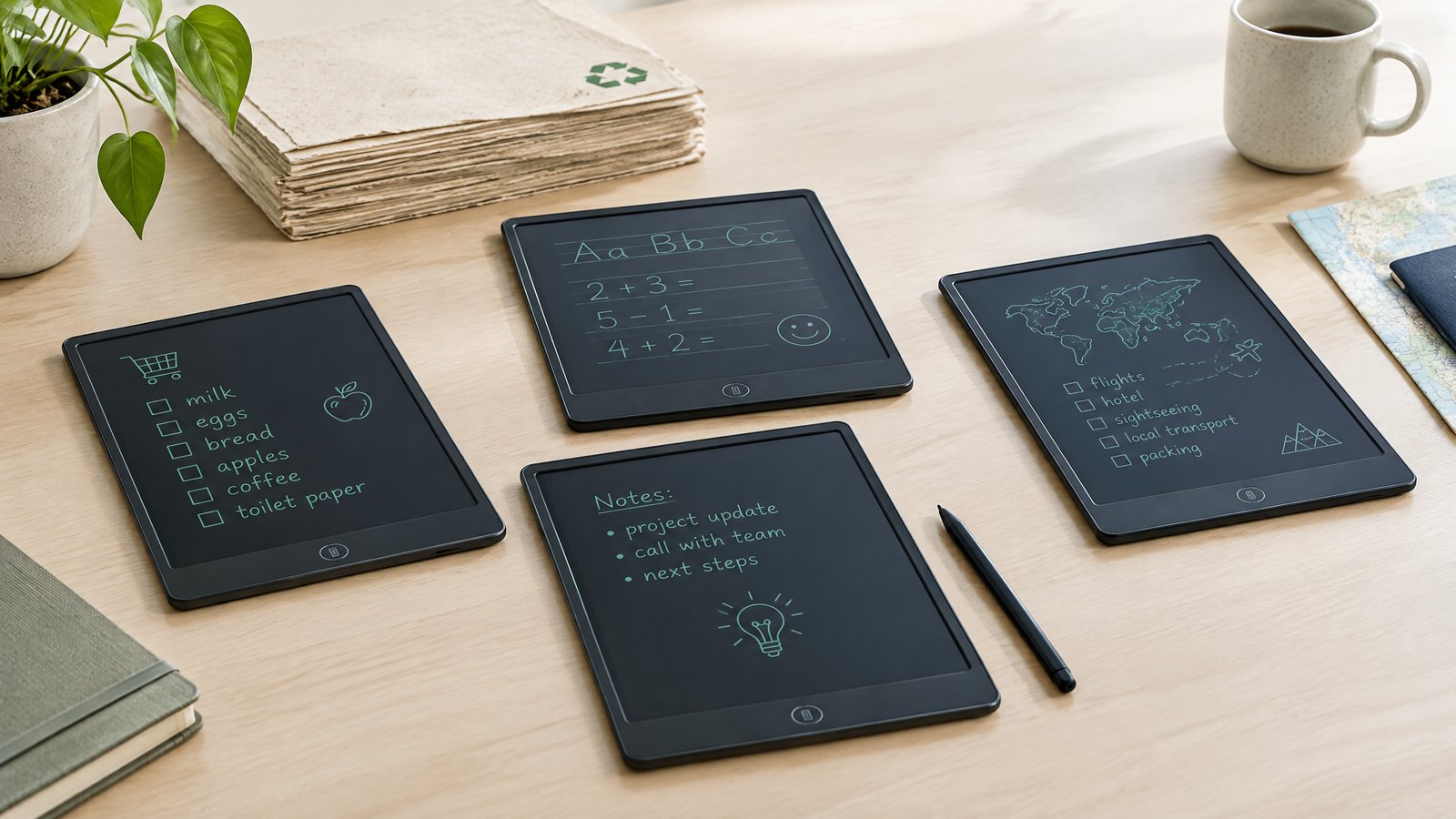
Most basic models are not digital notebooks: they normally do not save pages, sync to a phone, send files, or support selective erasing. Clearing commonly removes the whole screen. State those limits in packaging and listings. As an LCD writing tablet alternative to paper, it works best for temporary tasks—shopping lists, handwriting practice, travel activities, scratch notes, or quick calculations—not archival records, collaborative files, or content that must be retained.
Benefits and trade-offs for a B2B range
- Repeatable and simple: a stylus plus erase control supports quick, quiet use with little setup.
- Merchandisable: frame color, shape, stylus retention, logo treatment, inserts, and packaging can differentiate a range.
- Portable: thin formats can work for retail, travel, events, and replenishment programs, subject to packaging and freight review.
- Variable display experience: contrast and writing appearance vary by screen construction and ambient light; approve a physical sample.
- Not a blanket environmental claim: the product still contains plastic, electronics, and often a battery, so battery and end-of-life planning matter.
The procurement rule is simple: choose a reusable LCD device when erasable writing is the intended behavior, then specify and market it honestly.
2. Buyer context: turn a product idea into a sourcing brief
A reference image and target price do not create a quote-ready request. US, UK, German, and French buyers should give an OEM/ODM supplier a brief that identifies the actual product, intended user, commercial route, and market responsible party. A promotional giveaway, classroom aid, toy-oriented line, and desk accessory may use similar display technology but need different packaging, claims, battery decisions, and market review.
Record the intended age range and whether the item is marketed as a toy or as a general-use writing accessory. “For kids” is not enough. Product positioning affects the safety and documentation discussion, as well as artwork and customer expectations.
The brief should answer these questions
| Brief area | Questions to settle before quotation | Why it matters |
|---|---|---|
| Market and channel | Which countries, retailers, and sales channels will receive the goods? | Rules, language, labeling, waste, and importer duties vary. |
| Product role and user | Toy, learning aid, gift, memo tool, or promotional item? What age and handling environment? | Shapes claims, design, and safety review. |
| Core format | Required display size, body shape, stylus layout, lock, and battery approach? | Prevents a quote based on a visually similar but unsuitable model. |
| Brand presentation | Logo method, colors, artwork, languages, inserts, barcode, and pack style? | Avoids late artwork and packing changes. |
| Order framework | Quantity, delivery date, Incoterm, destination, and inspection approach? | Enables feasibility and landed-cost planning. |
Do not make unit price the only comparison. Custom colors, molds, print setup, packaging, documentation, inspection, carton dimensions, and payment terms affect total cost and launch risk. Ask for a quotation that separates product configuration, customization, and packaging.
3. Product definitions: know what you are actually buying
Retail labels overlap. The procurement distinction is functional: a basic erase-and-rewrite device is not an e-ink notebook, consumer tablet, or digitizing pen tablet.
An LCD memo board is generally a low-power surface for transient notes, simple drawings, reminders, and arithmetic. A pressure-responsive liquid-crystal writing film changes appearance when written on, while an electrical action clears it. The visible image may remain without continuous power, although construction varies by model.
An LCD writing board is the broader physical-product label for compact writing/drawing devices. It should not imply cloud storage, handwriting recognition, backlighting, or a full-color digital display unless the quoted model actually has that capability. An erase-lock switch usually prevents accidental clearing; it is not a security, childproofing, archival, or backup feature.
| Product type | Normal job | Key claim limit |
|---|---|---|
| Basic LCD writing device | Temporary writing or drawing | Usually no saved files, connectivity, or selective erase |
| E-ink note device | Long-form notes and reading | More complex and costly |
| Consumer tablet | Apps and digital productivity | Needs charging, software support, and privacy considerations |
| Paper notebook | Permanent handwritten record | Uses consumable pages and physical storage |
A stylus slot or tether is also a functional choice. It can reduce lost styluses, but the attachment and thin molded features must suit expected handling and the intended age.
4. Selection criteria: choose features around the use case
Choose the configuration that makes the intended interaction clear, withstands expected handling, and can be supplied consistently—not simply the biggest screen or most decorative feature set.
Screen size, usability, and portability
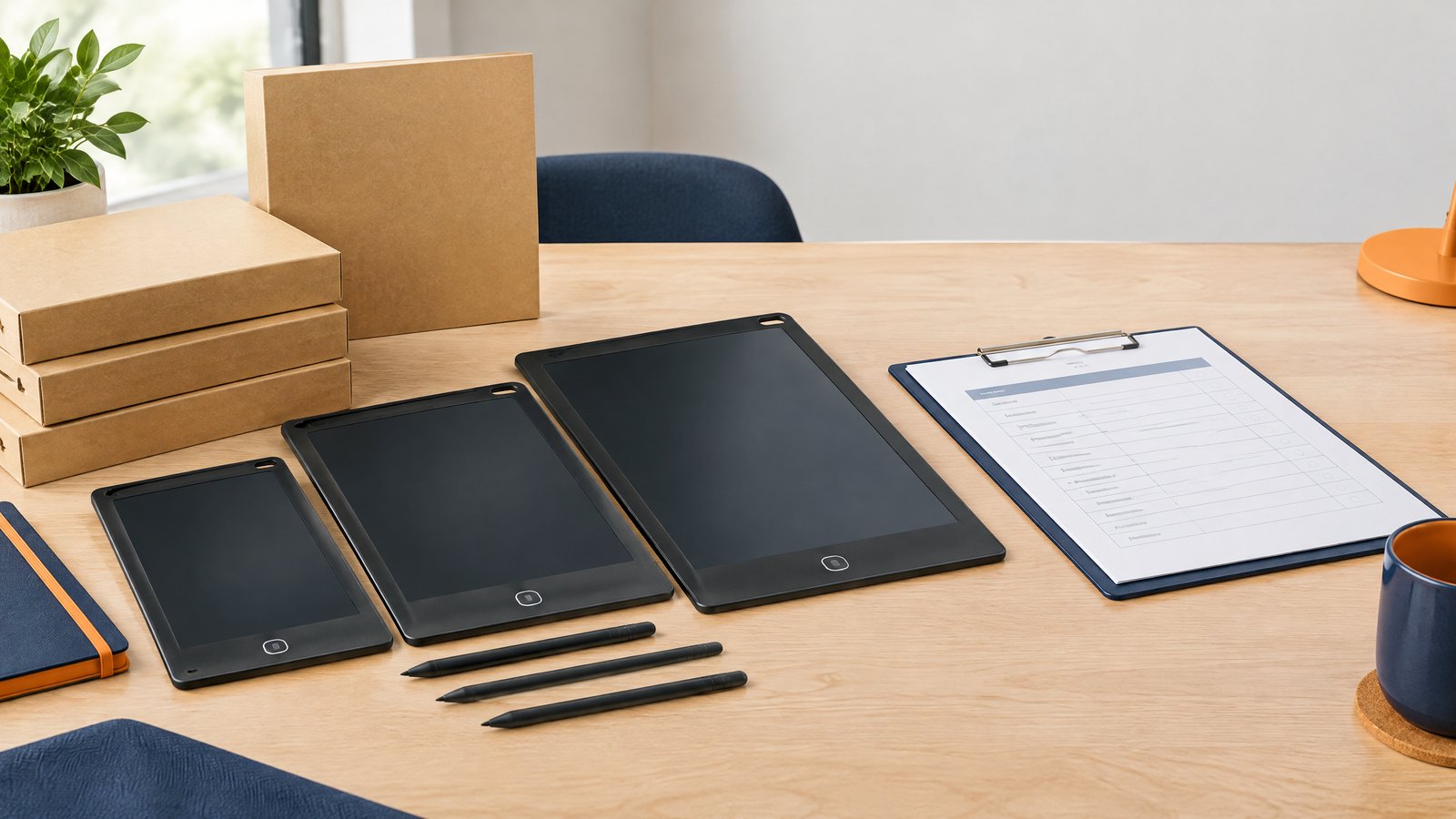
A small portable writing tablet works for shopping lists, travel packs, reception counters, and giveaways. A larger format gives more writing area for handwriting, maths, or family messages, but can increase unit weight, protective-packaging needs, carton volume, and screen-damage exposure. Compare usable writing area, overall dimensions, thickness, weight, retail pack, and master-carton data together. Confirm whether a quoted “10-inch” figure means diagonal display, whole product, or package.
Display, construction, and controls
Approve screen appearance in ordinary indoor light. Compare writing color or appearance, contrast, front layer, frame material, edge finish, screen fixation, and body flex. Online images should show a realistic reflective surface, not imply a luminous or backlit screen.
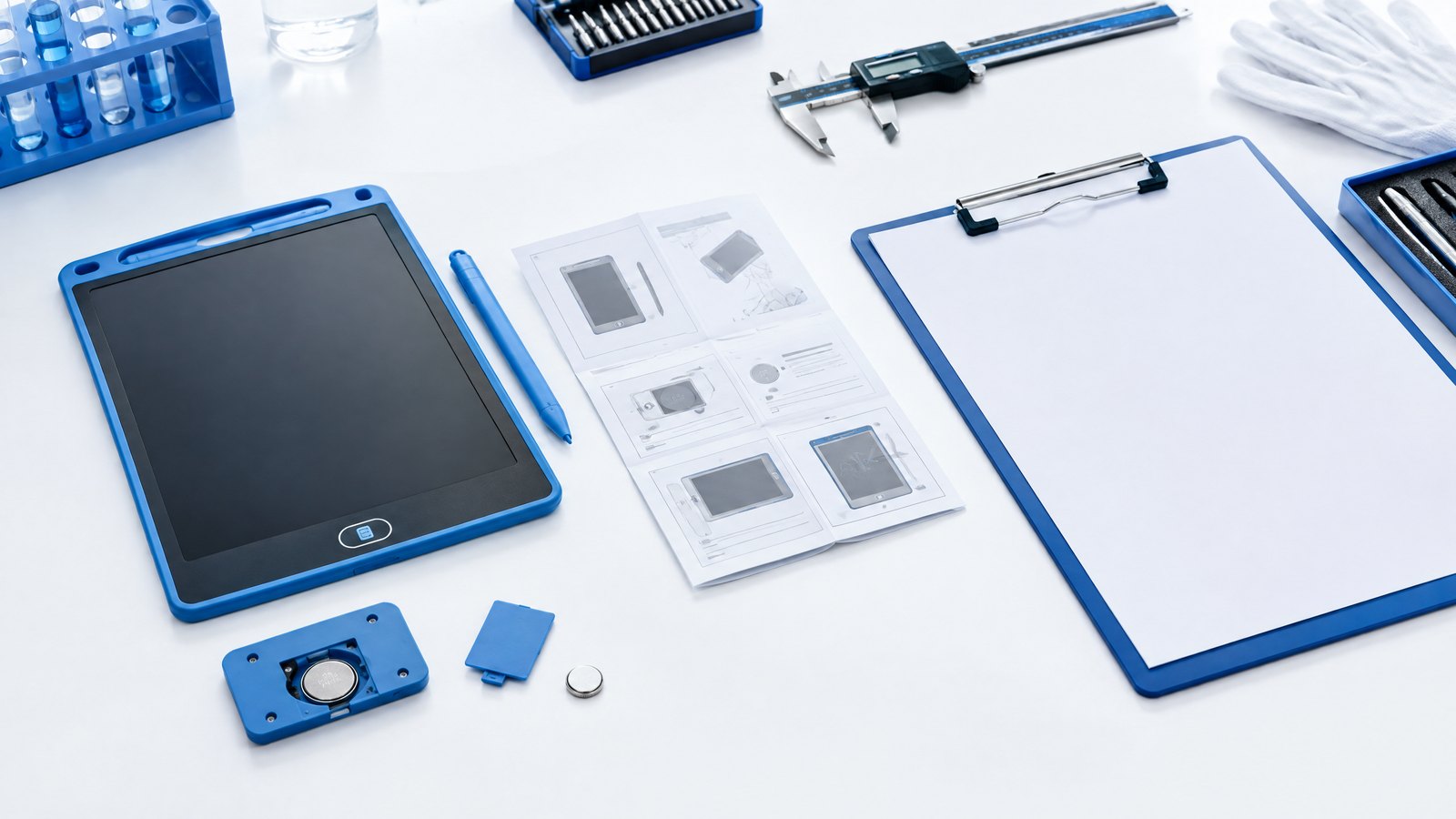
Specify erase-button position and feel, lock-switch location, icons, stylus attachment, battery-compartment design, and included-battery status. Clear control cues can reduce returns caused by a lock left on. The supplier should identify the exact battery type and compartment architecture in writing; do not infer either from a photograph. Avoid unsubstantiated “long battery life” claims.
Customization and range architecture
Brand colors, bezel or back logos, localized packaging, sleeves, and age-appropriate inserts can create a coherent assortment. Avoid introducing a new mold, screen change, print method, accessory set, multilingual box, and compressed timeline simultaneously. First approve the base product, then artwork and pack details, then release against a signed reference.
5. Technical specifications: request a configuration sheet, not assumptions
A purchase order should refer to a model-specific specification sheet. Generic catalog data are a starting point only: a change to screen, frame, lock, battery, stylus, or package can create a different configuration. Confirm specifications against the final quotation and approved sample.
| Category | Detail to confirm |
|---|---|
| Identity | Supplier model code, revision, photos or drawing |
| Display/product | Nominal size, usable area, screen appearance, L × W × H, net weight, materials, color reference |
| Function/power | Erase and lock behavior, stylus, activation instructions, battery type/quantity/inclusion, compartment design |
| Packaging/logistics | Unit pack, multilingual inserts, barcode, pack-out, carton dimensions and weights |
| Quality | Approved-sample revision, cosmetic standard, inspection criteria |
Functional expectations to test
Test the exact sample configuration before approving production. Write down checks for writing response, erase activation, lock engagement, stylus fit, screen appearance, button alignment, battery-compartment operation, print adhesion where relevant, and packaging legibility. Test more than one unit where practical.
Agree how natural display effects will be judged. An LCD surface may show marks or residual effects differently from ink. Define acceptable and unacceptable appearance in plain language, supported by approved photos when useful. Do not copy unverified life-cycle counts, impact ratings, operating ranges, material claims, or “non-toxic” statements from marketplace listings. The final quote, artwork, sample, and evidence review govern.
6. Factory and quality evidence: make approval visible and auditable
Buyers need evidence that a concept sample can become repeatable production. Look for a process: controlled sample approval, relevant component/assembly checks, defined function checks, packaging verification, finished-goods inspection, and an escalation path. Do not ask a factory to promise zero defects; ask how it controls foreseeable risks.
A sensible OEM/ODM approval workflow
- Quote review: align model, customization, intended market, quantity, packaging, terms, and open compliance questions.
- Pre-production sample: confirm form, color, display appearance, logo, stylus, instructions, and packaging mock-up. Track changes by revision.
- Sample approval: retain a signed approval record or sample card identifying the model/revision and any exceptions.
- Assembly and function checks: inspect screen seating, button and lock action, printing, battery compartment, and stylus retention. For screen/erase testing, agree the method and sampling level; a generic statement does not prove every unit was tested.
- Packaging checks: compare artwork, language, warnings, barcode, count, accessories, carton labels, and carton integrity with the approved master.
- Pre-shipment inspection: inspect finished goods against the agreed AQL or buyer plan, approved sample, and packing list; record material findings and corrective action.
These are realistic checkpoints, not claims about any individual factory. Ask LcdWritingTablet or another supplier to describe its actual control plan for the quoted model and share evidence it can legitimately provide. Book an independent inspection early enough for corrective action before shipment.
Questions that reveal process maturity
- Can the supplier identify the exact revision used for sample, artwork, and production?
- What screen/erase check occurs, when, and how is it recorded?
- How are color, language-insert, and barcode mix-ups prevented?
- Who owns containment, sorting, rework approval, and root-cause response if inspection finds a recurring defect?
Mid-article CTA: Planning a branded or wholesale program? Send LcdWritingTablet your market, intended age/use, preferred screen size, quantity, packaging needs, and launch date. Request a model-specific quotation and sample plan rather than choosing from a generic image.
7. Compliance and safety considerations: map the product to its market
Compliance is both a buyer responsibility and a supplier conversation. The route depends on destination, electrical design, toy/children’s-product status, battery configuration, claims, packaging, and the economic operator placing the goods on the market. This section identifies questions to investigate; it neither certifies a product nor declares any model compliant.
Classification comes first
For a child-directed item, determine whether it is designed, made, or marketed as a plaything. That may influence the toy-safety framework and testing strategy. IEC describes IEC 62115 as addressing electrical-safety aspects of electric toys with a function dependent on electricity, including battery-powered products. It does not replace checking the current national or regional requirements and classification of the final item.
In the United States, children’s products subject to CPSC-enforced requirements may need a Children’s Product Certificate; general-use products can require a General Certificate of Conformity. Ask a qualified compliance adviser, laboratory, or responsible economic operator which rules and documents apply. Never add a certification mark or statement without its underlying basis.
Battery, materials, and labeling
For a product containing or designed to use a button or coin cell, review compartment access, warning placement, instructions, packaging treatment, and applicable documentation before production. CPSC guidance addresses accessibility, warnings, and certification for relevant consumer products; verify current requirements and dates against the final battery configuration.
For UK and EU distribution, confirm current battery, electrical-equipment, toy, chemical, packaging, recycling, labeling, and market-surveillance duties with the responsible importer or local adviser. An EU route does not automatically cover Great Britain, and Germany and France can impose national producer-responsibility, registration, language, or packaging duties.
The European Commission states that RoHS restricts specified hazardous substances in electrical and electronic equipment and that WEEE addresses separate collection and proper treatment of e-waste. Determine the buyer’s producer/importer and local registration obligations instead of relying on a symbol or supplier statement alone. Review product and pack identification, responsible-party details where applicable, warnings, age grading, battery/disposal information, origin marking where required, and translated instructions before artwork release.
Use specific, supportable claims. “Reusable for temporary writing” is more credible than unqualified “zero waste,” “eco-friendly,” or “replaces paper forever.”
8. Application examples: match the configuration to the moment of use
Design the range around a real scenario, rather than a vague “fun and learning” promise.
Home, travel, and children’s activity retail
An electronic notepad for kids can support doodling, letter and number practice, prompts, waiting-time activities, and travel. Prioritize manageable size, a comfortable stylus, clear erase/lock instructions, protective packaging, intended-age positioning, and market-appropriate safety review. Show realistic use and explain that drawings are cleared, not saved.
A kids writing board line can differ by size, colorway, or activity-card theme. Adding magnets, clips, games, or multiple accessories may change safety, packaging, and age implications; reassess them rather than treating a bundle as a cosmetic change.
Household, education, office, and events
For household lists, hospitality reminders, or reception notes, a neutral frame and retained stylus may matter more than playful graphics. Do not use it as a permanent, private, or regulated record.
For schools and tutoring kits, specify labeling, storage, stylus replacement, cleaning instructions, battery management, and whether the device is an activity aid rather than an assessment record. Avoid unsupported learning-outcome claims.
For offices and event programs, a branded desk scratchpad or interactive giveaway can work well when delivery timing, color match, logo legibility, and pack-out are controlled. Approve a physical branded sample and print-position drawing before volume production.
In care or communication settings, limit use to non-confidential visual prompts or simple reminders unless a suitable approved process governs sensitive or persistent information.
9. Buyer checklist: a release gate before production and shipment
Use this compact release gate. A “yes” should mean evidence is in the purchase file, not merely that the item was mentioned in a sales call.
Product and commercial scope
- Final model code, revision, configuration, intended user/age, markets, and channel are recorded.
- Size, usable writing area, material, color, stylus, erase/lock, battery, logo, packaging, barcode, and carton pack-out are approved.
- Quantity, price basis, Incoterm, payment terms, ship window, destination, and responsible parties are documented.
Quality and production control
- A pre-production sample and approved exceptions are tied to a revision.
- Cosmetic criteria and screen/erase/lock functional checks are agreed.
- Packaging copy, language, warnings, accessories, barcode, and carton marks match the approved master.
- The pre-shipment inspection plan, release authority, and corrective-action path are agreed.
Compliance and documentation
- Market obligations are assessed for the final classification and configuration.
- Battery access, warnings, instructions, and packaging treatment are reviewed.
- Applicable reports, declarations/certificates, technical documents, and responsible-party information are independently reviewed as appropriate.
- RoHS, WEEE/producer responsibility, labeling/language, local registrations, and evidence for claims have owners.
10. FAQ
Are reusable LCD writing devices a replacement for notebooks?
They can replace selected temporary-paper tasks such as a list, child’s doodle, quick calculation, or desk message. They are unsuitable where users need saved pages, signatures, sharing, search, or an audit trail. Describe the use case rather than claiming universal substitution.
Do these products need charging?
Many basic models use a small battery principally to clear the display, rather than a rechargeable system, but designs vary. Confirm the exact battery, included-battery status, erase mechanism, and instructions in the final quotation.
Can users erase one word or recover a cleared drawing?
Basic models commonly clear the whole screen and do not store the previous image. Source another technology if selective erase, saving, or recovery is essential.
What should an OEM/ODM buyer send for an accurate quote?
Provide markets, intended use/age, target size, quantity, color/logo treatment, unit packaging, language needs, delivery destination/date, and any compliance or inspection conditions. A reference image should supplement a written specification.
Is a screen lock a safety feature?
No. It usually prevents accidental clearing only; it does not secure data, establish child safety, or control battery access.
What evidence is reasonable before release?
Keep the approved sample/revision, final artwork, packing specification, functional and cosmetic criteria, and pre-shipment inspection record. For a new supplier or custom project, consider independent inspection and a documented response to material findings.
Can we call it eco-friendly because it is reusable?
Not automatically. Make precise, substantiated statements about repeated temporary use and account for battery and electronics end-of-life responsibilities.
11. Conclusion and CTA: source for the real use case
Reusable LCD writing products earn their place when buyers specify them as durable tools for temporary marks—not as miniature computers or permanent notebooks. The commercial opportunity lies in matching size, construction, controls, branding, packaging, and documentation to a defined user and market. The sourcing discipline lies in approving the exact configuration, validating functional behavior, reviewing compliance responsibilities, and inspecting the final packed goods against the same reference.
For US, UK, German, and French buying programs, start with a market-aware request for quotation. Include intended use and age, final destination, quantity, size, branding, package copy, battery preference, and desired evidence. Treat every catalog image as a starting point and every specification as provisional until it is confirmed on the quoted model and approved sample.
End CTA: Contact LcdWritingTablet with your procurement brief to discuss an OEM/ODM LCD writing-device configuration, sample approval route, packaging requirements, and pre-shipment inspection expectations. Ask for a written, model-specific quotation before making performance, safety, or compliance claims.
Sources and verification note
This guide uses public references as orientation only. Requirements change and final applicability depends on the product and market. Verify the current texts and seek qualified advice before sale:
- U.S. Consumer Product Safety Commission: Button Cell and Coin Battery Business Guidance — U.S. battery-access, warning, and certification context.
- International Electrotechnical Commission: IEC 62115 — scope for safety of electric toys.
- European Commission: RoHS Directive — hazardous-substance restrictions for EEE.
- European Commission: Waste Electrical and Electronic Equipment (WEEE) — collection and treatment framework for e-waste.
Image plan
| # | Purpose | Insertion position | English caption | ALT text | English AI image prompt |
|---|---|---|---|---|---|
| 1 | Establish the product’s temporary-note use without implying app connectivity. | Below the introduction | “A reusable LCD writing device for temporary notes, sketches, and reminders.” | “Reusable LCD writing device on a tidy desk with handwritten temporary notes.” | “Photorealistic B2B product lifestyle image, slim black reusable LCD writing tablet on a clean light-wood desk, stylus beside it, simple handwritten grocery list and meeting notes visible, neutral daylight, no logos, no app interface, no readable brand names, realistic reflective screen, premium ecommerce composition.” |
| 2 | Help buyers compare configurations by size and use. | In Section 4 after “Screen size, usability, and portability” | “Screen size and form factor should follow the intended use and packaging plan.” | “Three unbranded LCD writing devices in small, medium, and large sizes beside a ruler and retail packaging mockups.” | “Professional product comparison photograph for a B2B buyer guide: three unbranded LCD writing tablets in small medium and large formats arranged front-facing on a neutral gray studio background, styluses included, a simple unmarked ruler for scale and plain packaging boxes, realistic materials, no text overlays, no logos.” |
| 3 | Visualize responsible quality controls instead of making unsupported performance claims. | In Section 6 beside the approval workflow | “Sample approval, function checks, and packaging verification create a traceable release process.” | “Quality inspector checking an LCD writing device, erase function, and packaging against an approved sample.” | “Documentary-style factory quality-control scene, gloved inspector at a clean workbench comparing an unbranded LCD writing tablet to an approved sample sheet, testing erase button and screen response, plain packaging cartons nearby, bright realistic factory lighting, no company logos, no certifications displayed, professional B2B image.” |
| 4 | Support the children’s retail use case with age-appropriate, non-branded imagery. | In Section 8 under “Home, travel, and children’s activity retail” | “Choose child-oriented features and packaging only after confirming the intended age and market requirements.” | “Child using an unbranded LCD drawing tablet at a family travel table with adult supervision.” | “Warm, realistic lifestyle photograph for a buyer guide: school-age child using an unbranded colorful LCD writing board to draw at a travel table, parent present in the background, safe tidy setting, no recognizable characters, no logos, no text, natural daylight, product visible but not exaggerated.” |
Continue with the next sourcing decision.
Use these internal links to compare products, check common buyer questions, review compliance preparation, or send your requirements to the factory.
Turn this sourcing plan into a product brief.
Share your target market, product requirements, packaging preference and estimated volume for a practical OEM / ODM discussion.