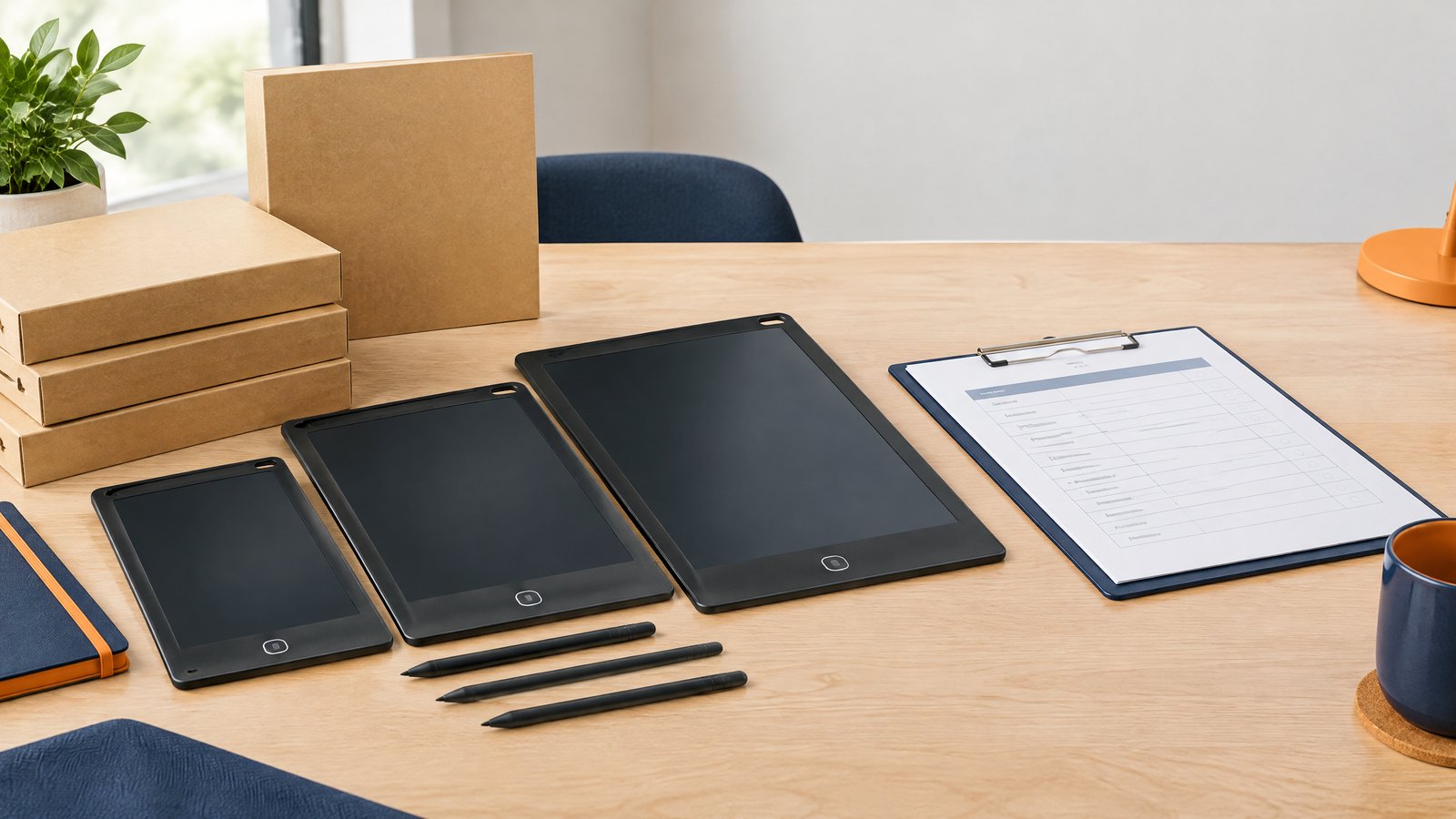
This guide provides a practical B2B decision framework. Final specifications, market obligations, testing scope, labels, packaging and shipment requirements must be confirmed for the exact finished SKU and destination.
Direct answer: Schools and learning programs use LCD writing tablets most effectively when they buy them as a defined teaching tool rather than as a generic giveaway. Start with one repeatable activity—such as phonics practice, number work, exit tickets, or quiet individual response—then specify the screen, erase method, stylus retention, battery design, age range, packaging, and acceptance tests that support it. For a B2B order, the lowest unit price is not the best decision if samples are hard to erase, styluses detach, labels are incomplete, or cartons fail the chosen shipping route. A controlled sample, written specification, documented checks, and a small pilot help a school buyer turn a reusable writing surface into a practical classroom system.
2. Direct-answer introduction
LCD writing tablets for schools are best treated as single-purpose, reusable practice tools. They can reduce the friction of handing out worksheets for short writing tasks, but they are not automatically a replacement for paper records, a learning-management system, or a full digital tablet. A buyer should first define the teaching moment, the person who manages the devices, the age of the learners, and the route to market. Then the buyer can select a simple model whose physical design and documentation match that use.
For example, a teacher-led classroom may prioritise an easy-to-see display, a clearly located erase control, attached stylus storage, and unit identification. A take-home literacy program may instead prioritise protective packaging, plain-language instructions, age-appropriate warnings, and a method to replenish or replace devices. A distributor may need retail-ready barcodes, multilingual artwork, and verifiable compliance records. These are different buying cases even when the tablet body looks similar.
This guide is written for overseas institutional and trade buyers sourcing from an OEM/ODM manufacturer. It explains a practical purchasing process, not legal advice. Whether an item is a toy, children’s product, electrical/electronic equipment, wireless device, or a general-use instructional aid depends on its design, claims, marketing, age grading, destination market, and the responsible economic operator. Confirm the final classification and obligations for the exact finished product before placing it on a market.
3. Who this is for
This guide is for schools, school groups, after-school providers, non-profit learning programs, education distributors, importers, private-label brands, and curriculum publishers that need a repeatable procurement process. It is particularly useful where a buyer is sourcing an OEM/ODM model, creating custom artwork, or building a class set rather than buying one consumer unit.
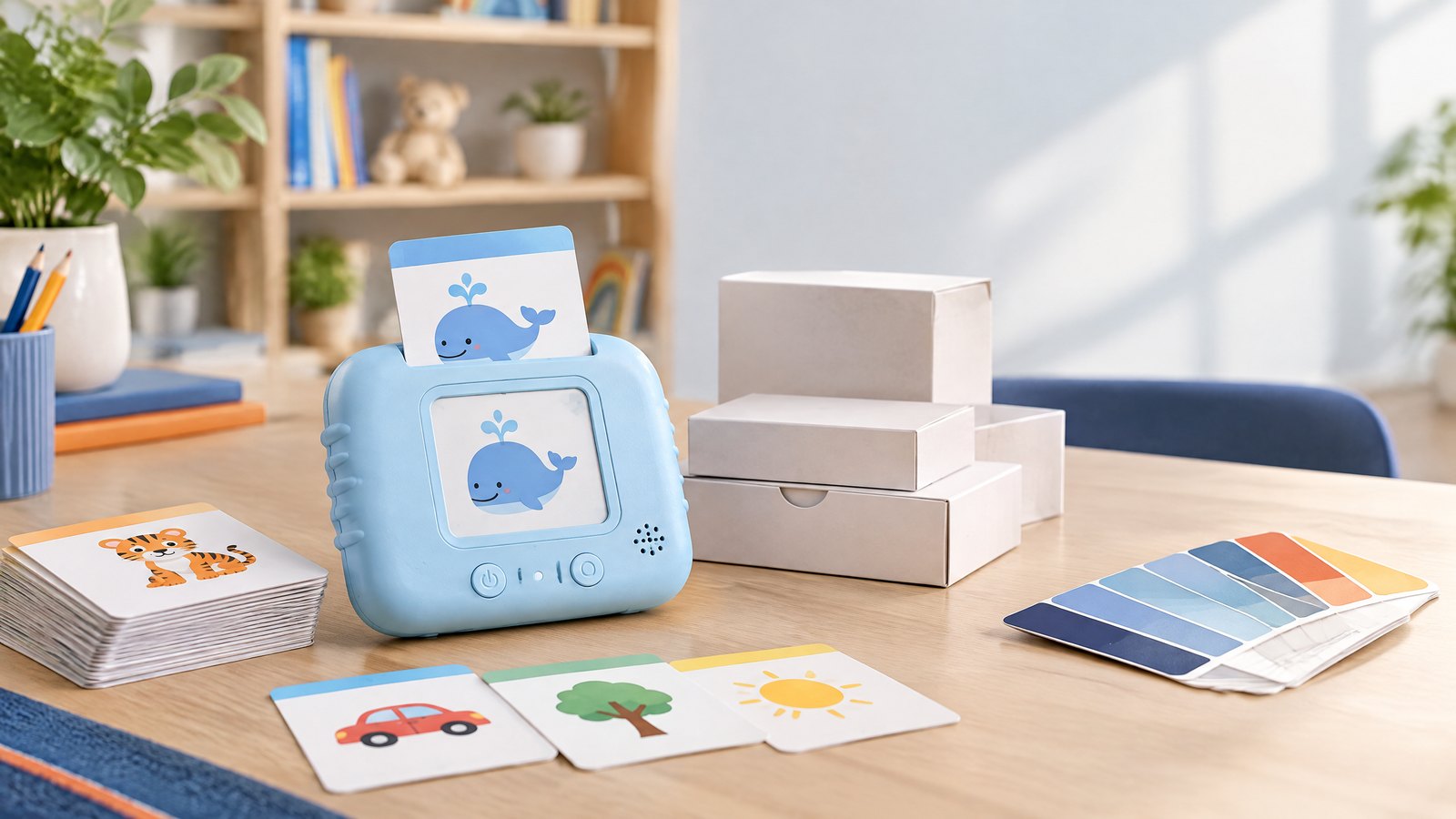
An LCD tablet can sit beside talking flashcard learning machines for audio prompts or smart electronic badges for program events, but evidence for one product does not automatically cover another. Audio devices can add speakers, rechargeable cells, stored content, or radio functions. Badges can add charging, display, connectivity, or data-handling issues. Keep each finished SKU under its own model/revision, bill of materials, artwork, evidence file, and market review.
Schools should first assign ownership. Who issues, stores, counts, and quarantines the devices? Who handles missing styluses or depleted batteries? A distributor must convert “durable, child-friendly writing board” into requirements for age range, usable writing area, erase behaviour, power, language, contents, labels, and cartons.
Public-sector and grant-funded buyers should preserve an approval trail. The UK Department for Education advises schools to identify the purchase and anticipated spend before selecting an allowed procurement route; approved options can include pre-checked suppliers and pre-agreed terms. 1 Local rules vary, but documenting the need, supplier selection basis, acceptance criteria, and contract owner is useful discipline.
4. Buyer decision framework: decide the learning job before the product
The strongest starting point is a concise use-case statement: one learner group, one activity, one setting, and one success condition. “Learners practise letter forms during a 10-minute station activity; the teacher must see each response at arm’s length and reset the board between turns” is more usable than “We need tablets for education.”
An LCD writing tablet may display handwriting or drawings until cleared, without an app, account, internet connection, camera, or persistent learner record. That simplicity can reduce classroom setup. It also means the buyer should not promise file storage, analytics, cloud synchronisation, or accessibility features that the selected model does not provide. If the program needs saved work, audio feedback, managed accounts, or student data, select an architecture that supports those functions and assess privacy, cybersecurity, and radio requirements separately.
Use five decision gates. First, define the pedagogical task. Letter formation, spelling, mental maths, and quick responses need different product traits. Decide whether learners need a blank surface, template, colour distinction, or erase lock; added features bring cost and failure modes.
Second, define the operating environment. Record handling frequency, supervision, storage, cleaning method, likely drops, and whether batteries may be changed on site. For younger learners, review small parts, battery access, cords, and age grading.
Third, control the configuration. Identify model, display/writing area, case, stylus, erase/lock control, battery or charging interface, contents, packaging, artwork revision, and carton pack count. This is the configuration that must be sampled, tested, inspected, and shipped.
Fourth, map the market. State countries of sale, channel, intended age, claims, and responsible party. In the EU, products classified as toys must meet Toy Safety Directive requirements; the Commission identifies physical/mechanical, flammability, chemical, electrical, hygiene, and radioactivity risks, and says EU toys carry CE marking. 2 Not every writing tablet is a toy, and a CE mark alone does not prove conformity. Assess the finished SKU and claims.
Fifth, choose evidence before production. Match bills of materials, reports where applicable, declarations where applicable, battery information, labels, instructions, packaging, and production records to the final configuration. A report for a similar product, different material, obsolete battery, or old artwork may not support the delivered item.
| Teaching or program use | Product traits to specify | Sample verification | Buyer caution |
|---|---|---|---|
| Phonics, letter formation, spelling | Visible stroke contrast, usable stylus, template compatibility, easy reset | Readability in classroom light; child and adult can write and clear consistently | Do not claim handwriting recognition or stored progress unless it exists. |
| Mental maths, quick responses, exit tickets | Clear work area, obvious erase action, durable case, optional lock | Teacher can read the response at the intended distance | Plan how a response is recorded if it must be retained. |
| Learning stations or quiet activities | Retained stylus, numbered units, simple instructions, storage tray or sleeve | Stylus retention, repeated handling, return/count routine | A low-cost stylus is expensive if it causes incomplete sets. |
| Take-home or community kits | Protective packaging, age grading, care guidance, replacement process | Final sealed pack, contents, label readability, handling simulation | Home use shifts maintenance and safety communication to the end user. |
| Multi-product bundle | Common branding; separate model IDs, manuals, and evidence files | Contents, artwork, function, and traceability for each SKU | Keep flashcards and badges controlled separately even in one kit. |
The decision is ready when the school can explain both what it is purchasing and how success will be observed: a teacher can distribute, use, reset, count, and return a complete set in one lesson.
5. Comparison and specification table: build a purchase-ready brief
A specification should separate must-have acceptance points from nice-to-have preferences. This avoids a quotation that is technically comparable only in appearance. The supplier should confirm which fields are standard, configurable, subject to minimum-order constraints, or unavailable. If custom colours, logo printing, packaging, battery changes, or new tooling are requested, ask for the change to be identified by revision and reflected in the approved sample.
| Specification area | Buyer question | Purchase-ready requirement or testable acceptance point | Why it matters in schools |
|---|---|---|---|
| Intended use and age | Who uses it, under what level of supervision? | State use case, age grade, market, and whether the item is child-directed or general-use. | It informs design review, instructions, claims, and applicable obligations. |
| Display and writing area | Can the intended learner produce readable work? | Define usable area, contrast expectation, viewing environment, and whether ruled/template use is needed. | A nominal screen size does not confirm classroom visibility. |
| Write/erase behaviour | Is clearing obvious and repeatable? | Demonstrate writing and erase action on every sample; define any lock/unlock behaviour and instructions. | Confusing erase controls waste teaching time and lead to avoidable returns. |
| Stylus and small components | Will the writing tool stay with the device? | Specify stylus geometry, attachment/tether concept if used, storage location, and small-part review. | Missing or loose accessories can disrupt a full class set. |
| Case and finish | Will the unit tolerate routine handling? | State material, colour, logo location, visible surface standard, edge/part fit, and cleaning guidance. | Cosmetic consistency supports inventory control and a professional program presentation. |
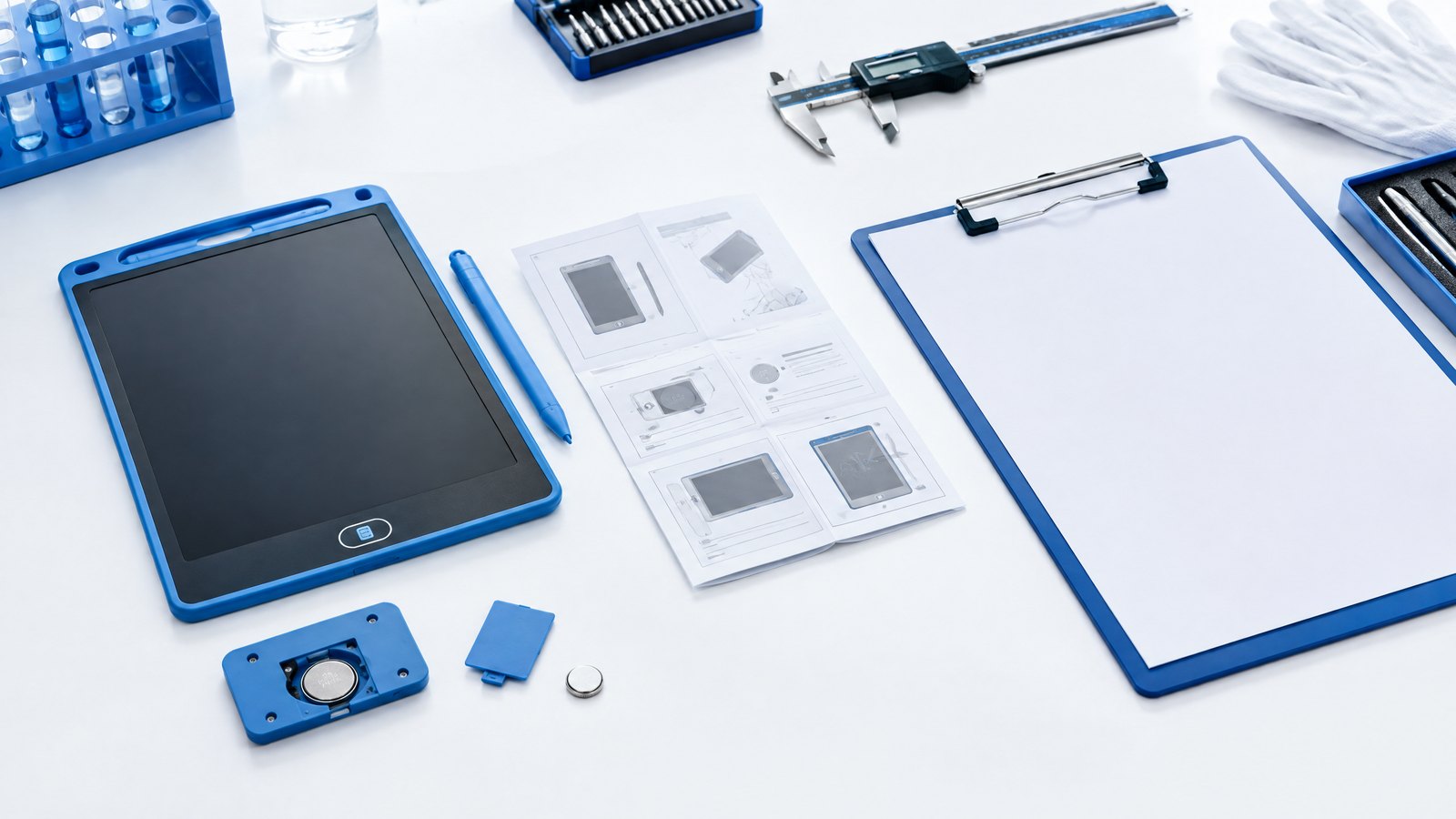
| Power and battery | What power source is installed and who maintains it? | Name battery chemistry/cell type, access method, replacement instructions, battery labeling, or charging method. | Battery choice affects safety review, transport paperwork, and school maintenance. |
| Electronics and connectivity | Does the model transmit or only display locally? | State radio functions as “none” or list them precisely; identify any charging/data port. | Wireless functions can change regulatory, privacy, and IT requirements. |
| Branding and artwork | What will a school or end user see? | Approve logo, colours, model number, warnings, importer/responsible-party details where required, manual, and carton marks as controlled artwork. | Artwork can carry safety and traceability information, not just branding. |
| Packaging and logistics | How will complete units arrive? | Define individual pack, inner pack, master carton, pack count, gross/net weight fields, carton markings, and pallet approach if applicable. | Carton configuration affects counting, damage control, warehousing, and freight quotes. |
| Traceability and documents | Can the buyer connect a unit to its evidence? | Use a model/revision identifier and production/lot reference; request a document index tied to the finished SKU. | Evidence becomes difficult to defend when it cannot be linked to the delivered configuration. |
For powered devices, do not accept “battery compliant” as an answer. Ask the supplier to identify the exact cell or battery in the sample and production unit, its test-summary availability where relevant, and the proposed transport classification. IATA’s current guidance states that, except for button cells installed in equipment, manufacturers and subsequent distributors of lithium cells, batteries, and equipment powered by them manufactured after 30 June 2003 must make the UN Manual of Tests and Criteria 38.3 test summary available. It also notes that a URL or QR code can be used rather than a paper copy with every consignment. 3 A freight forwarder or dangerous-goods specialist should confirm the shipping method and current documentation for the actual consignment.
If the model uses a replaceable button or coin cell and will enter the U.S. consumer market, build that point into the design review early. CPSC guidance describes requirements that may include secured battery compartments, warnings on packaging, product where practicable, and instructions; it also points to different treatment for qualifying toys complying with the relevant ASTM F963 battery provisions. 4 The details matter, so avoid treating a generic battery statement as a market-specific solution.
6. Buyer checklist: questions to close before a purchase order
Use this as a gate. A “no” or “unknown” should trigger clarification before production, not an informal workaround after cartons are printed.
- Learning and configuration: Is there a named activity, age range, supervision assumption, owner, model/revision, battery configuration, contents list, artwork revision, and packaging revision?
- Claims and sample: Do website, carton, manual, and sales claims match the actual functions? Has the buyer checked the approved sample under representative lighting and handling conditions and recorded its configuration?
- Market evidence: Has a competent party reviewed classification, age, market, claims, and documents? For U.S. children’s products where applicable, CPSC says a CPC is based on third-party, CPSC-accepted laboratory testing when required, and that the CPC and supporting reports must be in English. 5
- Electrical and radio review: For EU electrical/electronic products, has the responsible party assessed relevant legislation rather than requested a generic “CE certificate”? RoHS restricts ten substances in electrical and electronic equipment unless a specific exclusion applies. 6 If radio functions are present, review final hardware for every market; the FCC distinguishes intentional-radiator certification from SDoC procedures generally used for unintentional radiators. 7
- Artwork and receipt: Are required warnings, language, identifiers, care directions, and economic-operator details approved? Are sampling, functional checks, defect definitions, carton marks, report format, and rework authority agreed?
- End of life: Has the responsible operator checked relevant waste, registration, marking, reporting, or take-back duties? EU WEEE rules promote separate collection and proper treatment, but implementation is market-specific. 8
Mid-article CTA: Send your intended use, destination market, target age range, expected quantity, branding brief, and delivery window to info@lcdwritingtablet.com. Request a sample-and-specification review so the model, packaging, and documentation questions can be aligned before bulk production.
7. Sample, testing, factory, and shipment inspection workflow
A dependable school order uses staged controls. These checks do not replace legal conformity assessment or laboratory testing; they catch usability, configuration, workmanship, and packing errors while correction is still practical.
Gate 1: Brief and quotation alignment. Supply a one-page product requirement document and separate artwork. The quotation should identify model, options, contents, quantity, price basis, sample status, tooling or setup items if any, packaging assumption, lead-time assumption, and exclusions. List destination markets and ask what evidence is available for the final configuration.
Gate 2: Functional and visual sample approval. Use the proposed configuration, not a catalogue image. Simulate the classroom routine: unpack, issue, write, clear repeatedly, return to storage, and count a set. Check visibility, case fit, stylus usability, controls, print, labels, language, and contents. Photograph approved points and log the model, battery, artwork revision, and date. Approve a revised sample or change notice if anything changes.
Gate 3: Evidence and in-process review. Create a document index tied to the finished model/revision. Review reports for product identity, date, laboratory scope, standard version, result, and differences from production. Before final packing, verify case colour, logo placement, display, stylus, battery fit/compartment, labels, and language. Check first-off printed artwork against the approved proof.
Gate 4: Pre-shipment inspection and receipt. Agree the sampling approach and acceptance criteria in advance. Verify quantity, identity, workmanship, write/erase function, lock where fitted, battery operation, stylus attachment, contents, carton marks, and pack condition. Record defects by severity with photographs. U.S. acquisition guidance offers a useful principle: inspection depth should reflect intended use, potential loss from defects, likelihood of correction, and inspection cost. 9 Release freight after the agreed report, packing list, carton data, and needed transport information are available. On receipt, count cartons, photograph damage, conduct a small functional check, and retain lot/model details.
The approved sample is the reference unit, the specification the contract language, and the inspection report the execution evidence.
8. Ordering and implementation preparation
Implementation begins before the purchase order. Give each unit or classroom set a simple identity number. A tray, pouch, or asset label helps staff issue, return, quarantine, and replace units. Do not place learner personal data on a basic writing tablet unless the program has a defined and appropriate reason.
Prepare a short teacher or operator guide showing the activity, distribution method, erase/lock steps, storage location, battery or charging owner, approved cleaning method, and route for damaged units. A visual one-page card is often more practical than a long manual, provided required safety and regulatory information remains complete and is presented as the market requires.
Choose an inventory model that fits use. A class set may use numbered tray slots. A take-home program may keep replacements and log issue date, model/revision, and reason. State support boundaries: what is replaced, who manages missing styluses, whether batteries are supplied locally, and how safety concerns are escalated. For rechargeable models, define charging equipment, supervision, location, and local electrical policy before selection.
Run a small operational pilot before scaling. Do not claim learning outcomes from this operational check. Observe distribution time, visibility, storage fit, cleaning, complete-set return, and clarity of directions. Ask whether teachers could see the work, learners understood clearing, units returned complete, and the task fitted the lesson. Use the answers to improve the kit or specification.
9. Practical applications: match the tablet to a repeatable routine
Early literacy practice. Use tablets for guided tracing, sound-to-letter response, letter-shape practice, or spelling rehearsal. Keep the task short and observable. For younger learners, select an intuitive stylus, screen boundary, and erase action. Templates should not hide mandatory labels or imply built-in software features.
Mathematics working and formative checks. Learners can show number bonds, arrays, calculation paths, or brief responses. The value is quick visibility, not permanent storage. Decide in advance how responses requiring retention will be captured.
Small-group tutoring and learning stations. A tablet can give each learner a temporary drafting surface without loose paper. Specify a complete, countable set: tablet, stylus, storage position, and reset/check routine. For mobile tutors, add protective packing and a return check between locations.
Audio-and-writing lessons and events. Talking flashcards can supply an audio prompt while the tablet receives a written response: prompt, write, show, correct, clear. Control the flashcard device separately for audio language, volume, battery, charging, and contents. Smart electronic badges can support event logistics, but their data, charging, display, and connectivity need separate implementation and market review.
Take-home kits. Pair a reusable board with a workbook when an erasable practice surface is needed. The final pack should communicate use, safe handling, storage, and contents. Test the sealed pack and master carton, not merely the bare tablet.
The stable routine is prompt, write, share or check, clear, return. Buy around that routine rather than making an unlimited promise of “digital learning.”
10. Detailed FAQ
Are LCD writing tablets for schools a replacement for student tablets or paper?
Usually not. They are reusable surfaces for temporary writing and drawing. They may reduce paper for selected short tasks, but they do not inherently provide saved files, accounts, collaborative tools, accessibility features, or assessment records. Use them for low-friction temporary responses; retain other tools where records or connected learning are needed.
What is the most important sample test for a school buyer?
Test the complete routine: unpack, issue, use, clear, collect, count, and store a representative set. This reveals visibility, stylus, erase, handling, and storage problems that a desk-side demonstration can miss. Record the approved configuration and do not assume a later custom version is identical.
Should a buyer choose a replaceable coin cell or a rechargeable model?
Choose based on the operational owner, not only component price. A replaceable-cell model needs controlled access, maintenance instructions, and market review. A rechargeable model adds charging equipment, cable management, supervision, storage, and transport considerations. Confirm the actual configuration and applicable market rules.
Do schools need CE marking, RoHS documents, an FCC filing, or a CPC?
There is no universal answer. Classification, age grade, electrical design, radio functions, market, claims, and responsible operator determine what applies. EU toy rules, EU electrical/electronic restrictions, U.S. children’s-product rules, and FCC procedures are not interchangeable badges. 2 5 6 7 Obtain competent advice for the finished SKU and retain evidence linked to it.
Is a test report enough to show an imported product can be sold?
Not necessarily. Check whether it matches the final model, materials, battery, artwork, age grading, standard version, market, and claims. Further duties may include technical documentation, declarations, labels, instructions, responsible-party information, registrations, or shipping documents. Ask who is responsible in the destination market.
How should a buyer inspect a bulk order without over-inspecting?
Agree sampling and defect rules before production. Focus on wrong model/artwork, incomplete contents, non-functioning write/erase behaviour, missing styluses, battery-compartment concerns, damage, label/instruction errors, and carton discrepancies. Match inspection effort to intended use, defect risk, and correction cost; keep reports and photographs with the shipment file. 9
Can a distributor use one compliance file for tablets, flashcards, and smart badges?
No. They can share branding while having different functions and components. Maintain separate model/revision files, and cross-reference shared elements only when they genuinely match.
What should be printed on the product and carton?
Final artwork depends on product, market, and responsible operator. Commercial needs commonly include model ID, traceability, contents, barcode, handling marks, and branding. Warnings, age grading, electrical/electronic marks, responsible-party details, and languages are market-dependent. Approve product, retail-pack, instruction, and master-carton artwork together.
How can a program judge operational success after rollout?
Measure distribution/return time, complete-set return, missing styluses, functional exceptions, teacher clarity ratings, storage fit, and replacement demand. These show whether the product and process fit the setting. Assess educational impact through appropriate teaching and assessment methods.
11. Conclusion: make the reusable tool operationally reliable
LCD writing tablets can serve schools and learning programs well when the buyer defines a narrow learning job and purchases the surrounding system: the exact model, approved sample, readable instructions, accountable storage, controlled packaging, market review, and shipment acceptance plan. The key is not to treat a low-complexity device as a low-complexity purchase. A missing accessory, an unclear erase action, an outdated report, or unapproved artwork can matter more than a small unit-price difference once the order reaches a classroom.
For a robust B2B procurement process, state the use case, document the final configuration, validate a representative sample, align evidence to the finished SKU, inspect before release, and pilot the real handling routine. Keep compliance statements qualified and specific to the destination product and responsible operator. That process makes it easier to compare supplier proposals fairly and to implement a reusable writing tool without overstating what it can do.
Final CTA: To start a school-program sample and specification review for LCD writing tablets, send the intended use, destination market, target age range, branding needs, quantity range, and packaging requirements to info@lcdwritingtablet.com. A clear brief is the best foundation for an OEM/ODM quotation, sample review, and controlled production plan.
References
Turn this sourcing plan into a product brief.
Share your target market, product requirements, packaging preference and estimated volume for a practical OEM / ODM discussion.