This guide provides a practical B2B decision framework. Final specifications, market obligations, testing scope, labels, packaging and shipment requirements must be confirmed for the exact finished SKU and destination.
2. Direct-answer introduction
Choose an LCD writing tablet when your market needs portable, low-consumable, erase-and-reuse writing without markers or loose sheets. Choose paper when permanent records, fine detail, archival handling, or universal familiarity matter most. Choose a dry-erase board when users need a shared, large-format surface and can manage markers, cleaning, and ventilation. For B2B buyers, the best choice is not a universal “green” or cost winner. It depends on the user’s task, the desired write-and-erase behavior, product positioning, age grade, accessories, local compliance duties, packaging, and the total cost of supplying the complete system.
An LCD writing tablet is not a miniature computer tablet. Many common products use a pressure-sensitive liquid-crystal writing layer. Pressure changes the visible state locally, and an electrical pulse erases the display; the image can remain visible without continuous power. That basic operating principle explains both the category’s appeal and its limits: it can offer instant reusability, but its writing is usually not a saved digital file, a backlit screen, or an erasable page at the line level unless a specific model explicitly provides those functions. 1
This guide translates that distinction into a sourcing decision for importers, private-label retailers, educational distributors, promotional-product buyers, office-supply brands, and product teams. It compares the three tools honestly, then sets out a practical route from sample approval to shipment release. It does not assume that one category is compliant in every country or that a factory document automatically covers a changed design. Final obligations depend on the exact product, intended age and use, destination market, labeling, battery configuration, and the responsible economic operator.
3. Who this is for
This guide is for buyers selecting a writing system, not merely negotiating a unit price: retail and e-commerce teams, office-supply brands, education distributors, gift buyers, and product managers. A parent may value a tethered stylus and secure battery access; a teacher may need group visibility; a retail buyer may need compact packaging and repeatable branding; and a professional user may need a durable record. Paper or an approved digital-record process is usually the safer starting point when the original must be filed, signed, or attributable.
For imported consumer products, intended use and marketing can change the regulatory analysis. CPSC explains that product classification identifies which safety rules apply. Children’s products generally require third-party testing and a Children’s Product Certificate (CPC), while some regulated general-use products require a reasonable testing program and a General Certificate of Conformity (GCC). A product is not automatically a children’s product because a child might use it; its design, presentation, and primary intended audience matter. 2 A child-focused product sold as a plaything may also require toy-specific consideration. 3
Before requesting prices, state whether the project is an adult desk board, school tool, children’s learning product, toy-like drawing board, promotional item, or retail bundle. Include intended age range, destination markets, sales channels, required functions, and accessories. That is a usable brief for both the manufacturer and your compliance adviser.
4. Buyer decision framework
Start with the job to be done. The three tools serve different jobs: retaining information, creating an individual temporary note, presenting to a group, and supporting repeat practice. Paper is usually strongest for retention. Dry-erase is often strongest for shared presentation. LCD writing tablets commonly fit personal temporary writing and repeat practice, particularly where portability and marker-free use matter. No format is best at all four jobs.
Paper accepts conventional writing tools, permits multiple pages, and supports filing, annotation, copying, scanning, and physical handover. Its trade-off is recurring supply and an end-of-life pathway. EPA reports that paper and paperboard had a 68.2% U.S. recycling rate in 2018, but 17.2 million tons were landfilled that year; recovery is substantial, not universal. 4
A dry-erase board offers a shared, visible canvas but requires markers, an eraser or cloth, cleaning, and replacement accessories. EPA identifies VOCs as emissions from some solids and liquids and lists permanent markers among graphics and craft-material sources. 5 A California government-supported study found average total VOC emissions from the tested permanent and dry-erase markers were more than 400 times those from highlighters and washable markers. This is not a health conclusion for every marker or setting, but it supports deliberate marker sourcing and appropriate use instructions. 6
An LCD writing tablet removes sheets and markers from the normal write–erase cycle. Ask whether erase is whole-screen only, whether a lock is fitted, what battery is used, how the display reads in expected lighting, and whether the final model actually offers capture, backlighting, connectivity, or audio. If digital retention is essential, a simple LCD writing tablet may be the wrong category.
| Decision dimension | LCD writing tablet | Paper | Dry-erase board | What the buyer should decide |
|---|---|---|---|---|
| Primary strength | Portable temporary notes, doodling, repeat practice | Permanent pages and records | Shared, visible collaboration | Is the output temporary, permanent, or communal? |
| Writing and erase behavior | Pressure-based visible trace; typically electronic full-screen erase | Ink, pencil, or other medium; manual disposal or filing | Marker trace; manual wiping and periodic cleaning | Must users erase one item, one page, or the entire surface? |
| Consumable dependency | Usually low during normal writing, but battery/accessory needs remain | Recurring paper and writing-tool supply | Recurring marker, eraser, and cleaner supply | Which consumables can the channel support? |
| Portability | Often high for personal sizes | High for pads and notebooks | Varies widely by board size and mounting | Is the product carried, stored, or installed? |
| Record retention | Usually temporary unless the user manually copies it; verify model features | Strong physical record and easy filing | Temporary; photo or transcription can preserve content | Is a legal, educational, or operational record required? |
| Visibility and group use | Best for near-user viewing; assess contrast and size | Best for individual reading | Often strongest for groups when sized and positioned well | How far away must content be legible? |
| Maintenance | Protect display; manage battery and stylus; verify erase function | Reorder, store, recycle or dispose of pages | Replace markers; wipe surface; manage residue and accessories | Who performs maintenance, and how often? |
| Market and compliance attention | Electronics, batteries, intended-age classification, labeling and end-of-life can apply | Claims, inks, paper sourcing, and product-specific rules as relevant | Markers, chemical communication, mounting, and product-specific rules as relevant | Which product is easiest to manage in the intended jurisdiction? |
A practical five-question screen
Ask whether users need to keep the original writing, whether several people must see it at once, whether reduced routine ink and sheets justify an electronic product, who owns maintenance, and which claim can be substantiated. Where records matter, start with paper or a product designed for secure capture. Where group viewing matters, compare a dry-erase board or a larger display solution. “Reusable writing surface” is usually more precise than “zero waste,” “eco-friendly,” or “non-toxic.” FTC Green Guides say environmental claims should not mislead and should be qualified where necessary; for an unqualified recyclable claim, the Guides link availability to a substantial majority, defined as at least 60% of consumers or communities where sold. 7
Buyer conclusion: Choose the format from the information lifecycle—create, share, retain, erase, and replace—not from the word “reusable” alone.
Ready to compare an OEM specification?
For a project-specific side-by-side sample plan, packaging brief, or manufacturing discussion, send your intended market, age grade, target use, preferred size, and artwork requirements to info@lcdwritingtablet.com. A clear brief makes it possible to compare an LCD writing tablet against paper or dry-erase alternatives on the same operational basis.
5. Comparison and specification table
The table below distinguishes product facts that should be written into a purchase specification from market claims that should be reviewed separately. It is deliberately model-neutral. Exact dimensions, materials, battery type, screen construction, writing color, lock behavior, retail pack, and test requirements must be confirmed on the approved sample and production documentation.
| Specification or sourcing point | LCD writing tablet: what to specify | Paper: what to specify | Dry-erase board: what to specify | Verification method |
|---|---|---|---|---|
| User and age grade | Intended audience, age claim, play value, adult/child positioning | School, office, art, archival, or general use | Classroom, meeting, home, or portable use | Review listing copy, pack artwork, warnings, and buyer brief together |
| Writing surface | Display size, visible area, contrast expectation, response to supplied stylus, screen protection | Sheet size, ruling, paper weight, opacity, binding | Board dimensions, finish, frame, mounting, erasability | Inspect approved sample in intended lighting and use orientation |
| Erase system | Whole-screen or stated selective behavior; erase button/lock response | Tear-out, eraser, correction, or retention method | Marker/eraser compatibility and cleaning instructions | Demonstrate a documented write–erase sequence |
| Power and accessories | Battery chemistry/type, replaceable or sealed design, stylus, holder/tether, manual | Pen/pencil compatibility if bundled; refill or refill-free position | Marker quantity/type, eraser, tray, cleaner, mounting hardware | Verify bill of materials (BOM) and pack contents against signed artwork |
| Branding | Logo location, color, back print, packaging graphics, manuals | Cover, inner pages, labels, wrapping | Header, frame, board face, marker/barrel, carton | Approve artwork proof and physical color/placement sample |
| Retail protection | Display scratch protection, button protection, stylus retention, hanging or shelf format | Corner protection, moisture control, banding | Corner/frame protection, board-face protection, carton strength | Conduct packing review and transit-risk assessment |
| Claims | “Reusable,” usage instruction, stated functions only | Paper content or recycling claims only when substantiated | Reusable board and marker-use claims; avoid unsupported air-quality claims | Legal/compliance and listing review before print release |
| End of life | Market-specific electronic/battery collection information where applicable | Local paper recovery guidance only when accurate | Separate treatment for board and markers where applicable | Confirm obligations with destination-market adviser or producer scheme |
An LCD tablet has a product-system boundary wider than its visible board: review the device, battery, stylus, battery door, screws, packaging, instructions, labels, master carton, and listing together. A dry-erase system includes board, markers, cleaning, mounting, and replenishment. Paper still needs decisions on pack protection, ink interaction, claims, and recurring stock.
Do not accept a generic report or a photo of a mark as the specification. Check whether evidence identifies the final model, materials, age grade, market, and relevant standard or regulation. Changes to batteries, accessible materials, size, housing, warnings, or intended age can affect whether earlier evidence remains applicable.
6. Buyer checklist
Use this checklist at quotation stage to prevent a late discovery that the chosen format cannot support its retail promise or destination market.
- Define the use and user. State one clear use case, intended age range, destinations, and channels; avoid “for everyone.”
- Specify the information lifecycle and configuration. Record retention, shared visibility, size, housing, screen appearance, stylus/tether, lock function, battery, screws, pack contents, and manual languages.
- Request a BOM and critical-material identification. Match surface, housing, stylus, paint/print, battery, screws, and pack to the approved design. A BOM manages change; it is not a compliance certificate.
- Control battery access and product claims. For U.S. consumer products with replaceable button/coin batteries, CPSC guidance describes secure compartments, warnings, instructions, and applicable testing considerations. 8 Assign an owner and substantiation to “recyclable,” “safe,” “non-toxic,” “sustainable,” and “paper-saving” claims.
- Build a market-specific matrix and retail pack. EU RoHS restricts ten substances in electrical and electronic equipment unless an exclusion applies, and WEEE addresses separate collection and treatment of electronic waste. 9 10 Include required identification, warnings, instructions, and local-language needs in packaging review.
- Plan support. Decide on replacement styluses, warranty handling, cosmetic limits, and any support process. Do not promise battery life or write cycles without final-product evidence.
Qualified compliance map
If an LCD writing tablet is placed on the EU market as a toy, the toy safety framework requires applicable conformity assessment and CE marking; requirements address physical, mechanical, flammability, chemical, electrical, hygiene, and radioactivity risks. The European Commission records that the newer Toy Safety Regulation is scheduled to apply after transition from 1 August 2030. 11 For other consumer products, GPSR has applied since 13 December 2024, covers online and offline sales, and requires a responsible EU economic operator and lifecycle risk assessment. 12
This is not a declaration that every LCD writing tablet is a toy, must carry a particular mark, or has identical duties in every country. Classification, age grading, supply-chain role, and final configuration control the analysis. Obtain qualified advice before placing goods on a market. CPSC similarly identifies ASTM F963 as mandatory for children’s toys and flags separate considerations for electrical/thermal energy, small parts, batteries, and use-and-abuse testing. 3
7. Sample, testing, factory or shipment inspection workflow
Issue a controlled product brief before the purchase order. Include revision number, destinations, purpose, age grade, dimensions, visible-area expectation, colors/materials, battery configuration, packaging, labeling languages, claims, artwork, and a component drawing. Require the supplier to identify exceptions instead of silently substituting materials.
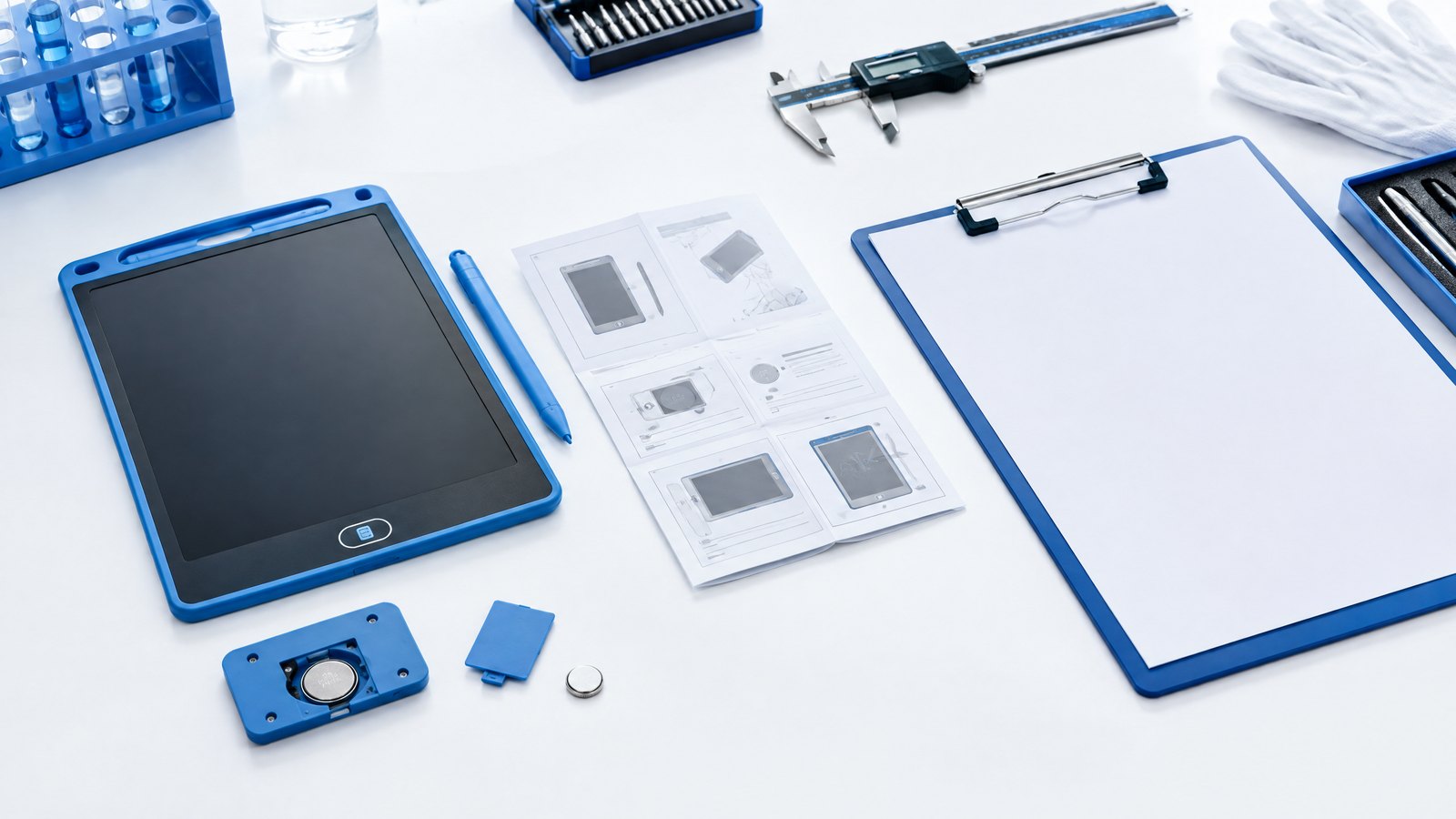
Review a development or pre-production sample with a scorecard. Check writing response with the supplied stylus, erase and lock behavior, display contrast in expected lighting, stylus fit or tether, battery-door operation, screw seating, sharp edges, logo placement, and complete pack-out. For children’s products, evaluate foreseeable use and misuse within the relevant testing plan, not as an adult office device.
Freeze a golden sample after functional unit, color, print, manual, labels, accessories, and packaging are approved. Link photos of the sample and carton to the BOM, artwork revision, and inspection checklist. Then request evidence appropriate to the final model and market. For lithium batteries shipped by air, IATA identifies lithium-ion batteries contained in equipment as UN 3481 and says that, except for button cells installed in equipment, manufacturers and subsequent distributors must make the applicable UN 38.3 test summary available. 13 Confirm transport classification and packing with a freight forwarder or dangerous-goods specialist.
During production, check approved parts against the BOM. At final inspection, check cosmetics, pack contents, labels, carton quantity, and the agreed function. Define incomplete erase, dead areas, loose stylus, poor lock response, incorrect print, and pack damage before production. Release goods only after quantity, packaging, markings, and inspection findings match the purchase order; retain scorecards, evidence review, reports, carton photos, and final artwork in the product file.
8. Ordering and implementation preparation
Keep one controlled product file containing the purchase order, signed specification, BOM, approved artwork, sample photographs, pack-out drawing, compliance matrix, claims register, inspection checklist, shipping marks, and current manual. Assign owners for approvals. A sourcing manager should not be the only approver for a children’s warning or environmental statement.
For LCD writing tablets, explain actual use: writing, erasing, lock function if fitted, surface care, battery replacement if relevant, and whether the model records or transmits content. Do not imply saving, scanning, connectivity, or dark-room use unless the ordered model provides it. For paper, plan refills and protective packaging. For dry-erase, define marker type, eraser, cleaner, mounting, and replenishment.
Give packaging a separate gate: avoid pressure on a tablet screen or button, prevent a loose stylus from scratching the display, and review carton orientation and route-appropriate protection. Coordinate battery shipping early. Before launch, synchronize listing, carton, and manual with the final model, dimensions, pack contents, functions, warnings, and age/use statement. GPSR includes consumer products offered online and sits alongside applicable sector rules. 12
9. Practical applications
Adult desk notes and household lists. LCD writing tablets suit quick, visible reminders when content can be copied before clearing. Paper is better for notes that are filed, signed, mailed, or archived. A dry-erase board can suit shared planning.
Children’s drawing and early practice. LCD tablets can support tracing, mark-making, simple maths, and doodling. Match visual claims, age indication, stylus design, battery configuration, and pack features to the intended child audience. Paper remains useful for work that must be kept, graded, displayed, or sent home.
Classroom and tutoring. Dry-erase boards support shared explanation. Personal LCD tablets can act as individual response surfaces. If individual work must be retained, use paper, a photo workflow, or a fit-for-purpose digital system. Plan marker management, ventilation practice, and cleaning as a classroom system. 5
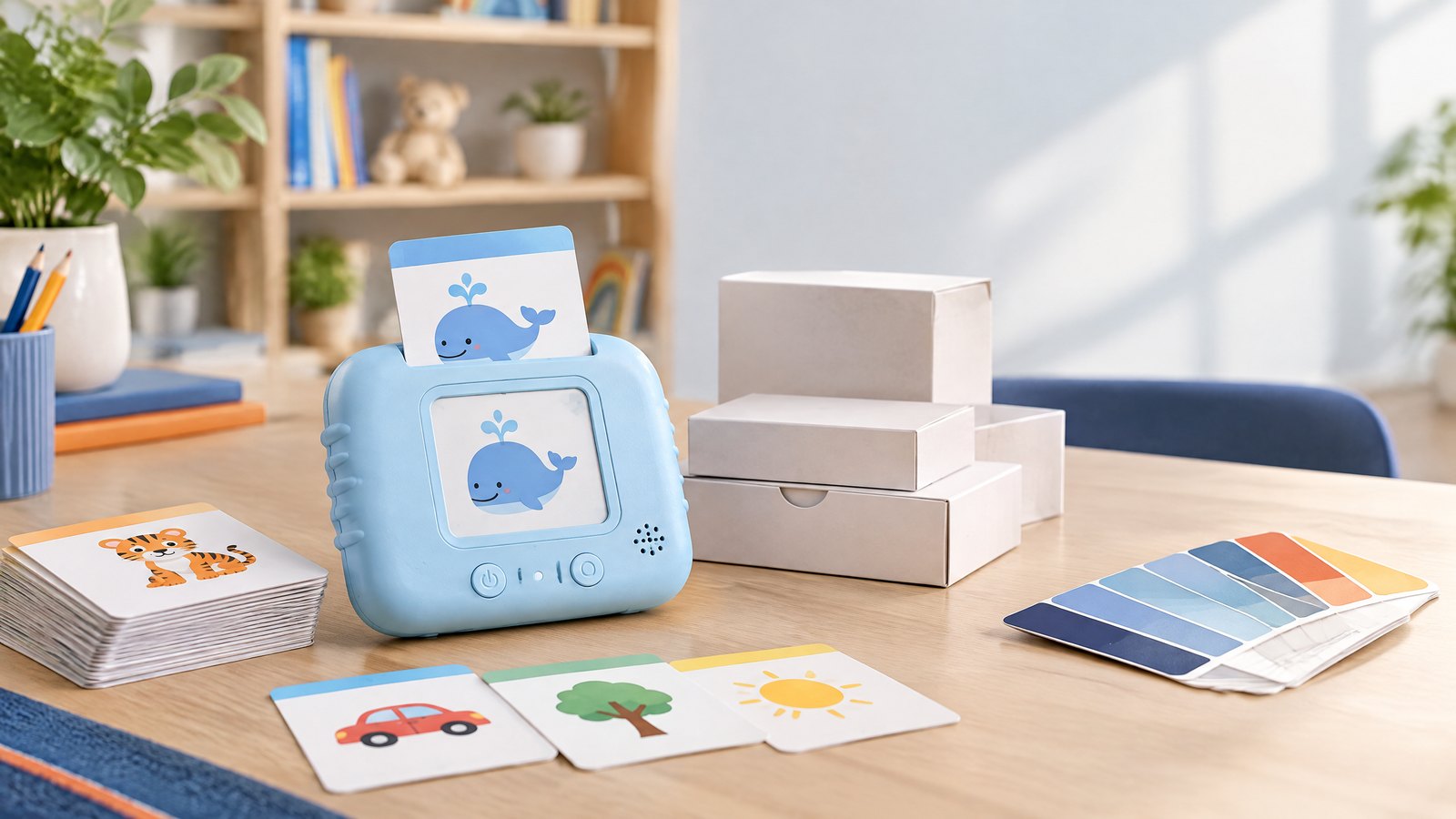
Travel, promotions, learning, and badge assortments. A compact LCD tablet can fit portable branded programs, provided stylus retention, scratch resistance, packaging, and missing-accessory handling are tested. A talking flashcard learning machine bundled with a writing product needs its own age, battery, instructions, claims, and compliance review. Smart electronic badges serve identity or event communication, not the same writing task, and should be assessed separately for display, connectivity, data handling, battery, and end of life.
10. Detailed FAQ
Is an LCD writing tablet a replacement for paper?
For some temporary uses, yes: lists, doodles, repeated practice, and quick notes. It is not automatically a substitute for documents that must be retained, signed, filed, copied, or independently read without the device.
Is a dry-erase board more reusable than an LCD writing tablet?
Both are reusable, but their systems differ. Dry-erase depends on markers, wiping, cleaning, and refills. An LCD tablet generally reduces those routine consumables but has an electronic device, battery, display surface, and end-of-life considerations. Do not turn “reusable” into an unqualified environmental superiority claim.
Can an LCD writing tablet save notes or use power while writing?
Do not assume it can save notes. A pressure-sensitive tablet can retain a visible image until cleared, but that is not memory, scanning, cloud storage, or export. Many pressure-sensitive cholesteric designs are bistable: the image can remain without continuous power while voltage clears the display. 1 Verify functions and do not print battery-life claims without final-product evidence.
Can users write with any pen or sharp object?
Use the supplied stylus or only implements identified in the manual. Sharp or unsuitable objects can damage the surface. Do not claim “write with anything” unless the final product has been assessed for that claim.
What should a U.S. buyer consider for a replaceable coin cell?
The answer depends on classification and current rules. CPSC guidance describes secured compartments, accessibility controls, warnings, and instructions, with distinct treatment for toys compliant with relevant ASTM F963 battery provisions. 8 Confirm the final design with qualified support.
Does an EU product need CE marking?
Only where applicable EU legislation requires it and the relevant conformity process is complete. Toys sold in the EU require CE marking under the toy safety framework. 11 An electronic product may also be within other applicable rules, such as RoHS, depending on configuration.
How should sustainability claims be handled, and what should be inspected?
Define claims narrowly and substantiate them for the product, package, and market. An LCD tablet may reduce routine sheets and markers for a particular use, but paper recovery is not universal and electronics need end-of-life handling. 7 Before shipment, inspect the signed specification: model and color, screen, write/erase and lock response, battery door and screws, accessories, printing, warnings, manual, packaging, carton marks, and quantity.
11. Conclusion and final CTA
The best answer to LCD writing tablet vs paper vs dry erase board is a portfolio decision based on the user’s information lifecycle. Paper is the strongest starting point when the record matters. Dry-erase boards are practical for shared, visible work when marker and cleaning routines are acceptable. LCD writing tablets are compelling for portable, temporary, marker-free writing and repeat practice, provided the buyer specifies the exact erase behavior, power system, accessory design, intended user, and market documentation.
For a B2B launch, treat the selected format as a complete product system. Start with a defined use and age grade. Approve a golden sample and controlled BOM. Review market-specific obligations for the exact final configuration. Verify packaging, instructions, claims, factory controls, and shipment details before release. This approach produces a more credible product offer than broad promises about being “paperless” or “eco-friendly.”
To discuss an OEM/ODM LCD writing tablet specification, a comparison sample, custom artwork, retail packaging, or a product brief for your destination market, contact info@lcdwritingtablet.com. Include your target use, user age, markets, required functions, preferred size, branding, packaging format, and planned sales channel so the project can be evaluated on the details that actually determine market fit.
References
Turn this sourcing plan into a product brief.
Share your target market, product requirements, packaging preference and estimated volume for a practical OEM / ODM discussion.