This guide provides a practical B2B decision framework. Final specifications, market obligations, testing scope, labels, packaging and shipment requirements must be confirmed for the exact finished SKU and destination.
Introduction. Choosing an LCD writing tablet for kids is not just a matter of selecting a bright shell color or a large screen. For importers, private-label brands, retailers, schools, promotional buyers, and distributors, the real decision is whether the product definition, age grade, safety file, user experience, pack-out, and quality plan fit the target market. A tablet that feels appropriate to a six-year-old may be unsuitable for a toddler range; a model that works for a value retail program may not support the presentation, accessories, or packaging expected of a gift brand.
This guide is written for US, UK, German, and French buyers evaluating a Shenzhen OEM/ODM supplier. It turns a familiar consumer product into a procurement specification: what to ask for, how to compare options, and what to verify before an order is released. Specifications, applicable requirements, lead times, and documentation vary by model, battery arrangement, intended age grade, destination, and quotation. Confirm every product-specific point in the supplier’s quotation, approved sample, and compliance file before purchase.
1. Direct answer and summary
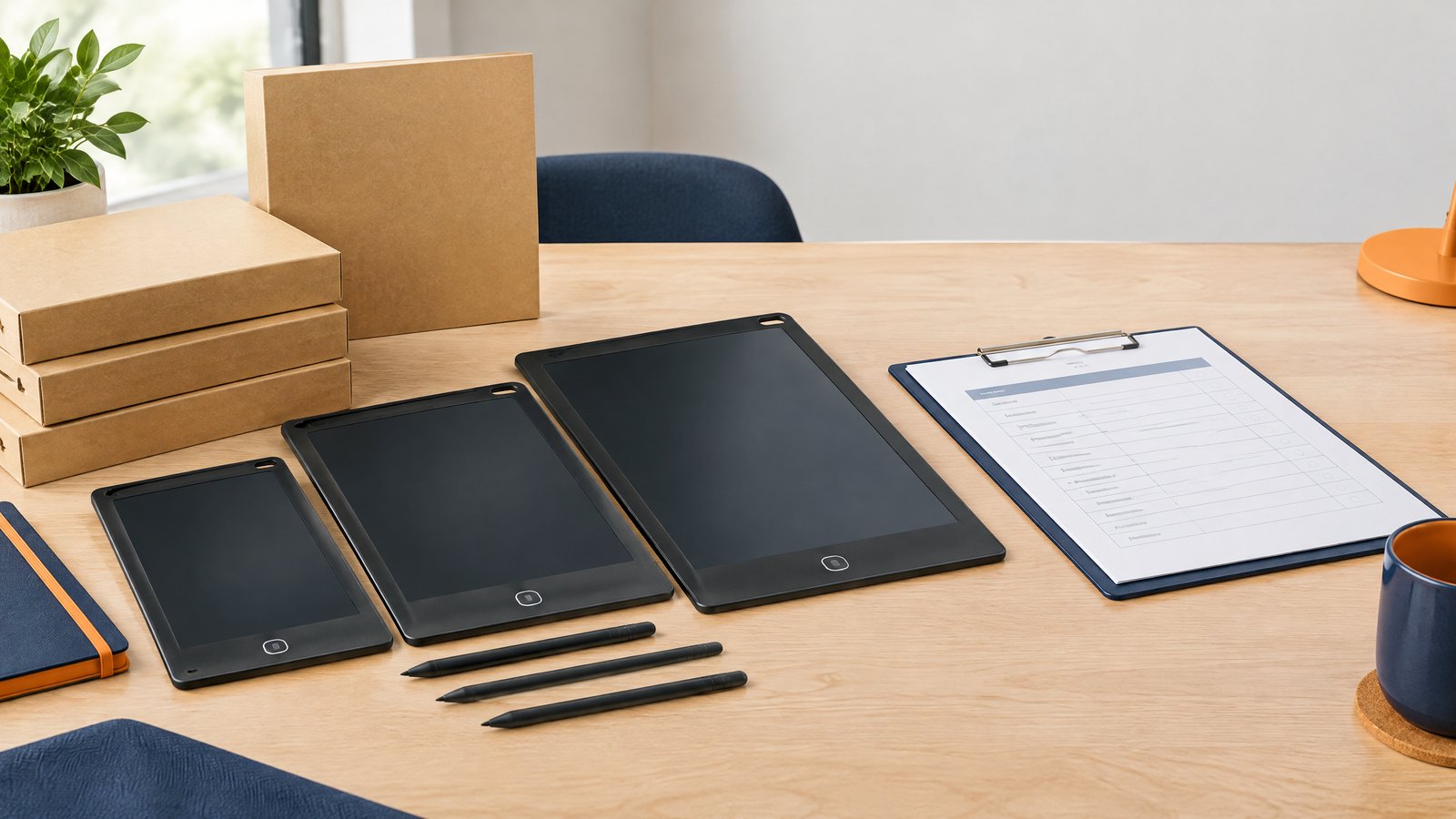
The best writing tablet for kids is the one matched to a clearly defined user age, use case, sales channel, price position, and market-compliance plan—not necessarily the model with the largest display or the longest feature list. Start by locking five decisions: intended age grade; screen size and writing area; erase and lock behavior; battery and enclosure construction; and the evidence you require before shipment.
Specify a responsive screen, stylus, erase and lock functions, battery arrangement, smooth accessible edges, and relevant instructions. The finished unit, carton, listing, and age grade must match the approved sample.
Use this short procurement sequence:
- Define the child age, retail channel, target landed cost, market, and intended claim set.
- Compare representative samples rather than comparing catalogue photos alone.
- Convert the sample into a signed specification covering materials, dimensions, color, artwork, accessories, packaging, and critical functions.
- Identify applicable safety, chemical, electrical, labeling, and market-access obligations with the responsible importer or compliance adviser.
- Agree on inspection criteria, acceptable quality limits if used, and what evidence must be supplied before shipment.
2. Buyer context: define the commercial brief before choosing the product
An LCD tablet can be sold as a preschool activity product, travel companion, classroom handwriting aid, restaurant giveaway, holiday gift, or a low-waste alternative to disposable note paper. Each proposition changes the specification. A toddler-focused SKU often prioritizes hand feel, a simple interface, rounded housing, and an age-appropriate accessory design. A school or travel offer may prioritize display area, pen retention, sturdy storage, and an easy lock/erase workflow. A private-label gift product may put equal weight on shelf presentation, color consistency, packaging graphics, and perceived quality.
Write a one-page brief before pricing: destination, importer, age grade, volume, format, retail target, launch date, languages, brand assets, and channel. State the proposed classification and claims; the responsible economic operator should assess them, not a catalogue title. Separate must-haves from cost drivers such as screen size, display effect, shaped housing, accessories, battery type, and premium packaging. The factory can provide technical data, but the buyer controls final market claims and compliance decisions.
3. Product definitions: know what you are buying
A kids drawing tablet typically uses a liquid-crystal display that changes appearance under pressure from a stylus or fingernail. It is usually a non-networked, non-emissive writing surface: it does not need ink, the image remains until cleared, and a button triggers an electrical erase cycle. It is different from a conventional tablet computer, which has a powered color display, operating system, applications, charging circuitry, and often wireless functions.
A doodle board for kids may refer to the same product family, but the phrase is broad. In sourcing, define the actual configuration rather than relying on the retail term. Ask whether the model has a monochrome or multicolor display effect; a replaceable or tethered stylus; a mechanical lock slider or electronic lock feature; a coin cell or another power configuration; a fold-out stand; magnets; an integrated handle; a protective case; and included drawing templates or accessories.
Core component vocabulary
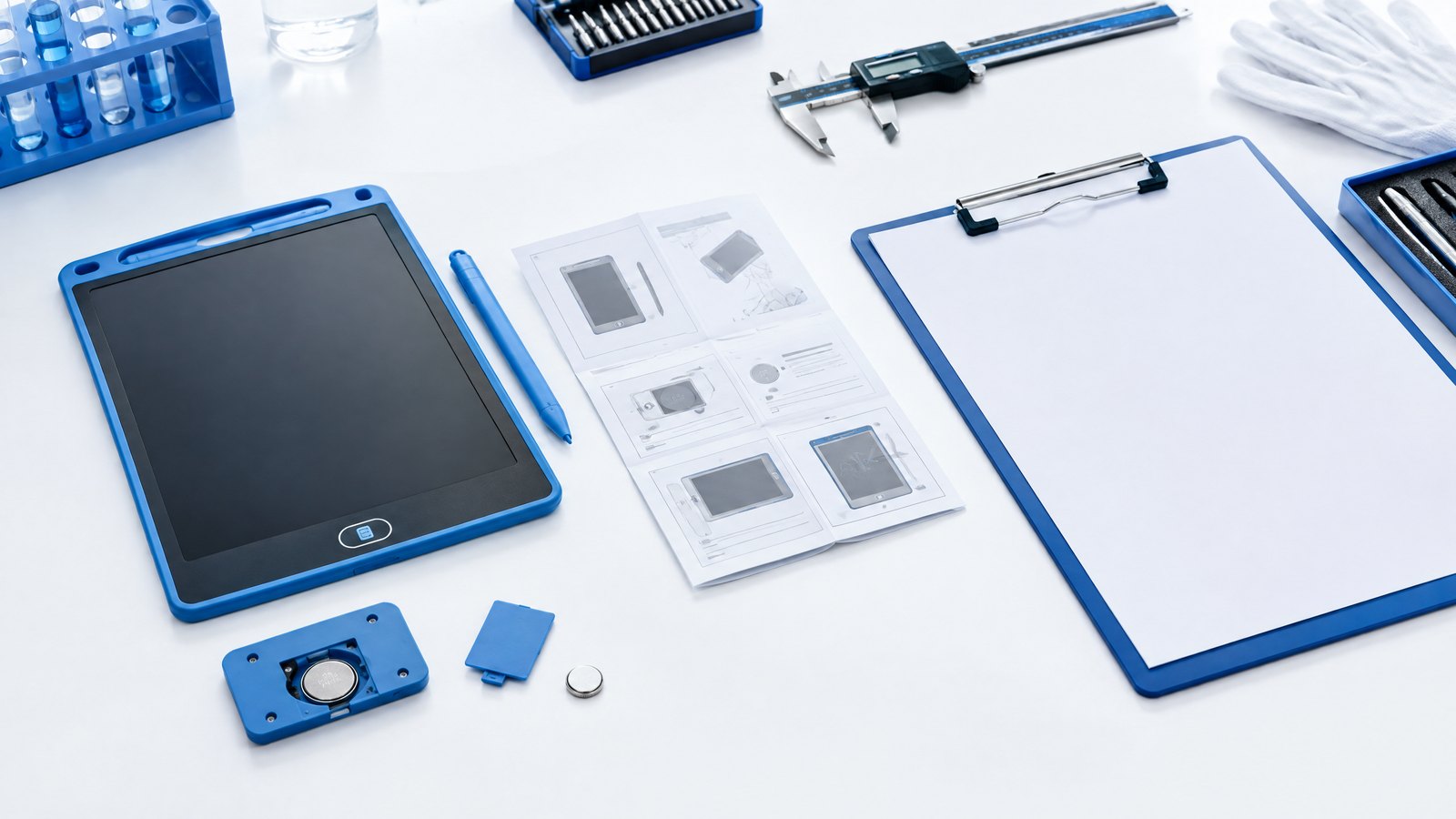
- LCD writing panel: The pressure-sensitive panel and its visual layer. “Color” may describe the writing traces, the frame, or both; it does not necessarily mean a full-color backlit screen.
- Housing and bezel: The outer plastic shell and screen surround. Their geometry influences grip, edge accessibility, screen protection, and assembly quality.
- Stylus and retention feature: The writing tool and method that keeps it with the device, such as a slot, cord, or magnetic hold. Consider loss risk, attachment strength, and age suitability.
- Erase circuit and button: The electrical mechanism that clears the writing. Buyers should define whether the function must work with the screen unlocked only and how its operation will be demonstrated.
- Lock control: A control intended to prevent accidental erase. It is not a security or data-protection function and should not be marketed as one.
- Power compartment: The area containing the battery and cover. Its construction, fastener, accessibility, markings, and instructions deserve careful review.
4. Selection criteria: choose for the child and the channel
Age grade and interaction simplicity
Age grading informs product design, packaging, warnings, functional expectations, and the evaluation of foreseeable use. Do not use a broad age claim simply because it increases the potential audience. For a LCD writing tablet for toddlers, minimize cognitive steps: write, view, erase. Examine the size and shape of the stylus, whether the pen can be mouthed or detached, how the device behaves when dropped, and whether small accessories are necessary at all. Use the intended age grade approved for the exact product and market; it should be supported by the appropriate assessment and documentation.
When sourcing an LCD writing tablet for 3 year olds, the buyer should particularly scrutinize accessible components, stylus retention, battery-cover security, rounded edges, instructions for adult caregivers, and the clarity of age marking. For an LCD writing tablet for 5 year olds, children may benefit from a larger writing field, simple practice sheets, name-writing use, or travel activities, but those features should still be tested with real, age-relevant handling during sample review. Neither phrase substitutes for a formal product safety or age-grading decision.
Screen experience and usability
Screen size should be specified as the usable writing area and the overall product size, not merely a marketing diagonal. A larger area may improve drawing and letter practice, yet it can add fragility, cost, weight, and carton volume. Ask to view lines, light pressure marks, broad strokes, and erased areas under ordinary indoor light. Assess contrast from typical viewing angles, blank-screen cleanliness after erase, and whether the child can hold the tablet without covering the writing area.
Form factor, accessories, and visual language
Choose a form factor that supports the use case. Thin rectangular boards suit packing and handwriting. Animal-shaped or handled frames can create gift appeal but introduce extra contours to inspect and potentially more packaging complexity. A stand may help tabletop use; a lanyard-style attachment can help portability but must be considered carefully against the intended age and product safety assessment.
Commercial fit
Ask for a quotation that separates unit configuration, packaging, tooling if any, printing, accessory options, sample charges, and shipment terms. This makes cost movement visible when comparing models. Consider packed cube and master-carton quantity alongside ex-works price: a low-cost tablet in a bulky gift box may be less economical delivered. MOQ, color assortment rules, artwork lead time, and reorder conditions should be written down.
Mid-article CTA: Send LcdWritingTablet your target market, age grade, screen size, annual volume estimate, packaging concept, and logo artwork. We can help structure a model-specific OEM/ODM quotation and a sample-approval checklist; final specifications and applicable documentation should be confirmed for the quoted SKU.
5. Technical specifications: turn preferences into measurable requirements
A purchase order should convert broad preferences into controlled requirements. Build a data sheet with a “target,” “approved tolerance or option,” “verification method,” and “owner” for each critical item. Do not rely on ambiguous language such as “good quality,” “bright display,” or “strong battery cover.”
Product and display specification
At a minimum, record the model code; overall length, width, depth, and nominal unit weight; usable screen dimensions; nominal screen diagonal if used in marketing; frame material; display effect; panel color; shell colors; stylus material and size; and any stand, handle, or pen-retention feature. Define whether a screen protector is shipped on the display and whether it must be removed before use. Measure the approved sample, because quoted nominal dimensions may not tell a buyer what fits in a retail fixture or a school supply bin.
For screen performance, define the review conditions. A practical sample protocol can include writing with the supplied stylus over multiple screen zones, checking light and normal pressure response, activating the lock feature, operating erase after unlocking, and viewing the cleared screen under typical indoor lighting. The goal is repeatable acceptance, not a claim that every panel will look identical under every light condition. Confirm the method and the agreed accept/reject criteria in writing.
Power, erase, and battery details
Ask the factory to identify the exact battery type, nominal configuration, whether it is supplied installed or separately, the battery-cover design, fastener type, and replacement instructions. Battery-related product requirements can depend on the market, intended age, product classification, and final design. Do not make runtime claims unless they are supported by an agreed test method for the exact model and battery.
Packaging and logistics specification
Package design is part of the product. Define retail carton material and finish; window or no window; inner tray; instruction sheet; barcode placement; country-of-origin statement where required; age grading and warnings; language content; carton drop or transit testing requirements if any; and master-carton markings. Specify how tablets are oriented, separated, and protected so styluses, screens, and erase buttons do not suffer avoidable transit damage.
6. Factory and quality evidence: what credible control looks like
A responsible procurement process does not require a buyer to accept unverified promises. It asks the factory to show how the agreed product is controlled. For LcdWritingTablet, or any OEM/ODM supplier, request evidence proportionate to the order and risk: the approved sample record, artwork approval record, inspection checklist, production traceability approach, relevant reports for the exact or properly representative SKU, and a pre-shipment inspection plan.
Sample approval is the reference point
Approve a sample only after reviewing the whole deliverable, not merely the tablet body. Document the model, colors, decorative artwork, screen behavior, stylus, lock and erase operation, battery arrangement, accessories, insert, retail carton, and master carton. Photograph the approved sample from all sides and identify it by date or version. If the buyer accepts a golden sample, state where it is retained and how it will be used during inspection.
Functional and appearance checks
For production, define checks that can be observed and repeated. These may include visual examination for cracks, sharp flash, warpage, dents, color inconsistency, printing defects, loose parts, screen marks, and packaging damage. Screen/erase testing can cover writing response in multiple areas, lock operation, erase operation, and screen condition after clearing. The sample size and acceptance criteria should be agreed by buyer and supplier; if an AQL plan is used, define the inspection level, critical/major/minor defect classifications, and whether an independent inspector will apply it.
Packaging checks and pre-shipment inspection
Before shipment, packaging checks should compare finished packs with the approved artwork and pack-out list. Inspect carton integrity, print clarity, barcode placement/scannability where applicable, count, insert presence, product orientation, accessory inclusion, and master-carton marks. Confirm that the shipped revision matches the revision shown on the approved proof.
7. Compliance and safety considerations: build a market-specific file
Compliance must be assessed for the finished configuration and market. An LCD tablet that is presented, designed, manufactured, or marketed as a children’s plaything may be regulated as a toy; other product claims and construction details can add obligations. Ask qualified compliance professionals and the responsible importer to determine the applicable framework. The supplier should be asked for relevant, current, product-specific documentation—not for a generic assurance.
For the United States, the Consumer Product Safety Commission explains that ASTM F963 is a mandatory consumer product safety standard for children’s toys, with applicability depending on the product, and that children’s products subject to CPSC-enforced requirements require certification in a Children’s Product Certificate (CPC). The CPSC guidance also identifies topics relevant to this category, including small parts, accessible edges and points, markings, labeling, and electrically operated toys. The exact requirements and test plan must be determined for the final product and intended age grade.
For Germany and France, the European Commission states that the EU Toy Safety Directive sets safety criteria before toys are placed on the EU market, covering general health and safety plus physical/mechanical, flammability, chemical, electrical, hygiene, and radioactivity risks. It states that toys sold in the EU carry CE marking as the manufacturer’s declaration of compliance with essential requirements. The Commission also notes a newer Toy Safety Regulation with a transition period; buyers should verify the rules in force at the time their goods are placed on the market. For electrical and electronic equipment, the EU RoHS framework restricts specified hazardous substances; scope and applicability should be assessed for the exact product.
For the UK, confirm the current Great Britain and, if applicable, Northern Ireland route, conformity marking expectations, documentation, labeling, and recognition arrangements at the time of sale. UK market rules can differ from EU rules, and changes or transitional provisions should not be assumed from an older purchase order.
Practical evidence request list
Ask the supplier to identify which documents it can provide for the exact model and which need to be arranged for your branded configuration. Depending on the product and destination, this can include a product specification, material/component declarations, test reports issued for the relevant SKU or properly justified representative configuration, battery information, labeling/artwork proofs, instructions, declarations, and production traceability details. Check report holder, model references, dates, laboratory accreditation scope where relevant, market, age grade, product construction, and whether the branded/packaged item matches the sample.
8. Application examples: specify the product around real use
Preschool and home-learning range
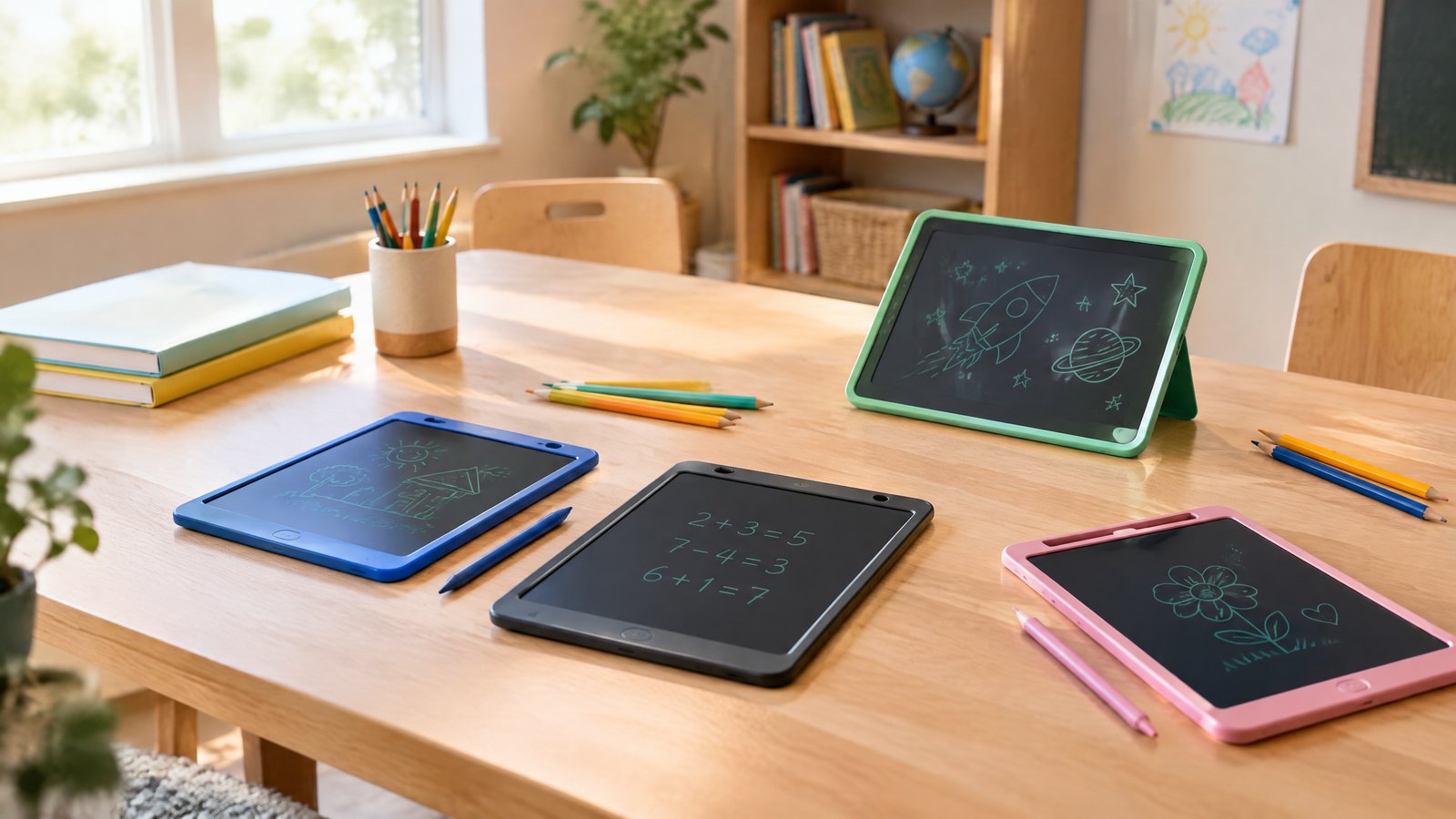
A preschool line may emphasize first marks, shapes, simple tracing, and quiet independent play. Select a readable screen, an easy-to-grasp body, a simple erase action, and an age-appropriate stylus solution. Use calm, clear packaging that explains what the product does without implying digital learning outcomes that have not been validated. Confirm whether templates or cards add value or simply increase accessory risk and pack-out complexity.
Travel, hospitality, and promotional use
For travel retail, restaurants, family events, or branded promotions, slimness, unit protection, logo execution, and speed of use can outweigh premium features. Specify a compact size, simple packaging, pen storage, and visual instructions. Buyers should consider whether a promotional item’s intended age grade and distribution context alter their safety, warning, or documentation needs. A logo added to a standard model is still a branded product that must be reviewed in its final configuration.
School, therapy, and waiting-room activities
Classroom or waiting-room programs often need repeated temporary writing, low noise, easy storage, and straightforward cleaning directions. Consider a larger writing area, stand or stackability, an easy-to-locate stylus, and an orderly storage system. Do not market the product as a medical or therapeutic device without a separate, substantiated basis. For institutional purchasing, define spare-parts expectations, batch identification, cleaning compatibility, and a method for handling units with cracked screens or loose components.
Retail private label and gift sets
For retail, specify price, unboxing, shelf footprint, multilingual copy, and returns prevention. Every added gift-set item must be specified and inspected; verify that the final packaging protects the screen and matches the contents.
9. Buyer checklist: use before releasing a purchase order
Use the following list as a handoff between product, sourcing, quality, compliance, and logistics teams.
- Intended user, age grade, market(s), classification, channel, and product claims are documented.
- The exact model, display effect, screen size, colorway, shell material, stylus, lock, erase arrangement, and battery configuration are specified.
- A complete sample—not only the device—has been approved with photos, revision date, and sign-off record.
- Logo, artwork, carton copy, instructions, warnings, required language versions, barcode, and origin/traceability details are approved for the final market.
- The quotation identifies product configuration, packaging, accessories, printing, tooling if applicable, MOQ, Incoterms, and payment/lead-time assumptions.
- Applicable product-safety, chemical, electrical, labeling, documentation, and conformity requirements have been assessed by the responsible party.
- Requested reports and declarations are checked against the final model, age grade, brand, packaging, and destination; gaps are resolved before shipment.
- Functional checks include writing response, erase function, lock behavior, stylus/retention condition, battery-compartment review, and screen appearance.
- Cosmetic and construction checks cover cracks, sharp flash, loose parts, print quality, fit, color, scratches, and packing protection.
- An inspection plan defines sampling, defect definitions, acceptance criteria, timing, responsible party, and corrective-action path.
- Master-carton count, dimensions, gross/net weight, shipping marks, and battery/logistics handling have been confirmed.
- A change-control rule requires written approval for changes to components, material sources, artwork, packaging, or factory.
10. FAQ
What screen size is best for children?
There is no universal best size. Choose based on use: compact formats suit travel and promotions; larger writing areas suit drawing, practice, or shared tabletop use. Compare usable writing area, total dimensions, weight, handling comfort, and packed cube on samples. Confirm the final dimensions in the quotation.
Are LCD writing tablets suitable for toddlers?
Some designs may be appropriate for a toddler range, but suitability depends on the exact construction, accessory design, intended age grade, warnings, and applicable safety assessment. Do not infer suitability from frame color, a “kids” product name, or a supplier photo. Review the exact model and final packaging for the target market.
Does an LCD writing tablet need charging?
Many models use a replaceable battery for erase only, but this is model-specific. Confirm the exact configuration and never claim rechargeable or battery-free without support.
Can the drawing be saved or transferred to a phone?
Standard LCD writing tablets commonly show temporary marks and erase them; they generally do not save, print, or wirelessly transfer drawings. If those features are required, specify them from the outset because they change product architecture, cost, documentation, and potentially data/privacy considerations.
What should a buyer inspect before shipment?
Inspect the approved product version and packaging, not merely random finished units. Check appearance, screen response, erase and lock function, stylus and accessory inclusion, battery-cover condition, printing, warnings/instructions, barcode, carton pack-out, master-carton marks, and quantity. Agree the sampling and acceptance method before production ends.
Can an OEM supplier print our logo and packaging?
Usually OEM/ODM options can include logo application, colorways, inserts, and retail packaging, subject to model, artwork, order quantity, tooling, and production constraints. Provide editable artwork and a defined brand guide. Obtain a final proof and ideally a physical packaging sample; pricing and feasibility should be confirmed in the supplier’s model-specific quotation.
11. Conclusion and CTA
A successful children’s LCD tablet program is built on controlled decisions: define the child and use case, select a model for real handling rather than catalogue appearance, make specifications measurable, approve a complete sample, validate the final-market documentation, and inspect the final pack-out. This approach supports better sourcing conversations, fewer preventable revisions, and a more defensible product file.
LcdWritingTablet is a Shenzhen OEM/ODM manufacturer ready to discuss an LCD writing tablet for kids program for US, UK, German, and French buyers. Share your target age grade, market, preferred screen size, artwork, packaging format, order estimate, and requested evidence. We will help scope the available model and customization options, arrange a sample review process, and prepare a quotation. All specifications, production details, compliance evidence, and delivery assumptions must be confirmed for the final quoted model and order.
Sources and verification note
This is commercial procurement guidance, not legal advice. Verify current market obligations with the responsible importer, qualified compliance professional, and the applicable authorities. Useful public references include the US Consumer Product Safety Commission’s Toy Safety Business Guidance, which explains mandatory ASTM F963 coverage and CPC considerations; the European Commission’s Toy Safety page, covering the EU toy framework and CE marking; the European Commission RoHS overview; and ASTM International for the standards body’s current materials. Standards editions, legal frameworks, and product applicability can change; verify them at the time of placing goods on the market.
Image plan
-
Purpose: Show the product-selection conversation in a credible B2B sourcing setting.
Insertion position: After Section 1, “Direct answer and summary.”
English caption: “Comparing LCD writing tablet samples by screen area, stylus retention, shell design, and packaging.”
ALT text: “Buyer comparing several LCD writing tablet samples for children on a procurement desk.”
English AI image prompt: “Photorealistic B2B product sourcing scene in a clean Shenzhen showroom, diverse hands comparing four unbranded LCD writing tablets for children, different screen sizes and pastel frames, stylus and retail packaging samples on a white table, technical checklist visible but unreadable, soft daylight, premium editorial product photography, no logos, no text.” -
Purpose: Explain key physical components and help buyers compare configurations.
Insertion position: In Section 3, after “Core component vocabulary.”
English caption: “Key components to specify: writing panel, bezel, stylus, lock, erase control, and battery compartment.”
ALT text: “Exploded-view style layout of an LCD writing tablet with its major components.”
English AI image prompt: “Clean isometric product diagram of a generic children’s LCD writing tablet, separated components arranged around the device: pressure-sensitive writing panel, rounded plastic bezel, stylus, erase button, lock slider, battery cover and small screw, pastel blue and yellow accents, white background, unlabeled callout space, precise industrial-design render, no brand logos, no readable text.” -
Purpose: Demonstrate realistic functional quality checks without claiming a test result.
Insertion position: In Section 6, after “Functional and appearance checks.”
English caption: “Sample functional review: writing response, screen clearing, lock operation, and cosmetic condition.”
ALT text: “Quality inspector checking writing and erase functions on a children’s LCD writing tablet.”
English AI image prompt: “Photorealistic quality-control workstation in an electronics assembly environment, trained inspector wearing clean gloves tests a generic LCD writing tablet for children with stylus, writes lines across the display and checks erase button, simple inspection sheet and caliper nearby, clean organized scene, documentary commercial photography, no company marks, no test-result text.” -
Purpose: Reinforce the packaging-approval and pre-shipment inspection stage.
Insertion position: Near the end of Section 9, before the FAQ.
English caption: “Final packaging verification checks artwork, inserts, unit protection, and master-carton pack-out.”
ALT text: “Open retail carton and master carton containing protected LCD writing tablets for children.”
English AI image prompt: “High-resolution packaging inspection scene, open unbranded retail carton holding a protected children’s LCD writing tablet, multilingual-style placeholder instruction leaflet with no readable words, barcode placeholder, dividers, and an open master carton behind it, shipping label area blank, neutral warehouse background, professional product photography, no logos or legible text.”
Continue with the next sourcing decision.
Use these internal links to compare products, check common buyer questions, review compliance preparation, or send your requirements to the factory.
Turn this sourcing plan into a product brief.
Share your target market, product requirements, packaging preference and estimated volume for a practical OEM / ODM discussion.