This guide provides a practical B2B decision framework. Final specifications, market obligations, testing scope, labels, packaging and shipment requirements must be confirmed for the exact finished SKU and destination.
School Bulk Orders for LCD Writing Tablets: Budgeting, Packs, and Program Rollout
A successful school order for LCD writing tablets starts with a defined teaching routine—not a catalogue size or a headline unit cost. Decide which moments the tablet will replace or improve, test a representative sample with teachers, compare the landed and usable cost of comparable packs, and roll out in manageable stages with clear storage, cleaning, replacement and battery procedures. That approach helps a school, district, academy trust, distributor or education reseller buy the right mix of tablets and avoid ordering more features, accessories or packaging than classrooms can use.
For purchasers in the United States, United Kingdom, Germany and France, the practical questions are similar: How many devices are needed at once? What is inside each pack? Who receives and distributes the cartons? What evidence belongs in the purchasing file? And how will teachers turn a reusable writing surface into a repeatable learning routine? This guide answers those questions from the perspective of LcdWritingTablet, a Shenzhen OEM/ODM manufacturer working with business buyers. It is a procurement and rollout framework, not a promise of a universal product configuration, delivery date, price or regulatory approval. Confirm the final specification, documents, labels and commercial terms for the destination market before issuing a purchase order.
Begin With the Job to Be Done, Then Define the Order
An LCD writing tablet is a lightweight, non-connected writing surface: a pupil makes a mark with a stylus or, on some designs, a fingertip, and clears it electronically. It works for short-lived work—phonics responses, spelling rehearsal, number bonds, worked calculations, a drawing plan or an exit prompt. It is not a laptop, a permanent learner record or an individual accessibility accommodation without review.
That distinction matters in an LCD writing tablet school bulk order. “School” is not one use case. A reception class may need a compact shared board for mark making; a middle-school teacher may want a larger working surface for mental maths; a travelling tutor may value a portable, low-distraction prompt tool. The teaching moment should set the display size, housing, stylus retention, erase/lock behaviour, packaging and quantity.
Write one sentence before requesting prices: “Each Year 2 table group will use two reusable boards in ten-minute spelling and number-response rotations.” It gives purchasing and teaching teams something concrete to test. “Tablets for classrooms” does not.
Map users, locations and peak simultaneous demand
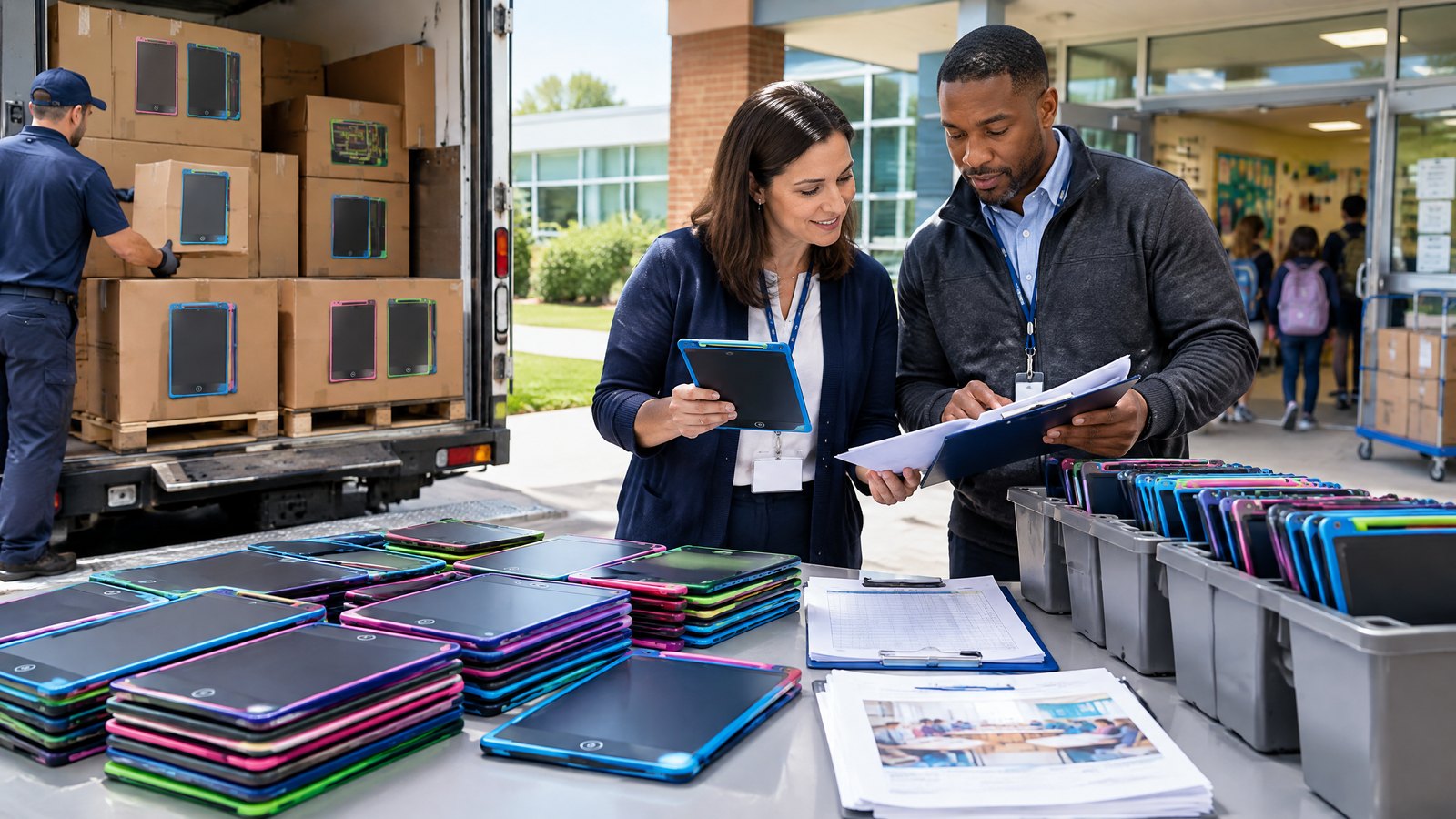
Count devices needed at the same time, then add only a locally approved allowance for demonstrations, loss, breakage or replacement. Do not begin with enrolment unless every learner will use one simultaneously. Record the classroom, intervention room, library, club or mobile kit; the group size; whether boards stay in a room, travel on a trolley or go home; the staff owner; and secure storage point.
A room-owned kit works well with a labelled tray and one teacher in charge. Central lending needs a booking owner, sign-out method and return count. Home issue needs family instructions, a return date and an answer to the missing-stylus problem. Decide these matters before cartons are ordered.
Turn classroom practice into a specification
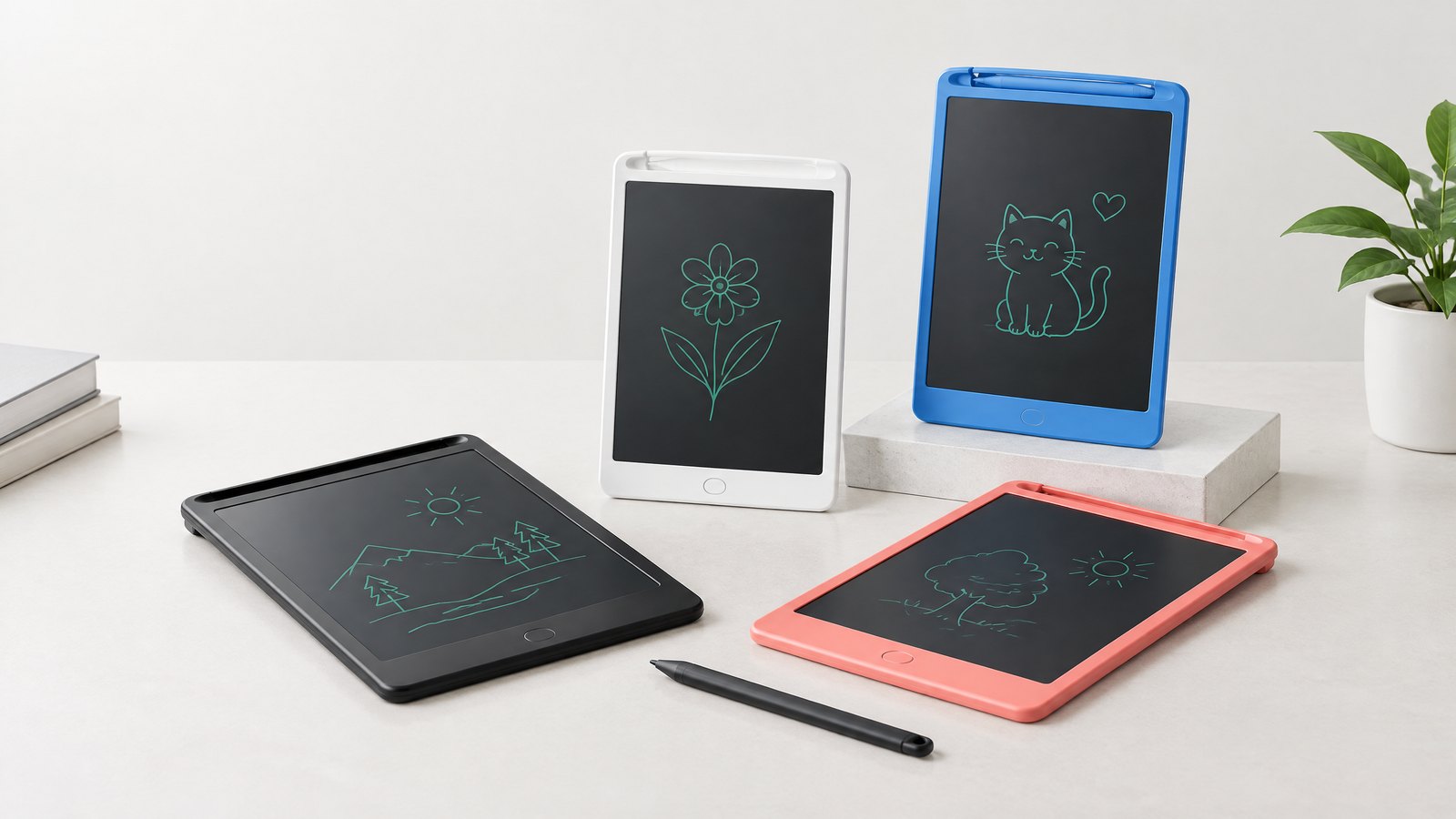
Use observable requirements rather than “good quality”: size range; orientation; contrast in normal room light; writing feel; clear and lock behaviour; stylus retention; casing and edge expectations; battery type/access; pack contents; and barcode, carton-mark or insert-language needs. Request an approval sample that represents the quoted configuration, not merely a similar retail model.
Test it in a normal lesson. Can pupils hold it and retain the stylus? Can the teacher see the response from the expected distance? Is the clear action understandable? Does the storage tray fit it? Standardise where possible: too many sizes, colours and accessory sets make replenishment and teacher directions harder.
Build a Budget That Reflects the Delivered, Usable System
The LCD writing tablet school price is not just the ex-works unit figure. Compare the cost of putting a ready-to-use, correctly packed device into the intended classroom. Suppliers can quote different versions, currencies, trade terms and carton configurations. An apparently low number can omit custom packaging, freight, taxes, customs handling, inspection, fulfilment preparation, delivery or spare parts.
Use a landed-cost worksheet, not a unit-price shortcut
Make one line for each scenario and keep unresolved assumptions visible.
| Cost area | Questions for the worksheet | Why it matters |
|---|---|---|
| Configuration | What model, size, colour, lock function, stylus and battery arrangement are quoted? | Prevents like-for-unlike comparison. |
| Pack contents | How many boards, styluses, instructions, labels and specified spares are included? | Defines day-one usability. |
| Customisation | Are artwork, logo, colour, translated insert, barcode or carton marks included? | Changes approval and cost. |
| Quality process | What sample, inspection point and defect-reporting route apply? | Creates an acceptance trail. |
| Logistics | Which Incoterm, destination, freight service, customs party and last-mile delivery apply? | Makes responsibility clear. |
| School operations | Who receives, counts, labels, distributes, stores, trains and replaces units? | Captures work beyond purchase. |
For each scenario, add product and agreed contents, customisation, agreed quality services, logistics, destination charges, receiving/distribution work and approved contingency; then divide by usable boards. Show currency, quotation validity, Incoterm and named destination beside every quote. Ask what is excluded. If a public buyer has threshold, framework or approval rules, involve its procurement team early.
Separate a pilot from the scale phase
A pilot validates a teaching routine, configuration, handling process and supplier communication; it is not merely a smaller full order. Agree what “ready to scale” means: teachers can issue and collect kits smoothly, boards work for the planned response, receiving records reconcile, and issue reports have an owner.
For scale, allow time for sample sign-off, artwork proofing, production, inspection, transit, receiving and room distribution. A staged order can reduce uncertainty; a consolidated order may simplify freight and administration. Compare storage capacity, calendar, cash flow and the risk of carrying a configuration that teachers have not tested.
Design Packs That Match How Teachers Issue and Collect Devices
A classroom LCD writing tablet pack should support a repeatable handoff. The best pack is not automatically the largest carton; it lets a teacher issue, retrieve and count equipment without losing instruction time.
Choose the ownership model first
Individual learner packs suit personal practice, intervention and take-home programmes. Give each device an identifier and plan for returns, lost styluses and family guidance.
Table-group packs suit rotations. A tray or pouch holds a fixed set and a group leader counts it at the end. This limits labelling but needs a routine to stop boards migrating between groups.
Teacher demonstration or shared-resource packs fit the front of room, a specialist department or library loan system. Prioritise visible storage and a named custodian. For any model, maintain an item code, quantity, owner/location and purpose. Confirm final instructions, labels and legal information with the responsible importer, distributor or procurement owner for each market; do not assume one insert works in every channel.
Specify components and packaging together
Put the board, stylus, any approved battery arrangement, instructions, labels, storage elements and any requested spare components in a pack-content schedule attached to the order. Verify it against the physical sample. If a stylus detaches, decide whether it is tethered, slotted, separately packed or treated as a replacement part. If a battery is replaceable, document a staff procedure; pupils should not improvise with a battery compartment.
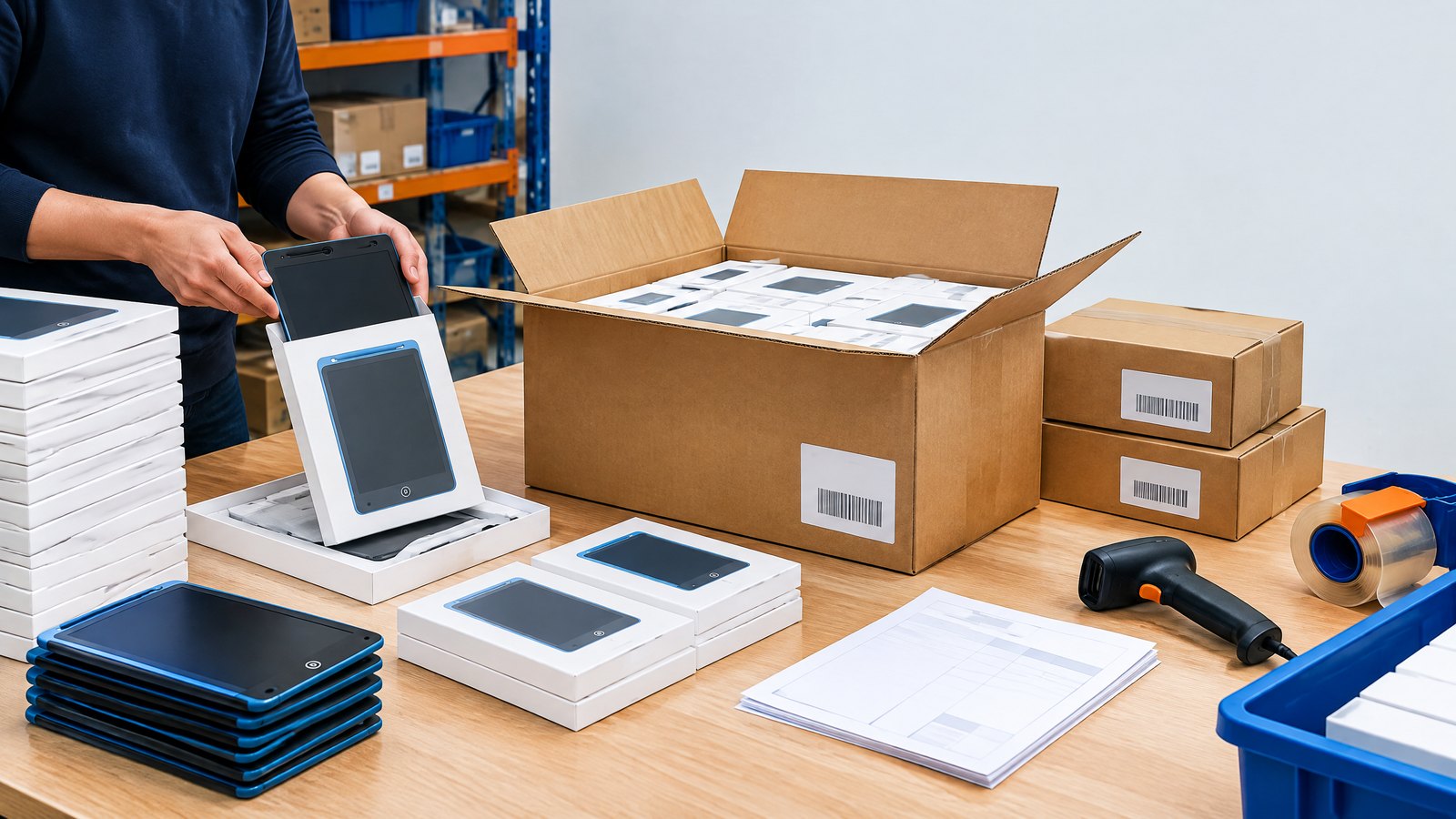
Retail-style boxes can suit direct distribution; bulk inner packs can cut unpacking time and waste for room-owned stock. Master-carton marks should identify model, quantity and destination without opening every box. Request barcodes, warnings, polybags or carton marks early, approve a proof and record who supplies each element.
Treat FBA and fulfilment as a separate operational design
Some education resellers route inventory through Amazon Fulfilment by Amazon (FBA); others use a third-party logistics provider. It is not simply “ship to an Amazon warehouse.” FBA can require a shipment plan, current routing, scannable labels, carton-content data, applicable packaging and compatible delivery. Use the seller’s current Seller Central instructions for the actual shipment, not a previous order’s rules.
Before production, settle who creates the shipment plan; whether sellable units or cases need labels; whether the pack is a retail-ready unit, multipack or bulk stock; who checks scanability and counts; and who owns refusals or relabelling. Retain the packaging approval, carton packing list, label artwork version and pre-shipment photos. This discipline also helps a school warehouse.
Planning a pack, private label or school-ready carton? Email info@lcdwritingtablet.com to discuss the use case, desired configuration and quotation inputs.
Select an Education Supplier Through Evidence, Not Assumptions
An LCD writing tablet education supplier should be assessed on controlled specification, traceability and communication—not attractive photographs alone. A Shenzhen OEM/ODM partner can discuss configuration, artwork and packaging, but the buyer must still choose the market route and verify the requirements of its final product and sales model.
Run a comparable request-for-quotation process
Give every supplier the same brief: market and sales channel; teaching use; quantity bands; preferred configuration and pack; branding/artwork status; barcode and label needs; destination or trade term; documentation questions; and decision date. Ask for assumptions, exclusions and lead-time dependencies.
Assess more than price. Is the reply specific about components and packing? Does the sample match the quoted version? Is artwork version control clear? Can the team describe approval, inspection, packing records and nonconforming-goods handling? A supplier that identifies open questions is often more useful than one that casually agrees to every request.
Create an evidence file before the purchase order
Retain the specification, sample sign-off, quotations, pack schedule, artwork proofs, label files, inspection scope, carton marks, freight instructions and issue-handling correspondence. If the organisation imports or sells under its own name, obtain specialist advice on applicable product, consumer, environmental, tax and customs duties. This article is not legal, tax or regulatory advice.
Do not claim “certified for every market” or “safe for all ages” without support for the exact final product, age range, documents and responsible entity. UK government guidance explains that WEEE roles depend on how electrical and electronic equipment is placed on the market.[^1] In France, public purchasers can consult the Ministry of Economy’s buyer resources.[^2] Local procurement officers, importers and qualified advisers should validate the route.
Plan batteries, care and end of life upfront
Many LCD writing tablets use a small replaceable battery, though type and access vary. Record the type, keep batteries under the school’s approved procedure and have staff supervise replacement as appropriate. The U.S. Environmental Protection Agency warns that button or coin batteries can be a swallowing hazard; it advises checking chemistry and local management options and says lithium and button-cell batteries should not go in ordinary trash or municipal recycling bins.[^3]
For UK placement, the responsible importer, brand owner, seller or distributor should evaluate current WEEE and battery responsibilities rather than leaving disposal to classroom staff.[^1] In every market, agree an end-of-life route with local facilities or the compliance team and keep damaged electrical items and loose batteries out of ordinary classroom waste.
Roll Out a Learning Programme Teachers Can Actually Sustain
An LCD writing tablet learning program is most useful when it consists of short routines. The board should lower the friction of rehearsing, responding and showing work—not create a technical lesson. Start with an objective, a quick written/drawn response and a decision about how the teacher will observe, record or extend the response before clearing it.
Use cases by teaching purpose
Early literacy and language. Learners can form a grapheme, trace a model, segment sounds, rehearse a high-frequency word, sketch a setting or show a vocabulary connection. The teacher scans boards before clearing and gives verbal feedback. Durable pupil work belongs in the school’s chosen record system when needed.
Mathematics. Use boards for number formation, estimates, arrays, place-value sketches, equation steps, fraction models and “show your method” checks. Prompt, circulate, ask selected pupils to explain and record patterns or misconceptions separately; the board is normally an ephemeral surface.
Science, humanities and arts. Label a diagram, sketch an observation, sequence an event, map a route or storyboard an explanation. The value is low-stakes drafting and discussion before paper or a digital platform.
Travel and out-of-class learning. On a coach, museum visit, field study or outdoor session, a compact board can offer a quiet prompt surface without a network. Pre-pack a named kit, issue after the safety briefing, keep spares with the responsible adult and count at every transition. It is not a safety device, attendance system or secure record.
Deliver a short training cycle
A rollout needs a common routine, not a long technical workshop. Show the exact model; demonstrate writing, clear and lock behaviour; practise storage and counting; share three subject prompts; and explain battery/damage escalation. Give rooms a one-page card with pack count, issue/return cue, inspection step and contact.
Have pilot teachers note issue/collection time, independent pupil use after demonstration, recurring handling problems, useful prompts and whether the activity revealed actionable learning. At review, retain, change or stop the routine; adjust pack/storage; add support; or scale. This evidence is more valuable than a vague satisfaction score.
Make inclusion and privacy intentional
A board may be a lower-pressure response option for some learners, but it will not suit every motor, visual, sensory, communication or learning need. Involve relevant teachers and inclusion or assistive-technology staff for individual decisions, and offer alternatives. Do not make the board the only response method.
Treat the device as an ephemeral surface: do not write sensitive student information on it, and follow school policy for photographs or observation notes. A non-connected writing tool is different from a connected service, which may require separate privacy, security and accessibility review.
Fund the Purchase Without Writing the Application Around a Product
An LCD writing tablet grant program proposal should start with a learner and teaching need, describe implementation and only then name equipment. Verify funder eligibility, allowable costs, procurement rules, evidence, reporting dates and asset-control requirements with the funder or school finance office. Do not assume products, freight, training, spares or branding are eligible because another grant allowed them.
A concise proposal sets out the learner group and need; routine and curriculum connection; pack model and simultaneous users; transparent cost basis; supplier-selection method; training, storage, care and end-of-life plan; inclusion considerations; and simple implementation measures such as teacher adoption, routine completion and observed response opportunities. Avoid unvalidated attainment claims. State what will be measured, who will review it and what decision it will inform.
A Practical Timeline From Enquiry to Classroom Routine
Phase 1: Align internally
Name an instructional owner, procurement owner, finance contact, receiving contact and inclusion/compliance reviewer. Write the use statement, demand map and draft specification. Identify school use, resale, FBA fulfilment or a mixed programme, and obtain local guidance where required.
Phase 2: Sample and compare
Issue the standard brief, test representative samples in lessons and record open issues. Finalise configuration, pack, translated inserts, private-label artwork, identifiers and carton marks only when the evidence supports them.
Phase 3: Control the order and shipment
Attach the final specification, pack list, artwork version, inspection method, trade term, consignee, payment schedule, issue process and shipping instructions to the order. During production, check against the agreed sample. Before dispatch, verify quantity, model ID, condition, contents, carton count and marks. For FBA use the seller’s current plan and labels; for a school warehouse, map cartons to room kits where practical.
Phase 4: Receive, launch and review
Receive against the packing list before room distribution. Quarantine visible damage or unexplained shortages, photograph it and use the agreed notification route. Assemble labelled kits, train staff and launch a pilot lesson. After a defined period, review losses, damaged items, missing styluses, teacher routine data and support questions before reordering.
Frequently Asked Questions
How many LCD writing tablets should a school order?
Order for planned simultaneous use, then apply the school’s approved approach to demonstrations, loss and replacement. A group rotation, intervention room and one-device-per-pupil programme need different quantities.
What should a classroom pack include?
State the boards, styluses, approved battery arrangement, instructions, labels, storage items, any specified spares and carton identification in writing. Verify the list against the sample and final packing list.
What should an OEM/ODM supplier receive for a quote?
Send market and channel, use case, quantity band, configuration, pack contents, branding/artwork, labelling/barcode needs, destination/trade term, launch window and documentation questions. Request stated assumptions and exclusions.
Can a reseller use the tablets for FBA?
Yes, but the seller must supply current FBA shipment-plan, label and packing instructions before production and verify them before dispatch. School use does not remove marketplace requirements.
Are the tablets suitable for records or high-stakes assessment?
Generally, no. Use them as an ephemeral rehearsal and response surface unless a separate approved process captures needed evidence. They do not replace recordkeeping, assessment, accessibility or data-governance systems.
How should replacement batteries and end of life be handled?
Follow product instructions and local procedures, document battery type, keep small batteries away from young children and use appropriate recycling or collection routes. Consult EPA guidance and local requirements in the United States; in the UK, evaluate current WEEE and battery duties with the responsible market participant.[^1][^3]
What is a good first pilot lesson?
Pick a short activity with a clear response—phoneme formation, a number model, a labelled diagram or an exit answer—then observe whether it informs the next teaching step.
Conclusion: Buy the Routine, Not Just the Board
A well-planned LCD writing tablet bulk order for schools connects five decisions: the learning moment, the usable pack, the full delivered cost, the evidence behind the supplier choice and the operational routine that starts on arrival. Use a small, representative pilot to test the configuration and handling process. Price like-for-like, keep the final order file complete, validate destination-specific obligations with responsible experts and give teachers a simple, repeatable routine.
For LcdWritingTablet buyers, OEM/ODM value comes from translating that controlled school brief into a consistent product and pack—not from making broad promises about every market or classroom. A disciplined rollout makes it easier to review what worked and to order the next configuration with confidence.
For a school bulk-order discussion, email info@lcdwritingtablet.com with your market, quantity range, pack idea and delivery destination.
Image Plan
| Image | Purpose and placement | English caption | ALT text | English AI image prompt |
|---|---|---|---|---|
| 1 | Hero image below the direct-answer opening; shows the instructional context rather than a generic product shot. | “Small-group learners use reusable writing boards during a guided maths response activity.” | “Teacher guiding four primary-school learners using LCD writing tablets at a table.” | “Editorial education photography, diverse primary school learners seated around a classroom table using slim black LCD writing tablets for a maths activity, teacher observing, natural daylight, realistic, no visible logos, horizontal composition.” |
| 2 | Place after “Design Packs”; visualises issue-and-return organisation. | “A labelled classroom kit makes issue, collection and quick counting easier.” | “Open classroom storage tray with labelled LCD writing tablet pack and styluses.” | “Clean documentary product-and-classroom photograph of an open labelled storage tray containing several LCD writing tablets and matching styluses, teacher hand checking inventory card, school setting, neutral colours, no logos, high detail.” |
| 3 | Place after “FBA and fulfilment”; illustrates preparation without implying an affiliation. | “Approved labels, carton counts and packing records should be checked before fulfilment handover.” | “Unbranded shipping cartons, packing list and barcode labels on a warehouse worktable.” | “Realistic warehouse quality-control scene, unbranded cardboard cartons, generic barcode labels, printed packing list and tablet product boxes on a worktable, staff hands checking carton count, no brand marks, documentary style.” |
| 4 | Place in “Roll Out a Learning Programme”; illustrates portable learning use. | “A compact writing board supports a supervised outdoor observation prompt.” | “Pupil using an LCD writing tablet to sketch observations during a supervised outdoor lesson.” | “Editorial photograph of a supervised school outdoor science lesson, pupil using a slim LCD writing tablet to sketch a leaf observation, teacher and classmates nearby, safe daylight setting, no visible logos, realistic.” |
References
Continue with the next sourcing decision.
Use these internal links to compare products, check common buyer questions, review compliance preparation, or send your requirements to the factory.
Turn this sourcing plan into a product brief.
Share your target market, product requirements, packaging preference and estimated volume for a practical OEM / ODM discussion.