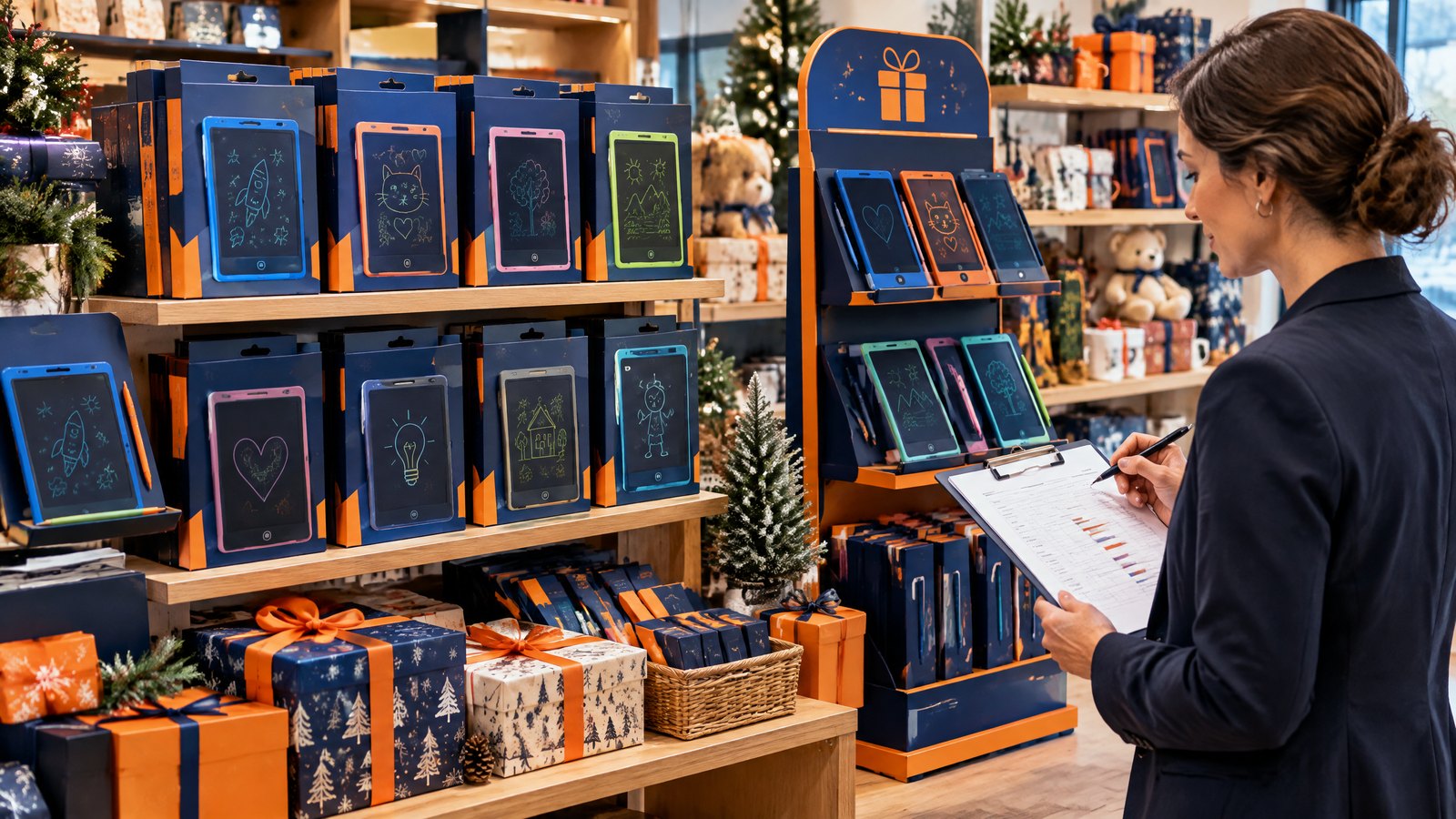
This guide provides a practical B2B decision framework. Final specifications, market obligations, testing scope, labels, packaging and shipment requirements must be confirmed for the exact finished SKU and destination.
LCD Writing Tablets for Subscription Boxes: Product Selection, Pack-In Design, and Repeat Supply
Direct answer: The best LCD writing tablet subscription box program uses a simple, low-power tablet as a repeatable activity platform—not a one-off gadget. Select a screen size and battery format that match the subscriber’s age and box dimensions, make the tablet work with a fresh monthly prompt card or themed insert, protect the lock and erase functions in transit, and freeze one approved specification before repeat orders. For US, UK, Germany and France launches, treat the tablet, battery, printed assets and retail/shipping packaging as one compliance and receiving system.
For a kids activity subscription product, the commercial win is not the lowest unit price. It is a tablet that arrives scratch-free, powers on, clears reliably, fits the unboxing story, and can be supplied in the same controlled version months later. This guide helps subscription operators, activity-box brands and retailers brief a Shenzhen OEM/ODM factory such as LcdWritingTablet, compare viable formats, and establish a replenishment process that protects customer experience.
Module 1. Decide whether an LCD tablet earns its place in the subscription box
An LCD writing tablet works where the box promises independent play, travel activity, early writing, drawing or puzzles. Its pressure-sensitive screen and stylus offer immediate use without app onboarding, charging cables, ink or disposable paper, so a printed activity card can explain it quickly.
The category is less effective when the value proposition needs permanent, highly detailed or color-critical output. It is an erasable visual surface, not a tablet computer or art-supply replacement. Its retention role is to make later themes usable: change the prompt card while the durable tablet remains familiar.
Define the job before requesting quotations: “A 6.5-inch reusable drawing tablet gift box item for ages 4–7, used with A6 cards in a 30 cm mailer.” This stops a supplier pricing a generic novelty that does not fit the audience or box.
A go/no-go test asks whether the item solves this month’s activity need, supports the retail-value target, survives the carrier route in its protective pack, and has a clear age grade and instructions. If not, choose another SKU.
Module 2. Build the subscription assortment around age, use case, and box geometry
Do not start with a catalogue color. Segment subscribers by hand size, supervision, drawing task and cubic volume. Young children need a comfortable stylus, uncomplicated erase action and a clear age grade. Travel boxes may value an attached stylus; letterbox shipments may need a thinner format.
Select a baseline format, then specify the variation rules
A 6.5-inch or similarly compact item is often the easiest first LCD writing tablet pack in because it uses less box volume. An 8.5-inch or 10-inch format creates more drawing room but increases dimensional weight and protection needs. Quote viewable area, finished dimensions and packed weight separately; a model label does not replace a sample measurement.
| Selection factor | Compact activity format | Larger hero-item format | Buyer decision |
|---|---|---|---|
| Monthly-box role | Supporting tool or add-on | Main value driver | Match to retail-value target |
| Screen space | Tracing, short games, names | Drawings, group games, handwriting | Test with real content cards |
| Freight and fit | Lower cube; easier mailer fit | More dimensional-weight exposure | Quote packed dimensions |
| Best repeat approach | Same device, changing prompts | Fewer variants; stronger seasonal use | Freeze an approved SKU |
Define allowed variation. Shell color and card artwork may change, while screen construction, battery tray, stylus, erase mechanism, dimensions and carton configuration remain fixed. That is the basis of repeat supply.
Convert child experience into an engineering brief
Ask the factory to confirm line color, indoor contrast, pressure response, erasure, screen feel, stylus retention, lock behavior and battery replacement with samples. State whether the button cell is user-replaceable or child-accessible. A premium gift needs different presentation from a mixed children activity product wholesale carton.
The brief should include age, languages, packaging dimensions, storage conditions, logo method, print files, marks, barcode owner, master-carton target, forecast and replenishment cadence. “For kids” or “good quality” is not measurable.
Module 3. Choose product features that improve use, not just the quotation
The core specification is a flexible LCD screen, housing, pressure-writing layer, erase button, stylus and battery. A lock prevents accidental erasure but needs clear instructions. A tether reduces loss but can tangle; a stylus slot must hold during vibration. A novelty shell can complicate a flat insert.
Favor features with a clear monthly job. An early-learning box may need one erase key and a lock; travel use favors a secure pen slot and thin sleeve. For a private-label activity box tablet, use an evergreen housing and let cards or sleeves deliver the seasonal story.
Be cautious with claims. “Eye-friendly,” “paper-saving,” “educational,” “non-toxic,” and “sustainable” need substantiation and market review. Describe the actual feature instead: “reusable erase-and-write screen; no charging cable required,” if true. Battery and end-of-life obligations still matter.
A buyer should retain a golden sample with photos of the device, battery compartment, stylus, labels and packaging. Record model code, screen type, shell/color reference, weight, button behavior and artwork revision.
Module 4. Design a pack-in experience that survives fulfillment and earns repeat engagement
A great pack-in performs three jobs within seconds: it explains the tablet, invites the first activity and protects the device. Use a small “Start Here” card at the top of the box. It can show: remove the stylus; write or draw; slide/unlock if locked; press erase; keep the battery cover closed. Use line drawings and short, market-appropriate copy rather than relying on a long generic leaflet.
Make the paper insert part of the product system
Plan prompt cards at the same time as the device. A card that asks a child to copy a detailed scene onto a small screen will disappoint even if the tablet works perfectly. Set safe margins so the supplied stylus does not obscure the instruction. Test card legibility at the intended age. When the box serves US and UK English plus German and French markets, allocate artwork space early for translations, warnings and recycling information; do not shrink vital text after final art.
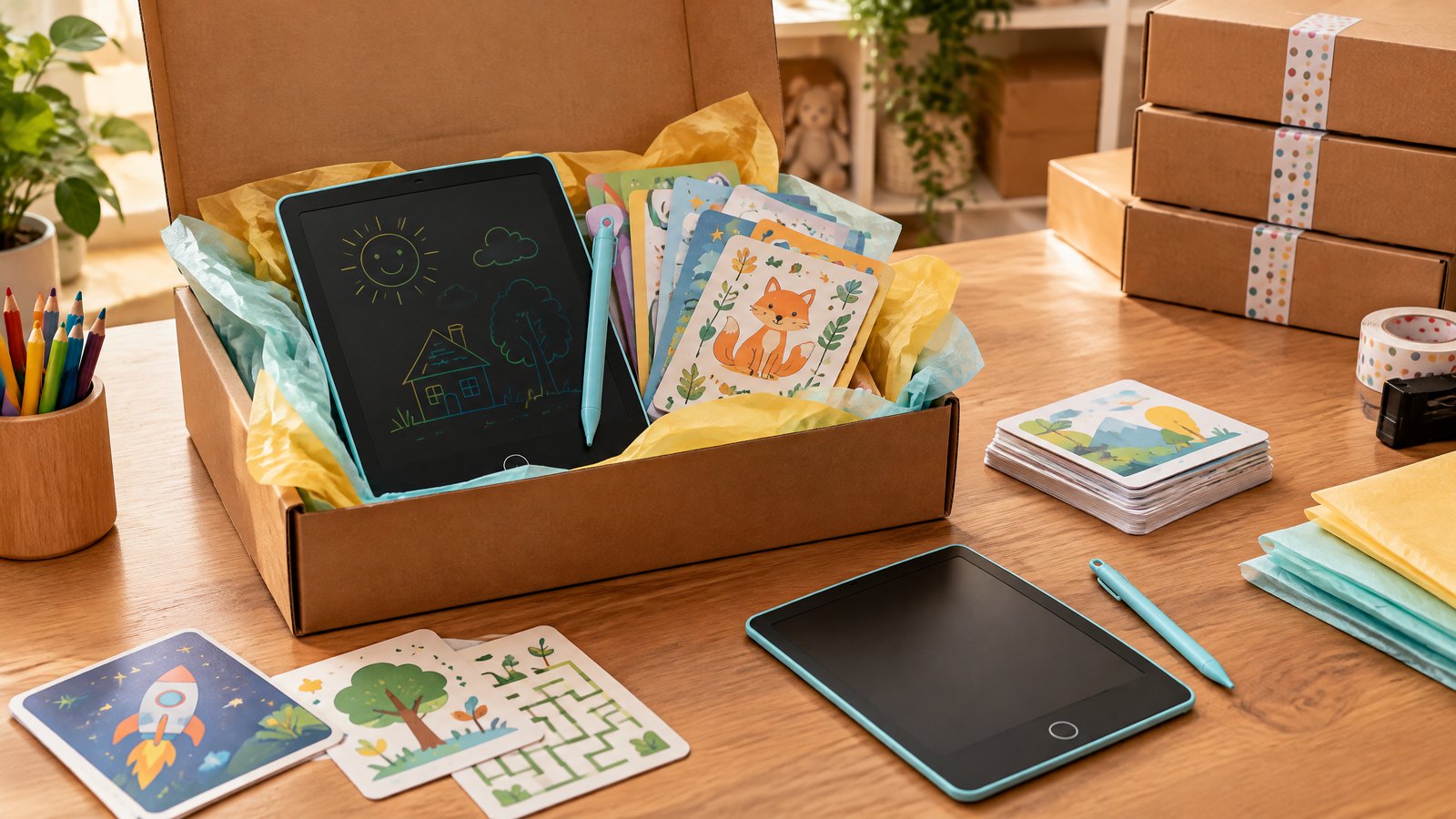
Common formats include a single activity card, a mini deck, a foldout challenge board or a branded sleeve with an on-pack game. The most repeatable option is often a standard device plus a monthly A6 or A5 card that is unique to the theme. It keeps the durable SKU stable while allowing editorial teams to create new content quickly. If the tablet is placed in month one, later boxes can revive it with a “bring back your drawing tablet” prompt, which reduces the need to ship duplicate electronics.
Engineer the nesting, not only the retail appearance
The screen should not be loose against scissors, hard toys, metal pins or heavy jars within a mixed box. Use a paperboard sleeve, molded-pulp tray, corrugated divider or card wrap that stops surface-on-surface rubbing. A simple protective film may help during production and fulfillment, but assess whether it causes unnecessary waste or confuses the recipient. Avoid a loose plastic bag where it creates a child-safety or local packaging concern. Choose a material and bag warning only after the applicable market requirements are verified.
Run a real pack-out test: load every item at maximum tolerance, close the outer mailer, shake it, drop-test the intended shipping configuration through the appropriate program, then open it as a customer would. Check that the erase button did not activate, the lock did not move, the stylus remains present, corners did not mark the screen, and the printed card is readable. Good pack-in design turns a generic tablet into a deliberate activity-kit component.
Module 5. Turn OEM/ODM options into controlled private-label decisions
OEM is normally the right route when the buyer has an approved existing tablet construction and wants brand artwork, specified colors, customized packaging or a curated insert. ODM becomes more relevant when changing the housing, adding a feature, altering the tooling, redesigning the functional interface or developing a non-standard form factor. The buyer should ask the supplier which elements are existing, which are customized, who owns the artwork and tool data, and what change costs or lead times apply.
Start with the lowest-risk customization that produces a coherent brand: colorway, logo, branded instruction card, sleeve and master-carton labels. That can be enough for a private label activity box tablet without taking the tooling risk of a novelty shape. Move to custom molds only if subscriber research, margin and forecast justify the cost across several production runs.
Create a purchase specification, not merely a purchase order description. It should state the device model and revision; approved physical sample; screen dimensions; material/color standard; logo artwork and placement; stylus specification; battery and isolation state; individual protection; card/sleeve material; warning and origin copy; barcode; carton count; palletization; inspection plan; and document package. Include photo callouts for details that written words misdescribe.
Set change control in writing. No substitute LCD film, battery supplier, resin grade, ink, logo process, carton board, inner pack or label artwork should be introduced without written approval. This is fundamental to repeat supply because an unannounced “equivalent” can create mixed inventory, a failed inspection or non-matching compliance documentation. Ask LcdWritingTablet to identify every critical component that has long lead time or a single approved source and to give early warning if it changes.
Module 6. Model cost as a landed, fulfillment-ready program
The factory unit price is only one line in the product decision. A low-priced device can become expensive if it needs a larger shipping box, a stronger divider, a separate insertion operation, higher damage allowance, or a manual battery isolation step. Compare quotations on one scope: EXW or FOB term; device; stylus; battery; logo; individual protection; printed insert; individual carton or sleeve; master carton; testing/documentation; inspection; inland transport; sea/air freight; duties/taxes; destination handling; and fulfillment labor.
For subscription operations, cost per successful delivered unit is more useful than cost per device. Estimate it as: purchase cost + inbound and duty + packaging + pick/pack insertion + outbound cube impact + expected replacement/return cost. Then compare two possible formats. A larger model may justify itself as a high-perceived-value acquisition gift. A compact model may win on margin when it nests with other box items and creates fewer carrier damage claims.
MOQ should be split into component logic. There may be one MOQ for an existing device color, another for branded packaging, a print MOQ for activity cards, and a higher MOQ for a custom mold. For monthly planning, negotiate a production blanket forecast with call-off quantities only after the factory confirms component reservation, allowable forecast variance, payment terms, storage, shelf-life considerations for batteries, and lead time from release to ex-works date. Never assume a previous order guarantees identical components are still available.
For a factory-ready costed quotation and repeat-supply brief, email info@lcdwritingtablet.com.
Module 7. Build quality into the receiving plan, from pre-production to warehouse scan
Quality control begins before mass production. Approve the pre-production sample against the signed artwork and golden sample, and confirm revision control. Inspect the complete pack-out—not only the device—for tablet, stylus, battery state, card, sleeve, label and cartons.
Define functional, visual and pack-out acceptance criteria
Functional inspection should include writing response across the active screen, complete erase when unlocked, correct lock behavior, stylus fit/retention, no unintended operation in normal handling, and battery-compartment integrity. Visual inspection should check screen scratches, cracks, dents, sharp edges, incomplete logo, dirty screen, color mismatch, print registration and warning legibility. Pack-out inspection should check SKU, language card, barcode scan, correct quantity, protective material, carton drop/handling performance where specified, and carton markings.
Specify the sample standard and severity definitions in the inspection protocol. Critical, major and minor defects must mean something concrete. For example, an accessible battery compartment or a cracked housing is not in the same category as a light, non-visible molding mark. Set an acceptable quality level with an inspection partner or supplier only after risk review. Do not use a generic AQL number as a substitute for defining safety and functionality defects; critical safety failures should have zero acceptance.
At receiving, quarantine one representative carton per SKU until the warehouse confirms count, external condition, label scan, artwork revision and a small functional check. Photograph damage before breaking down cartons. Capture carton and device lot information in the warehouse record so customer-service reports can be traced to a production run. For a subscription box toy supplier, this evidence is essential when several monthly campaigns use visually similar tablets.
Monitor three post-launch signals: replacement reason, erase/lock complaints and missing-stylus reports. Review those with the factory after each first run, then quarterly. A simple defect-code report may reveal that a screen protection issue belongs to fulfillment while an intermittent erase issue belongs to the device. Correct the root cause before placing the next release, not after a second box has been packed.
Module 8. Confirm compliance, labels and producer responsibilities before goods ship
This section is a procurement checklist, not legal advice. Classification and required tests depend on the product’s intended age, marketing, battery configuration, actual construction, destination and the economic operator placing it on the market. Have the importer/brand and a qualified compliance adviser or test laboratory review the final physical sample, claims, labels and technical file before release.
United States: toy status, children’s-product records and batteries
If the item is designed, manufactured or marketed as a plaything for children under 14, it may be a toy under the US framework. ASTM F963 is a mandatory consumer product safety standard for children’s toys; CPSC guidance also describes certification and marking obligations for children’s products and specific labeling/instruction areas for battery-operated toys. The applicable ASTM sections and other rules must be determined for the actual SKU, age grade and components—not copied from a competitor listing. 1
Ask for the test plan, lab report(s), Children’s Product Certificate when required, tracking-label approach and factory details that support traceability. Ensure product and packaging identity stays consistent with the certificate and batch. A seller should also assess warning, battery and choking/small-parts implications for the actual age grade rather than simply printing an age icon. Battery access, retention and instructions are high-risk details that deserve a physical sample review.
Germany and France: EU toy, electronics, online safety and packaging obligations
For products placed on the EU market as toys, the Toy Safety Directive establishes essential safety requirements across physical/mechanical, flammability, chemical, electrical, hygiene and radioactivity risks. The European Commission states that toys sold in the EU carry CE marking; conformity assessment, technical documentation and the EU declaration process must match the actual product. 2 An LCD writing tablet with electronic components can also bring electrical/electronic equipment requirements. RoHS restricts specified hazardous substances in EEE unless an exclusion applies, while WEEE addresses collection and recycling; confirm the product’s scope and national registration obligations with a qualified adviser. 3
The General Product Safety Regulation has applied since 13 December 2024 and includes online and distance sales. It requires businesses to make available only safe products and uses a risk-assessment approach; sector-specific toy rules still apply where relevant. 4 For direct-to-consumer subscription shipments, make sure product identification, economic-operator information, warnings/instructions and online product data are reviewed for the final market language and role allocation.
Packaging is a separate workstream. EU packaging rules cover packaging placed on the market regardless of material or origin, and the PPWR has an application date of 12 August 2026. 5 In Germany, check the buyer’s role under current packaging law: the LUCID register guidance explains registration and, for certain foreign businesses selling packaged products directly to German end users, use of an authorised representative; system participation and data reporting can also apply. 6 For France, obtain current advice on packaging EPR, French sorting information and any applicable product/battery/electrical-scheme obligations before printing. Do not assume an OEM’s generic carton artwork transfers those duties to the subscription brand.
United Kingdom: confirm GB versus Northern Ireland and applicable marking
For Great Britain, the official guidance explains that CE marking recognition has been extended indefinitely and that CE or UKCA can be used in the outlined situations; it also sets out manufacturer, importer and distributor responsibilities, technical documentation and conformity assessment. 7 Northern Ireland and EEA routes are not interchangeable with Great Britain. Decide the sales destination, importer identity and marking path before artwork approval, then retain the declarations, test evidence and traceability records that support it.
In all markets, verify current requirements at the time of launch. Regulation changes, product claims, new packaging materials and a change from “activity accessory” to “toy” marketing can materially alter the compliance case.
Module 9. Plan repeat supply like a controlled replenishment program
The first purchase is a launch; later orders prove scalability. Use a rolling 6–12-month forecast for base demand, subscriber/promotional uplift, contingency stock and fulfillment dates. Share a monthly update and firm release window so the factory can secure components and print capacity.
A useful model has three inventory layers. Keep finished devices for near-term confirmed boxes, components for the next forecast window, and approved artwork/templates for future activity cards. Avoid holding a large inventory of season-specific printed sleeves if subscriber counts are uncertain. Hold a neutral branded tablet and apply the seasonal story in a short-run card, belly band or box insert where practical.
Protect continuity through a controlled bill of materials. The revision list should name the screen, housing, stylus, battery, print material, protective layer, carton and label. Require advance notice for supplier or material change, then approve a new sample and assess whether existing reports/documentation remain applicable. Set re-order triggers based on fulfillment-center weeks of cover plus production and freight lead time, not on a supplier’s optimistic “ready stock” promise.
For repeat orders, run a pre-shipment reconciliation: purchase-order revision, approved artwork, quantity by SKU and language, battery configuration, barcode, carton count, compliance-label version, documents, inspection release and shipment booking. This ten-minute control prevents a costly mismatch, such as French cards packed in a Germany allocation or an older sleeve paired with a new device revision.
Module 10. Use this sourcing checklist and buyer FAQ to remove ambiguity
Before placing the first order, a subscription buyer should be able to answer: Which exact model and revision are approved? What age grade and market claims will be used? What does each unit contain? What protects the screen? Which language/version goes to each destination? What acceptance criteria apply? Who owns compliance decisions and packaging EPR? What is the confirmed lead time, forecast flexibility and contingency plan? If these answers are dispersed across chat messages, convert them into the purchase specification and signed artwork pack.
Frequently asked questions
Is a writing tablet a good first-box item or a monthly repeat item? It is usually strongest as an onboarding or gift-box hero item, followed by new monthly prompt cards that revive the device. Repeating the same electronic device every month can feel redundant unless the recipient base changes or the tablet is part of a multi-child gift strategy.
What should be customized first? Start with the insert, branded sleeve, logo treatment and chosen colorway. Those create a recognizable unboxing experience without the cost and supply risk of new tooling. Use custom housing only when volume and brand differentiation justify it.
Can one specification serve the US, UK, Germany and France? Sometimes a common physical device can, but labels, responsible-party information, documentation, language, packaging obligations and market route still need market-specific review. Do not treat a generic “CE/FCC/RoHS” print as evidence that the finished subscription SKU is ready everywhere.
Should the tablet arrive with a battery installed? This is a design, safety, shipment and customer-experience decision. Define the exact battery type, isolation method, accessibility, test state and instruction before quotation. Validate the final configuration with the relevant shipping, product-safety and compliance specialists.
How can we reduce replacements? Use a protected screen-facing pack-out, retain the stylus securely, test the erase and lock functions on production samples, publish a clear start card, and use lot-level receiving checks. Log reasons for every replacement and link them to production/fulfillment records.
What evidence should a factory provide? Request the approved sample record, specification, relevant test reports, declarations/certificates as applicable, bill of materials/change history, factory and lot traceability information, packaging artwork proof, inspection evidence and shipment documents. The buyer remains responsible for judging whether the evidence applies to the final product and market.
Module 11. Plan product visuals, then close the procurement loop
Use the exact approved SKU in product visuals; a generic render should not replace the final shell, stylus or packaging.
| Purpose and placement | Suggested caption | ALT text | English AI image prompt |
|---|---|---|---|
| Hero image below the direct answer | “A reusable activity tool designed for monthly box themes.” | “Branded LCD writing tablet with prompt cards in a children’s subscription box” | “Commercial product photo, premium children’s activity subscription box open on a clean studio surface, branded LCD writing tablet with stylus, A6 drawing challenge cards and protective paper sleeve, cheerful but restrained colors, no readable logos, sharp realistic packaging detail” |
| Module 2 selection visual | “Screen size and card format should be tested together.” | “Compact and larger LCD writing tablets beside activity cards” | “Top-down B2B product comparison photograph of two unbranded LCD writing tablets, compact and larger size, next to A6 and A5 activity prompt cards and a ruler, neutral light background, precise realistic proportions, clean procurement catalog style” |
| Module 4 pack-out visual | “Protect the screen and retain the stylus inside a mixed-item box.” | “LCD writing tablet in protective paperboard pack-in tray” | “Cutaway product-packaging photograph of an LCD writing tablet secured in a recyclable paperboard sleeve and divider inside a monthly subscription box with adjacent soft activity items, stylus locked in slot, realistic studio lighting, focus on protection and nesting” |
| Module 7 inspection visual | “Inspect function, labels and complete pack-out before release.” | “Quality inspector checking LCD writing tablet erase function and carton labels” | “Documentary-style factory quality-control scene, gloved inspector testing the erase button on an LCD writing tablet beside golden sample, barcode scanner, inspection checklist and sealed cartons, clean Shenzhen electronics factory, realistic, no visible brand names” |
Conclusion
A successful LCD writing tablet subscription box is a reusable activity system, protected pack-in and controlled SKU. Begin with the recipient’s task and real mailer dimensions. Use prompt cards for monthly value, then lock the sample, quality criteria, compliance workstream, pack-out and revision control before scaling.
For LcdWritingTablet buyers serving the US, UK, Germany and France, this approach makes OEM/ODM work practical: the factory receives a testable brief, the fulfillment team receives a stable pack-out, and the subscriber receives a product worth keeping. Repeat supply becomes a planned operating process rather than a scramble to replace a generic novelty item.
To discuss an OEM/ODM LCD writing tablet program for your subscription box, email info@lcdwritingtablet.com.
References
Continue with the next sourcing decision.
Use these internal links to compare products, check common buyer questions, review compliance preparation, or send your requirements to the factory.
Turn this sourcing plan into a product brief.
Share your target market, product requirements, packaging preference and estimated volume for a practical OEM / ODM discussion.