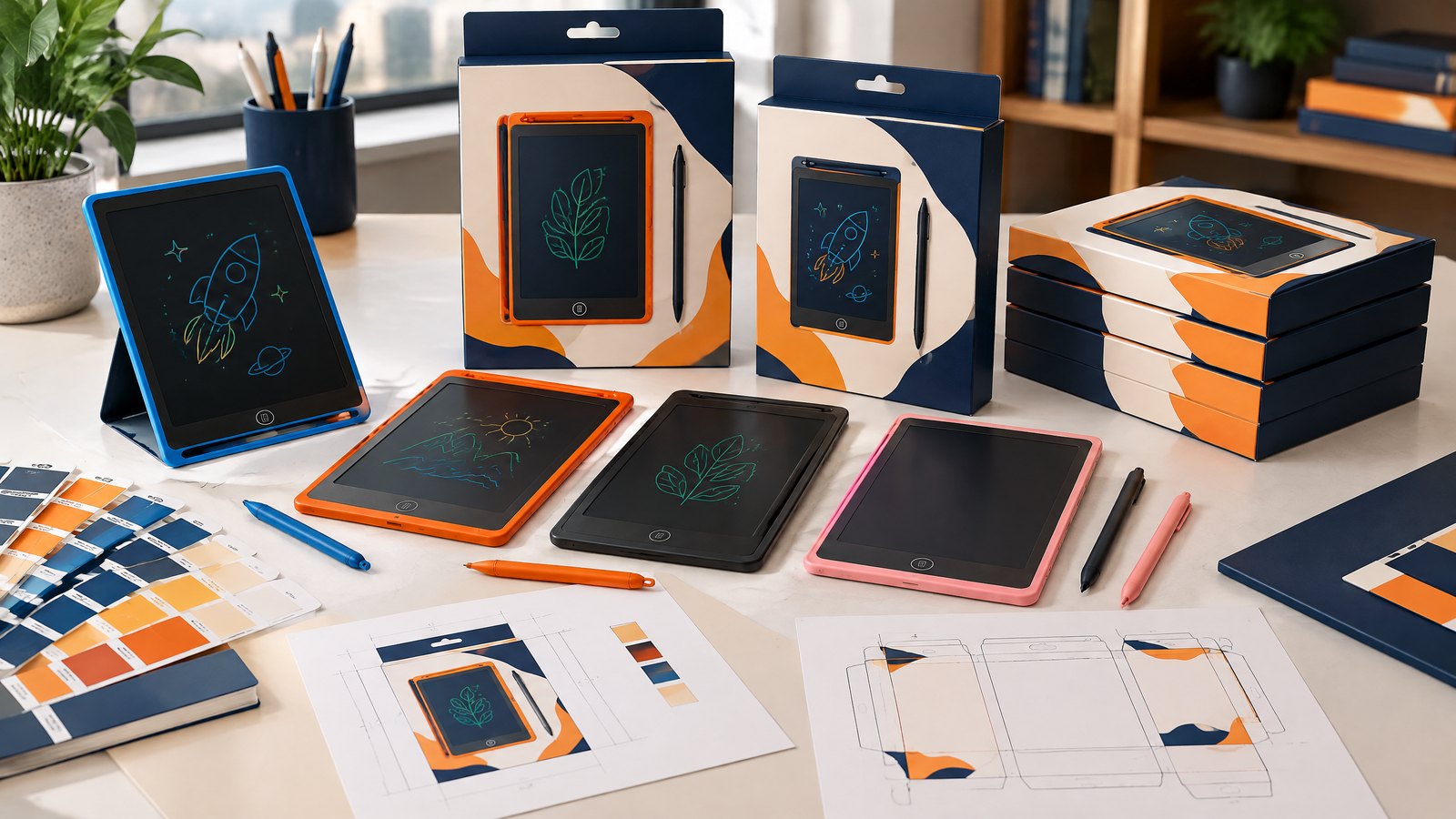
This guide provides a practical B2B decision framework. Final specifications, market obligations, testing scope, labels, packaging and shipment requirements must be confirmed for the exact finished SKU and destination.
LCD Writing Tablets for Occupational Therapy and Special Education: Procurement and Use Guide
1. Direct answer: what should a buyer procure?
For therapy rooms, special-education programs, and inclusive learning environments, procure an LCD writing tablet as a repeatable low-distraction writing surface, not as a substitute for clinical assessment, a communication system, or a general-purpose computer. Its useful job is narrow and practical: a learner can make a visible mark with a stylus or fingertip pressure, erase the board, and begin again without paper turnover, screen navigation, account setup, sound, or wireless interruption.
A successful LCD writing tablet occupational therapy purchase starts with the activity it must support. A clinic may need a small batch that is easy to wipe between sessions. A specialist classroom may need color-coded sets with a stable storage routine. A distributor may need retail-ready packs and localized artwork. Those are different specifications even when the display size is identical.
The right OEM/ODM brief therefore describes the learner group, adult supervision level, intended activities, environment, cleaning method, destination market, branding route, packaging configuration, and document package. It also states what is not being promised. The device can offer a reusable surface for drawing, copying, visual choices, and brief written responses. It does not diagnose, treat, cure, or guarantee an educational outcome. Occupational therapists, teachers, families, and program leads decide whether an individual activity is suitable and how it fits a learner’s goals.
For most institutional buyers, the lowest-risk starting point is a locked, single-purpose tablet with a tethered or stowable stylus, a reliably protected erase-control arrangement, legible visual cues, batch traceability, and a pre-agreed sample approval. A larger screen is not automatically better: it can support larger letter formation and shared prompting, but it adds footprint, pack volume, and a longer reach distance. Test the exact intended tasks before freezing dimensions.
2. Buyer context: procurement must reflect participation, not a generic product category
Occupational therapy in schools supports children and young people’s development and learning 1. Use participation as the procurement lens: define what a learner needs to do—make a choice, trace a route, copy a short model, rehearse a transition, or share a response—then choose the board and workflow that remove friction.
For US public-agency buyers, assistive technology may be required as special education, a related service, or a supplementary aid; home use can be determined case by case by the IEP team 2. This does not make every LCD board assistive technology for every learner. Preserve individualized decisions and record the educational rationale.
For UK, German, and French programs, pilot with an OT or therapy lead, special educator, procurement owner, and the person responsible for storage. Distributors should add packaging and market-compliance ownership before artwork approval.
A writing tablet for special education is most valuable when it creates a low-pressure way to try, revise, and clear a response. The instant-clear feature can reduce visible clutter between attempts, but it can also erase work a learner wanted to keep. Adults should decide when they will photograph or transcribe meaningful work, when to use a lock feature if available, and when paper or another tool is a better record. The absence of saved data is often a privacy advantage; it also means it is not appropriate when a durable record is required.
Treat accessibility as a design and deployment question. A visual board may be helpful for some learners but inaccessible or unhelpful for others because of glare, contrast needs, motor range, vision, sensory preferences, or communication method. Under the ADA, covered entities must provide auxiliary aids and services when needed for effective communication, considering the nature, complexity, context, and the person’s usual methods of communication 3. A tablet can be one optional material within an accessible system; it should never displace a learner’s established communication support.
3. Product and use-case explanation: map activities to a controlled surface
An LCD writing tablet shows a pressure-made line and clears it through an erase control. Evaluate mark visibility, writing force, active area, stylus handling, erase/lock behavior, enclosure, and battery access against activities—not screen inches and unit price alone.
Therapy and learning activities that suit the format
For LCD tablet fine motor activities, use short repeated tasks: trace broad paths, connect dots, copy strokes, mark a choice, or complete a visual-motor warm-up. An adult can vary challenge with high-contrast models, fewer marks, positioning, or a nearby template. The board is a reusable material within a teacher-led or professional-led activity, not the intervention itself.
A LCD writing tablet sensory activity can be a quiet mark-making option in a planned regulation routine. Define its purpose and stopping rule; observe frustration from accidental erasure, stylus handling, reflection, or faint marks. “Sensory” is not a universal benefit, so use learner and practitioner feedback.
Useful special-education workflows include visual choice making, pre-writing rehearsal, brief first/then or task prompts, and shared review of a drawn response. Capture a choice before clearing if documentation is needed; retain an accessible companion format where written visual information is not the learner’s effective method. The board is a visual anchor, not a communication system.
When the tablet is the wrong tool
Do not choose this format where the learner needs tactile letters, braille, auditory feedback, pressure-sensitive digital capture, permanent work storage, screen-reader output, or an alternative access method that the product cannot support. It can also be a poor fit where a visible erase button triggers repeated clearing, a stylus creates a safety concern, or the setting cannot keep coin-cell devices secured and supervised. Build alternatives into the program instead of forcing a product match.
4. Specification and decision framework: turn learner needs into measurable acceptance points
An adaptive writing tablet for children is not defined by a marketing adjective. It is defined by an agreed set of task, access, durability, and safety requirements. Convert each desired benefit into something a sample reviewer can observe.
Define the task before selecting the display
Write a one-page use-case card: user age/supervision, posture, activity duration, intended marks, stylus need, erase-control rule, and disposition of completed responses. “Children will draw” is vague; “adult and learner trace six 15 mm-wide paths on a tabletop, then erase” is testable.
Choose screen size from the longest mark and available working area. Request the active writing area—not only external dimensions—and test it with actual templates. Larger boards help shared modeling only when they remain practical to hold, store, and protect.
Specify usable controls and physical details
Request the erase mechanism, lock function, stylus/attachment, battery-door design, corner construction, and indoor-light contrast. A photo cannot confirm button force, accidental activation, stylus retention, or icon readability.
Verify whether the learner can make a visible line; the stylus is retrievable and appropriate for the setting; adults can distinguish erase/lock state; the lock works; cleaning preserves essential graphics; and the board is stable for its intended orientation.
For an ODM project, stabilize functional decisions before decorating the product. Brand color, logo placement, multi-language instructions, and custom packaging should be approved only after the physical sample passes activity trials. If a custom mold, new mechanism, or redesigned battery area is proposed, it requires a separate risk and validation plan—not merely a revised quotation.
Build an acceptance matrix
Use a pass/fail and observation matrix. Examples: “mark is visible to reviewer at the intended distance under the agreed light,” “erase occurs only when the approved sequence is used,” “stylus stores in the defined location,” “no sharp or loose feature is observed after the agreed functional checks,” and “outer carton labeling matches the approved SKU matrix.” Where a test calls for a recognized method or a legal standard, specify that exact method, edition, laboratory scope, and report identity in the purchase documents. Never replace those requirements with a generic claim that a product is “tested.”
5. Procurement and validation process: approve the program, not only the sample
A capable therapy clinic writing tablet supplier should translate the brief into samples, artwork proofs, pack information, inspection criteria, and traceable shipping documents. The buyer still owns final specification, market role, and suitability. Use staged releases so design does not bypass functional review.
- Discovery and requirement sheet. Give the factory a written application summary, target countries, buyer role, artwork languages, required documents, expected pack configuration, and sample decision date. Flag immediately if the item is a children’s product, educational resource, or general-use product, as classification affects the compliance work.
- Reference sample and activity trial. Ask for the proposed configuration, not only the nearest catalogue model. Run short observed trials with the activities listed in the use-case card. Record what users can do independently, what staff must prompt, and what fails.
- Specification freeze. Sign off on the bill of materials that matters to compliance and performance: display, housing resin, stylus, battery, door, fasteners, artwork, packaging, and instructions. Tie color and logo references to an approved proof.
- Pre-production confirmation. Review the production sample, packaging proof, markings, carton marks, barcodes if required, and document list. Recheck that a last-minute battery or packaging substitution has not altered obligations.
- Production, inspection, and release. Agree on the inspection level, sampling plan, defect classifications, rework rules, and what evidence is needed before the balance shipment is released. An independent inspection can be useful when the buyer needs a neutral check against the signed specification.
OEM/ODM CTA — Mid-article: To turn your therapy or special-education use case into a sample brief, pack plan, and inspection checklist, email info@lcdwritingtablet.com.
Image plan for this guide
| Image recommendation | Purpose and placement | English caption | ALT text | English AI prompt |
|---|---|---|---|---|
| Therapist-led tracing setup | Show controlled adult-supported use; place after the activity section | “A reusable writing surface for short, guided tracing practice.” | “Occupational therapist supporting a child using an LCD writing tablet at a table.” | “Documentary-style inclusive occupational therapy room, adult therapist beside a child using a black LCD writing tablet for broad line tracing, calm daylight, no logos, realistic clinical education setting, respectful and non-medical.” |
| Product-detail flat lay | Make decision features visible; place in the specification section | “Specify the active area, stylus storage, erase control, lock, and battery-door design.” | “Top and rear views of an LCD writing tablet showing stylus slot, erase button, lock switch, and secured battery door.” | “Clean commercial product flat lay of a generic LCD writing tablet, front and back views, labeled callout space but no text, black background with soft studio lighting, no brand logos.” |
| Sample review meeting | Show collaborative validation; place in procurement process | “Approve a use-case sample with the people who will deploy it.” | “Special educator, occupational therapist, and procurement lead reviewing LCD writing tablet samples.” | “Realistic school procurement review meeting with diverse special educator, occupational therapist, and procurement manager examining several generic LCD writing tablets and packaging proofs, bright meeting room, no logos.” |
| Carton receiving check | Reinforce traceability; place in receiving controls | “Match units, labels, documents, and cartons before program rollout.” | “Receiving staff checking carton labels and LCD writing tablets against an inspection sheet.” | “Warehouse receiving quality check of sealed cartons and generic LCD writing tablets, staff using paper checklist, visible but unreadable carton labels, clean professional lighting, no logos.” |
6. Quality and receiving controls: verify what arrived against what was approved
Useful pre-shipment evidence includes visual consistency, writing/erasing checks, stylus and battery-door assembly, pack counts, approved artwork, carton marks, and photos by SKU and lot. Specify frequency, sampling, and acceptance rather than adopting a factory plan by default.
Add use-relevant checks: sample across cartons, verify mark visibility with approved activity cards, consistent clearing, lock behavior, and stylus storage. Wipe a retained sample only with the agreed cleaner and cloth to check immediate compatibility; this is not a universal cleaning claim.
At receiving, quarantine a small check sample before distributing the full shipment. Match the purchase-order SKU, color, screen size, country-specific packaging, instruction language, batch or lot identifier, quantity per inner pack, and carton count. Confirm that the supplied documents correspond to the finished product and market, not merely to an earlier sample or another model. Photograph any variance before putting units into service. Separate damaged cartons, missing accessories, loose parts, weak markings, or unclear documentation until disposition is agreed.
Create a simple field-feedback loop. Staff should be able to report “eraser clears unintentionally,” “line too faint in room light,” “stylus frequently lost,” “lock confusing,” or “pack label mixed” using a consistent category and batch identifier. This supports corrective action with the supplier and prevents a subjective comment from being lost. It also helps distinguish an individual misuse issue from a recurring product or packaging problem.
A shipment example: before a multi-site school delivery, the buyer receives a carton list, approved pack artwork, and batch identifiers from the factory. On arrival, the receiving team selects unopened cartons across the consignment, counts inner packs, confirms the correct localized insert, tests agreed functions on a limited sample, and holds the remainder until discrepancies are logged. The rollout team then allocates sets by location with the batch record retained. This is more useful than relying on a single inspection photo taken at the factory.
7. Cost, packaging, and logistics: compare landed program cost, not unit price
Budget beyond board price for samples, configuration, artwork, compliance work, testing where needed, translation, packaging, inspection, freight, imports, warehousing, damage allowance, and replacements. Custom color, logo, lock, tether, insert, or country pack can change cost and lead time; obtain written assumptions.
Quote two packaging scenarios. Clinic packs may emphasize count and identification; retail packs may need multilingual information, barcodes, and presentation; school packs may need numbered bundles and a carton map. Avoid oversized retail packaging for institutional logistics.
For shipments from Shenzhen, identify product price, freight, export documents, import-clearance responsibility, taxes/duties, and final delivery separately. Confirm whether batteries are installed, separate, or excluded because that can affect shipment documents and labels. Involve the freight provider and importer of record early.
Carton markings should link to the usable SKU matrix: product description, model, color if relevant, market pack, quantity, gross/net weight if used, carton dimensions, batch or lot reference, and handling marks. Request a packing list that lets a warehouse reconcile the consignment without opening every carton. For customized education orders, a carton allocation list can reduce the chance that one classroom receives all of one color or language pack.
Avoid unsupported promises on minimum order quantity, production time, durability, or freight transit. These vary with configuration, component availability, test scope, artwork, order size, season, carrier capacity, and destination. Obtain a dated quotation and sample plan for the actual configuration instead.
8. Compliance caveats for the US, UK, Germany, and France
This section is a procurement prompt, not legal advice. Product classification, intended age, claims, battery configuration, packaging, sales channel, and who places the product on the market affect obligations. Before purchase, identify the legal manufacturer and each economic operator, confirm the destination market, and obtain professional regulatory advice where the buyer has uncertainty.
US
If a product containing a button or coin battery is within scope, US requirements can include secured battery access, warnings on the product/packaging/instructions as applicable, and certification requirements. CPSC guidance says replaceable button/coin battery compartments must require a tool or two independent simultaneous hand movements to open and must resist access or release in use and abuse testing 4. It also distinguishes requirements for children’s products and general-use products. Do not assume a screw alone proves compliance; request the relevant test evidence, certificate route, labels, and model match.
If the item is marketed for children, evaluate all applicable children’s-product obligations with qualified counsel or a competent lab. Keep therapeutic language disciplined. A reusable writing board should not be promoted as a medical device or as treating developmental, sensory, motor, or communication conditions unless the buyer has separately established the appropriate regulatory basis.
European Union: Germany and France
Electrical and electronic equipment placed in the EU may be subject to applicable product-safety, CE-marking, RoHS, WEEE, battery, packaging, and language/information requirements. CE marking is the manufacturer’s declaration that the product meets applicable legal requirements; it is not a government safety approval 5. Manufacturers are responsible for conformity assessment, the technical file, the EU declaration of conformity, and affixing the mark where applicable 5. Importers and distributors also have responsibilities.
RoHS restricts ten listed hazardous substances in electrical and electronic equipment within its scope, subject to exclusions and exemptions 6. Keep the declaration, technical documentation, bill-of-material controls, and test evidence tied to the actual finished model and revision. Germany and France can also have country-specific producer registration, take-back, packaging, consumer-information, and language requirements. Validate current national requirements and the correct responsible party before placing goods on those markets. The EU General Product Safety Regulation context also matters: only safe products should be available on the market, and Safety Gate is the rapid-alert system for dangerous non-food products 7.
United Kingdom
GB and Northern Ireland requirements are not interchangeable. UK government guidance says EEE in scope requires supporting technical documentation, a Declaration of Conformity, required information/labels, and appropriate conformity marking for the market 8. It also says that an importer placing EEE on the GB or NI market under its own name or trademark takes on manufacturer obligations 8. Confirm the current marking route, evidence retention, responsible economic operator details, local recycling obligations, and English instructions for the exact GB or NI destination. A branded import should not assume the Shenzhen OEM remains the only responsible manufacturer in law.
Across all markets, maintain a document register by model and revision: declaration(s), test reports, risk assessment where appropriate, artwork and label proofs, instructions, battery information, component declarations, traceability record, and corrective-action contact. Retain only claims you can substantiate. “Compliant” without a defined market and applicable basis is not a usable purchasing specification.
9. Practical decision table: match the configuration to the program
| Deployment scenario | Primary job | Procurement priority | Use protocol | Receiving control |
|---|---|---|---|---|
| OT clinic individual sessions | Repeatable short visual-motor tasks | Cleanable housing, stable tabletop feel, clear function | Therapist selects task and documents needed outcomes separately | Check mark visibility, erase action, stylus storage, batch ID |
| Special-education classroom set | Brief response and guided practice | Color/SKU control, storage plan, adult-manageable erase/lock | Assign set location; teach clear/return routine | Match classroom bundles, inserts, counts, and carton map |
| Inclusion resource room | Choice-making and visual prompts | Readability in room light, quick adult setup | Pair with learner’s established communication supports | Test display under actual lighting; check localized instructions |
| Home–school loan pool | Consistent portable practice material | Traceability, durable pack, replacement path | Define borrowing, cleaning, and what is not recorded | Verify loan-pack contents, warnings, and batch records |
| Educational distributor | Market-ready resale assortment | Market documents, localized packaging, barcode/artwork control | Provide accurate claims and age/safety information | Confirm model-to-document match and sellable pack condition |
| Multi-site program rollout | Consistent activity resource across locations | Carton allocation, train-the-trainer guide, replenishment SKU | Use a standard activity card and field-feedback categories | Sample across pallets; quarantine discrepancies before allocation |
10. Frequently asked questions
Can an LCD writing tablet be called assistive technology?
It can be considered in an assistive-technology discussion when it helps meet an individual learner’s need, but the label is not automatic. In the US, IDEA requires public agencies to make devices or services available when required as part of a child’s special education, related services, or supplementary aids and services 2. The team should determine need case by case and document how the item supports access or participation.
Is it appropriate to market the board as a therapy device?
Use caution. It is a reusable writing and drawing surface that may support professionally selected activities. Do not make diagnostic, treatment, cure, or guaranteed-development claims without substantiation and an appropriate regulatory basis.
What accessibility features matter most?
Start with the learner’s usual access and communication methods. Test line visibility, glare, active area, writing force, stylus grasp, control clarity, accidental erase risk, stability, and whether a response must persist. These educational tablet accessibility considerations must be validated in activity context, not inferred from a product photo.
Should we select a lock function?
Select it when adults need to prevent inadvertent clearing while reviewing a response or handing the board between people. Do not assume it is needed for all learners. Test whether staff can understand its state and whether it introduces frustration or delays. The approved workflow should define who controls the function.
How should a clinic clean the units?
Follow the finished product’s approved care instructions. Before broad rollout, test the intended cleaner and cloth on a retained approved sample, including printed areas and seams. Avoid saying a product is disinfectant-safe unless the supplier’s material compatibility evidence supports that exact claim. Keep cleaning separate from battery servicing and do not allow liquid ingress.
What documents should an OEM/ODM buyer request?
Request the approved specification, artwork and packaging proofs, packing list, batch/lot record, applicable declarations and test reports, instructions, warnings, component and battery information as appropriate, inspection evidence, and shipping documents. For regulated markets, have the responsible importer or compliance owner verify model, revision, dates, market, and legal entity details.
How do we pilot before a large order?
Approve samples that match the proposed material, controls, screen size, stylus, battery configuration, and pack. Run short activities, record barriers, make controlled revisions, and reapprove any changed sample before production. Tie the decision to a written acceptance matrix.
11. Conclusion and OEM/ODM next step
The best procurement decision is not the board with the longest feature list. It is the configuration that lets a learner participate in a defined activity with fewer avoidable barriers, while staff can store, clean, supervise, and replace it reliably. Specify the use case first; validate the physical interface with real activities; control artwork, documents, battery and packaging details; and receive against evidence rather than assumptions. That approach lets a Shenzhen OEM/ODM project serve US, UK, German, and French buyers without overstating what a simple reusable writing surface can do.
OEM/ODM CTA — Final: For a country-specific sample, packaging, and documentation discussion for your therapy or special-education program, email info@lcdwritingtablet.com.
References
Continue with the next sourcing decision.
Use these internal links to compare products, check common buyer questions, review compliance preparation, or send your requirements to the factory.
Turn this sourcing plan into a product brief.
Share your target market, product requirements, packaging preference and estimated volume for a practical OEM / ODM discussion.