This guide provides a practical B2B decision framework. Final specifications, market obligations, testing scope, labels, packaging and shipment requirements must be confirmed for the exact finished SKU and destination.
LCD Writing Tablets for Travel: Car, Airplane, and Holiday Retail Use Cases
Direct answer: An LCD writing tablet is a strong travel product when it is easy for a child to hold, simple to clear, protected against accidental erasure, and packed so the stylus and battery compartment remain secure from car seat to carry-on bag. For buyers, the best travel program is not just a small board with an appealing color: it is a verified product-and-packaging system matched to a real use case—quiet back-seat play, airline-friendly offline drawing, holiday gifting, or reusable classroom travel packs. The right OEM/ODM brief turns those situations into choices about screen size, lock function, stylus retention, packaging, labeling, incoming inspection, and country-specific compliance work.
LcdWritingTablet is a Shenzhen OEM/ODM LCD writing tablet manufacturer working with buyers in the United States, United Kingdom, Germany, and France. This guide explains how travel-oriented LCD boards can be specified, sold, received, and used responsibly. It does not assume that a feature, test report, marking, or certification is universal; the buyer should confirm the requirements for the finished SKU, its intended age grade, batteries, packaging, sales channel, and destination market before placing an order.
Why LCD writing tablets fit travel better than many activity products
Travel creates a narrow job for a children’s activity product: occupy attention without loose pieces, a connection, noise, or cleanup. A reusable LCD board lets a child draw or write on one surface, clear it, and begin again. It does not replace supervision, books, or every type of learning activity, but it needs no apps, streaming, or bright video display.
For the shopper, LCD writing tablet for travel signals a practical benefit: a board that lives in a seat pocket, day bag, or activity pouch and can be reused during waiting time. For a retailer, it indicates a merchandising story that is clearer than technical vocabulary alone. “Keep-them-busy” messages should still be backed by visible product details: the erase control, lock behavior, stylus location, included components, age guidance supplied by the brand, and a truthful explanation of what the board does and does not retain.
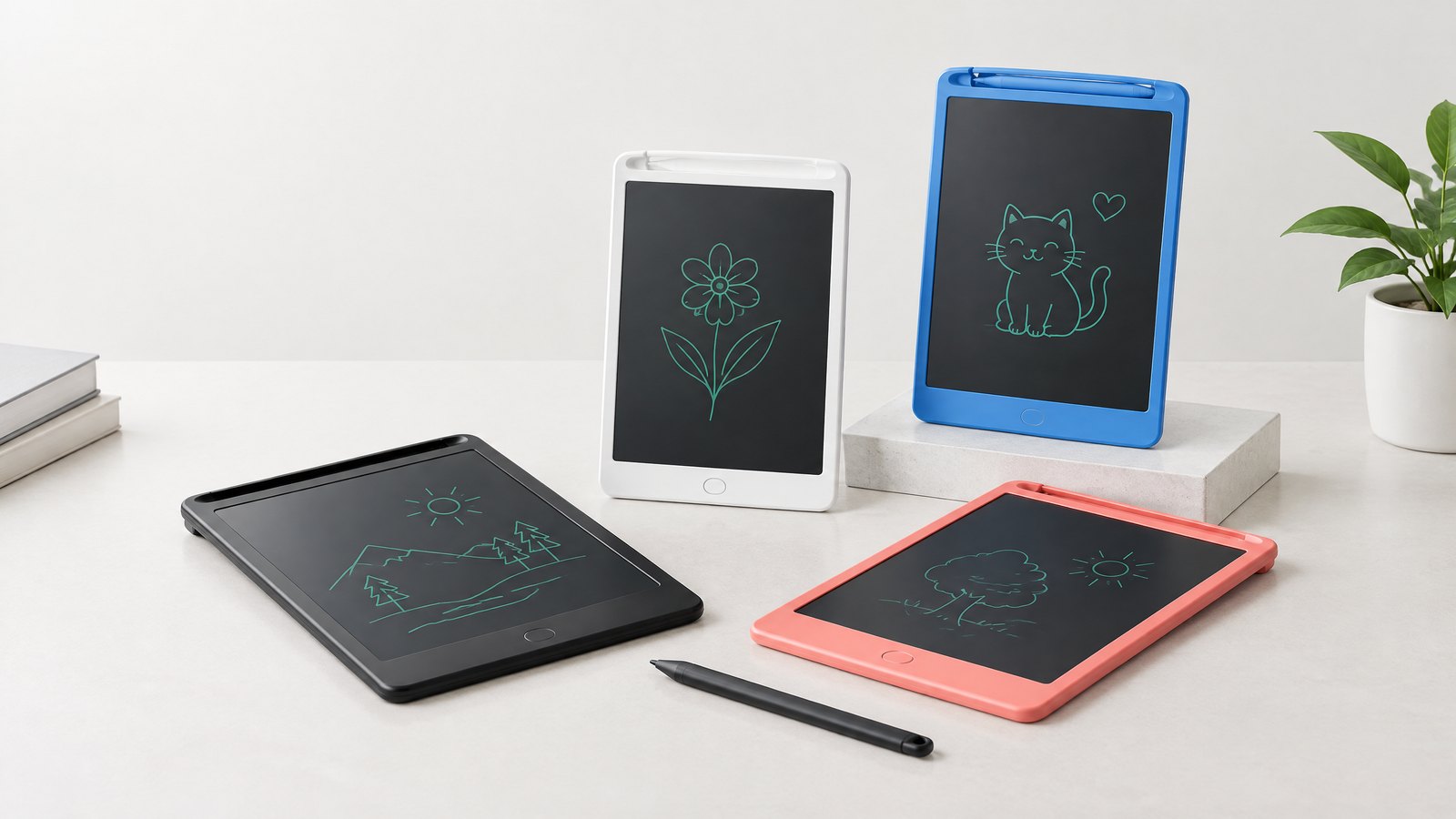
A travel LCD board normally uses pressure-sensitive liquid-crystal writing film rather than an app-based display. Marks appear when the user applies pressure with the supplied stylus or an appropriate writing point; a clear function removes the marks. Some versions have a lock switch designed to reduce unintentional clearing. Actual color appearance, line visibility, battery arrangement, sensitivity, and clear behavior vary by model. Buyers should evaluate the finished sample rather than assume that every LCD board performs alike.
The travel value proposition, translated into buying criteria
| Travel need | Product or program response to specify | What to check in a sample |
|---|---|---|
| A child needs a self-contained activity | Board, stylus, and clear instructions in one unit | The stylus is intuitive to remove and return; no sharp or loose packaging parts remain |
| A vehicle moves and vibrates | A manageable outline, stable hand feel, and a lock option if chosen | A child can hold the board on a lap; the clear control is not too easy to trigger |
| A flight has changing rules and limited space | Offline operation and compact retail packaging | The unit packs flat, stylus does not protrude awkwardly, and instructions tell families to follow crew directions |
| Gift retail needs fast understanding | Front-of-pack use scene and concise feature callouts | Shelf-facing copy is legible; the picture matches the actual included product |
| E-commerce needs a low-return experience | Accurate listing, protected unit, and traceable carton labels | Barcode scans, package protects the screen, and the variant received matches the listing |
The choice is situational. A larger board gives more area but can be awkward in a narrow seat; a smaller one packs easily but limits letters, maps, and shared games. A tethered stylus may reduce loss, while a detachable one can be easier to replace. Match the trade-off to the journey and user rather than claiming one universal format.
Use case 1: designing an LCD writing tablet for car travel
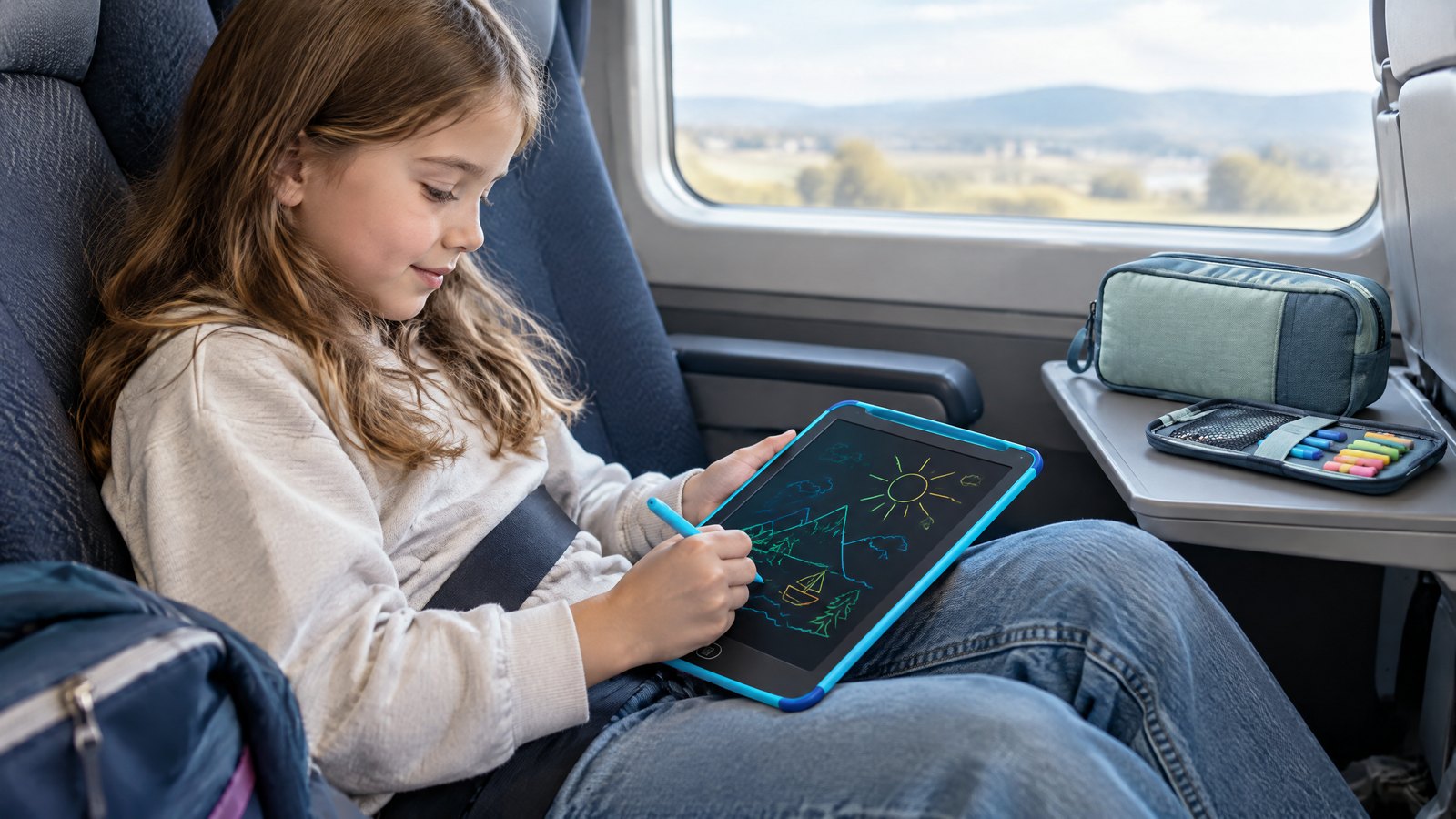
The phrase LCD writing tablet for car should lead to a back-seat experience, not merely a car graphic on packaging. During a drive, the board may be used on a lap, passed between siblings, stowed in a door pocket, or brought into a restaurant at the destination. It can support simple, quiet prompts: draw something seen out the window, write a packing list, score a roadside game, copy letters, play tic-tac-toe, or leave a reminder for the next stop.
What makes a car-oriented board usable
Start with handling. Request physical samples in the planned screen size and enclosure style, then try them in a stationary vehicle and on a supervised journey. Observe stylus loss, erase-button access, daylight legibility, and whether the board strikes a hard surface under braking. This evidence creates a better brief than a generic request for “high quality.”
Next, decide how the clear function works. A lock can help preserve a drawing while a child changes position, but it is not permanent storage, a childproof feature, or a substitute for instructions. Show the sequence—write, lock if applicable, unlock, clear—with an icon and test it repeatedly in the intended battery configuration.
Stylus retention deserves special attention: a lost pen makes an otherwise working product feel incomplete. A molded slot, tether, or replacement-stylus plan each has cost and visual implications. Test retention when the board is lifted, snag risk, and whether storage is obvious without a manual.
The term LCD tablet road trip belongs naturally in retail copy when it is tied to actual play ideas. Consider a package insert or a reversible card with activities that do not need an internet connection: alphabet hunt, “draw the next landmark,” travel bingo created by the parent, hangman, destination guessing, and a simple food-order drawing game. Do not print a pre-set game card that conflicts with the customer’s local language or cultural setting. For US, UK, German, and French programs, localized inserts or simple icon-led prompts can make the product feel intentionally designed rather than merely exported.
Parent-facing car-use guidance that reduces disappointment
Present an LCD board as a lap activity, not an in-car safety device or substitute for a child restraint. Adults should store it when unused, supervise as needed, and avoid driver distraction. “Quiet” can describe no intended electronic audio output; it cannot promise a calm journey.
A useful retail page can include a packing checklist:
- Inspect the board, stylus, and battery compartment before departure.
- Show the child how the clear and lock functions work before the car starts moving.
- Put the board in a pouch or seat organizer when it is not being used.
- Carry the product instructions and follow the brand’s stated care guidance.
- If the board is battery-powered, prevent access to loose batteries and keep replacement batteries out of children’s reach.
This last point is a responsibility issue, not a marketing embellishment. The U.S. Consumer Product Safety Commission warns that button and coin batteries can cause severe injury if swallowed and says toys using them require a secure closure opened with a screwdriver, coin, or tool.1 A buyer should confirm the actual battery type, compartment design, instructions, warning content, and applicable legal obligations for the intended market. Do not state that a product is “safe for all ages” merely because it is a simple drawing device.
Use case 2: specifying an LCD writing tablet for airplane travel
An LCD writing tablet for airplane can work well because its core activity is offline and does not depend on onboard Wi-Fi, charging ports, or downloaded content. That does not mean it is exempt from travel rules. Airline instructions and crew directions control what passengers may use and when. The FAA explains that operators determine whether certain portable electronic devices may be used without interfering with safe operation; passengers should follow their airline’s procedures.2
For product education, say “check your airline and follow crew instructions” rather than promising that the board is permitted on every flight or at every phase of flight. A basic LCD board may be distinct from a connected tablet, but neither product copy nor an import specification should overrule an airline. This cautious language also travels better across international retail markets.
Build the flight scenario into the product brief
The airplane environment brings limited space, closed tray tables, food, and rapid packing during seat changes. Buyers can specify:
- A compact, flat profile. Check that the retail pack and board fit the intended carry-on organization concept. Avoid claim language such as “fits all seat pockets,” because airlines and aircraft layouts differ.
- A simple startup. A child should be able to begin writing without pairing, signing in, or adjusting an app. Clear pictograms help when the product will move across English, German, and French channels.
- A controlled clear action. A lock feature may be useful where a half-finished game needs to survive a bumped tray table. Test it in the final production configuration.
- A secure stylus strategy. The pen needs a home before boarding, after snack service, and when the family is deplaning.
- Clear battery communication. Confirm the type of battery and the shipment/transport guidance applicable to the finished product. Do not make blanket air-transport claims without reviewing the relevant carrier, airline, and regulatory rules.
TSA advises travelers to pack properly, notes that officers may ask travelers to power up electronics, and says the checkpoint decision rests with the TSA officer.3 Do not claim identical treatment at every airport. Advise customers to pack the board for easy inspection, follow carrier requirements, and allow time for questions.
A flight-ready activity sequence
A portable board earns repeat use when the adult offers a sequence. For a portable writing tablet for kids, a “takeoff-to-landing” insert can suggest drawing the destination, making a picture packing list, tic-tac-toe, copying a word, sketching a meal, and recording a memory. These are optional activities, not developmental promises.
A travel doodle board can also make a practical restaurant or gate-area activity after a flight. That cross-use is valuable to holiday shoppers because a single small item moves from airport waiting time to hotel breakfast to the return journey. When presenting it online, use photos of normal supervised family settings rather than implying use in restricted areas or unsupervised care.
Need a flight- or car-travel LCD board developed under your brand? Email info@lcdwritingtablet.com with your target market, use case, preferred size range, packaging concept, and expected order timing.
Use case 3: holiday retail and giftable travel packs
Holiday retail is not just a seasonal color change. A travel product is often purchased by an adult who needs a useful gift now and wants to understand it in seconds. The front panel must therefore answer several questions plainly: What is it? Who is it for according to the brand’s age grading? What is included? What happens when the clear control is used? Is a battery included or not? Which language version is being sold? The answers must match the final unit and documents.
Merchandise by mission, not by vague novelty
A kids travel activity tablet can sit in holiday stocking-stuffer collections, family travel displays, book and puzzle departments, car gift guides, or e-commerce bundles. The strongest assortment logic is “reusable, quiet, packed-and-ready activity,” not an unsupported educational or environmental superlative.
Create two distinct retail stories if the channel allows it:
- Travel essentials: neutral colors, compact packaging, a small activity card, and copy focused on journeys, waiting rooms, and restaurants.
- Gift-ready holiday version: seasonally appropriate graphics, clear components callout, giftable presentation, and an inside message card or reusable prompt sheet if it can be included safely and accurately.
Avoid a date printed onto the product unless the forecast and markdown plan justify it. A flexible sleeve or insert gives seasonal relevance while letting the core board sell after the peak and reduces the risk of dated inventory.
Build content for US, UK, Germany, and France deliberately
The product may be shared across markets, but product name, age grading, warnings, required importer/responsible-party details, instructions, claims, battery information, and online content must match each market and final configuration. Translation is not localization: a literal translation can omit a warning or show an unavailable feature.
For EU sales, the European Commission states that the General Product Safety Regulation is intended to ensure only safe products are available on the market and provides business obligations through Safety Gate.4 For UK sales, the UK government says manufacturers and importers need to demonstrate compliance with relevant safety requirements through risk minimization, technical documentation, appropriate labeling, and safe-use instructions.5 These high-level sources are reasons to establish a compliance workstream early; they are not a substitute for a product-specific legal assessment or testing plan.
Give one person ownership of the “market release file”: final artwork, model number, bill of materials, instructions, applicable documents, supplier records, lot traceability, and channel listing. The factory can supply information and samples, but the brand/importer must understand destination-market obligations.
From travel concept to purchase order: an OEM/ODM workflow that holds up
Minor details determine whether a travel board reaches the customer intact and understandable. Treat sourcing as one chain: concept, approved sample, artwork, production, packing, freight, receiving, and after-sales feedback.
Step 1: write a decision-grade brief
A useful RFQ states destination markets, channels, user context, brand-set age grade, desired size, enclosure/color, writing color, lock behavior, stylus and storage, power arrangement, packaging, languages, barcode ownership, carton marks, inspection expectations, and documents for review.
Separate “must have” from “nice to have.” A car range may require a lock, stylus holder, and bilingual package; a metallic finish or gift sleeve can be costed separately. This avoids approving a visually attractive sample with unresolved functional or logistics requirements.
Step 2: approve the actual configuration, not an abstract model
The pre-production sample should closely represent proposed components and print. Check color, mark visibility, clear/lock response, stylus fit, seams, battery door, package fit, barcode, and multilingual artwork. Photograph it and record version-controlled sign-off. Review any later component, insert, or carton change rather than treating it as harmless.
Use shared defect language: critical safety/legal concerns, major unsellable functional or cosmetic issues, and agreed minor variations. Set the acceptance plan before mass production, not when goods are ready to ship.
Step 3: package for the journey after the retail journey
The product may travel through export packing, freight, a warehouse, FBA prep, fulfillment, and last-mile delivery before reaching a car or airplane. The retail package should keep board, stylus, battery information, and inserts together while explaining the product.
For FBA or another marketplace, review current channel instructions, not a generic blog checklist. Amazon says prep is required when packaging does not sufficiently protect units during shipping and handling.6 Check barcode scanability after any bagging, screen protection, final-SKU carton labels and traceability, inner-pack clarity, and ordinary-handling protection—without unsupported drop claims.
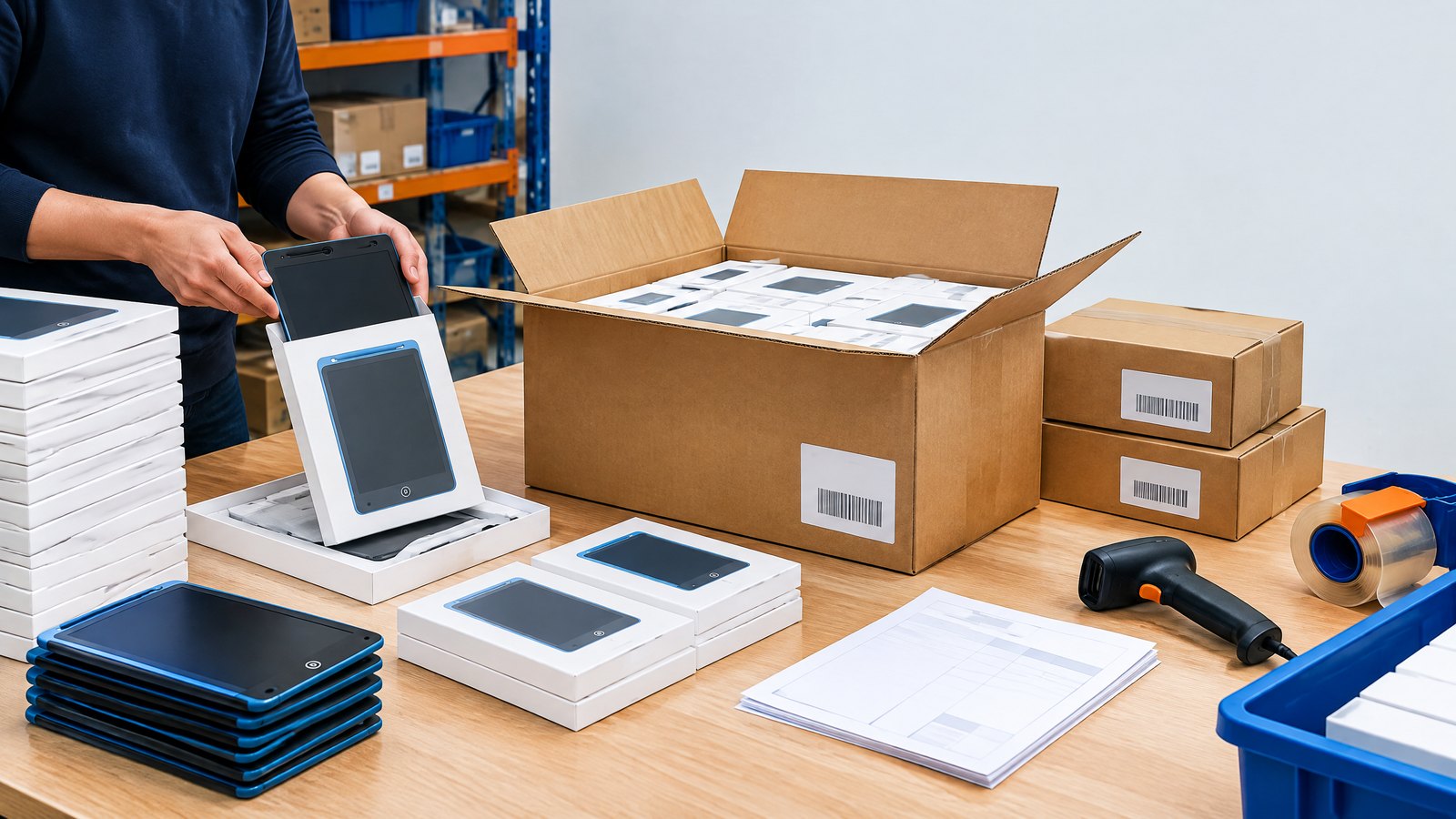
Step 4: receive inventory like a retailer, not only like a factory
When goods arrive at a school district, 3PL, holiday warehouse, or FBA prep site, compare the PO, packing list, carton labels, and product before release. Spot-check:
- model and color against the approved sample and SKU;
- retail-pack condition, visible text, and language version;
- barcode readability using the channel’s actual process;
- included stylus, inserts, and other declared components;
- clear and lock operation on selected units, where applicable;
- battery compartment condition and presence of required warnings/instructions;
- carton counts, lot/batch identifiers, and exterior damage;
- photo records of exceptions and a quarantine path for suspect goods.
This is not a claim that inspection eliminates defects. It creates a controlled decision point before travel merchandise is dispersed across stores or fulfillment nodes. Keep the approved sample, artwork PDF, receiving records, and supplier communication together so a later customer-service pattern can be investigated by lot and configuration.
School and group-travel rollout: simple operations matter
LCD boards can be relevant to schools, camps, libraries, museums, and tour operators when they need reusable, low-noise activities during transport, arrival queues, or supervised downtime. The school rollout should be designed as an operations project rather than advertised as a classroom cure-all. Teachers and group leaders need storage, distribution, collection, cleaning/care instructions consistent with the manufacturer’s guidance, and a way to identify incomplete sets.
Start with a controlled pilot
Before a broad rollout, give a representative group the final or near-final configuration. Define the activity context—for example, coach travel to a museum, an airport departure area, or a rainy-day holiday club—and observe practical issues: Do participants understand the lock? Are styluses being separated? Can the leader count and redistribute units quickly? Does the package create unnecessary waste? Which prompts work without additional materials? Record observations without implying educational outcomes that were not assessed.
A useful group kit can include numbered storage pouches, a leader instruction card, a designated return check, and a labeled reserve-stylus plan if the procurement policy allows it. The board itself should remain individually traceable to the extent appropriate for the program, especially when a concern must be linked to a delivery or batch. For younger children or any group with additional supervision needs, the organization should set its own adult-supervision and risk-management procedures.
Do not blend procurement claims with educational claims
It is reasonable to say a board can be used for handwriting practice, drawing, turn-taking games, and visual travel journals. It is not responsible to promise improved grades, developmental outcomes, or behavior changes without substantiation. For schools, procurement language should focus on actual features, cleaning/care instructions from the supplier, product documentation, instruction readability, planned supervision, and the organization’s purchasing and safeguarding rules.
A travel program that succeeds in a school setting can inform retail. If leaders consistently value rapid distribution and a pen-return routine, a consumer travel kit might benefit from an obvious stylus slot and a small “pack before you go” panel. If a prompt sheet works across a mixed-age group, it can become a digital printable for retailers—provided its language, artwork rights, and claims are reviewed.
Quality, safety, and claim control for travel listings
Travel shoppers often decide quickly, which tempts sellers to use shortcuts such as “airplane approved,” “unbreakable,” “certified for every market,” “non-toxic,” or “safe for all ages.” Avoid these unless the exact claim is supported for the exact version sold, its destination, and the context in which the claim is presented. “Tested” is not meaningful without identifying what was tested, to which relevant requirement, and whether the result applies to production.
A more credible listing tells the truth in ordinary language: “reusable writing and drawing surface,” “offline activity,” “clear function,” “lock switch if included,” “stylus included,” and “check airline instructions before use.” It identifies the brand or responsible seller, offers accessible instructions, and maintains an after-sales route for customers with a damaged unit or missing component. If a product uses a coin or button battery, follow applicable child-product and consumer-product rules; do not treat battery safety as a back-of-pack afterthought.
Keep recall and incident readiness in the product file. The European Commission’s Safety Gate is a public system for information about dangerous non-food products, and UK guidance emphasizes traceability and reporting responsibility in the supply chain.4 A mature buyer should know which lot went to which channel, retain supplier identity records, and have a written escalation path for a reported defect. That discipline matters as much for a small seasonal accessory as for a permanent range.
FAQ
Is an LCD writing tablet suitable for a road trip?
It can be a practical road-trip activity when the model suits the child, includes clear instructions, and is used under appropriate adult supervision. Choose a board that is manageable on a lap, has a sensible stylus-storage solution, and is stored when not in use. Do not present it as a vehicle-safety product or a substitute for child restraints and driver attention.
Can an LCD writing tablet be used on an airplane?
A basic board’s offline operation can make it useful during travel, but the passenger must follow the airline’s instructions and cabin-crew directions. The FAA explains that aircraft operators determine the permitted use of portable electronic devices in relevant circumstances.2 Pack the item accessibly and do not promise universal airline approval in a product listing.
What should buyers ask an OEM before ordering travel doodle boards?
Ask about the exact board configuration, stylus retention, clear/lock behavior, battery type and compartment, available artwork and language options, packaging protection, unit/carton labeling, sample process, quality checks, documentation available for review, production lead time, shipping terms, and destination-market responsibilities. Confirm every answer against the final approved sample and purchase order rather than relying on a generic catalog description.
How should a holiday retailer reduce returns for travel activity tablets?
Use honest product photography, show what is included, state the age grading chosen for the SKU, explain the clear/lock functions, and make the packaging protect the screen and stylus. Before receipt, validate barcodes and carton markings. At receiving, inspect a sample of units against the approved configuration, then retain records so recurring complaints can be traced by lot or delivery.
Are all LCD writing tablets the same?
No. They can differ in screen size, enclosure, line appearance, pressure response, clear mechanism, lock design, stylus arrangement, battery configuration, printed instructions, packaging, and intended market. A buyer should test the selected model and review its product documentation; a shopper should read the specific package and listing rather than assume features from a similar-looking board.
What does a school need for a travel-board rollout?
A school or group should define the activity context, supervision plan, storage method, distribution and return process, care guidance, missing-stylus procedure, and incident/escalation route. A small pilot using the intended configuration can reveal practical needs before a broader order. The organization should also apply its own procurement, safety, and safeguarding policies.
Conclusion: sell the journey, verify the product system
Travel-oriented LCD writing tablets work best when the product is designed around the real journey: a child drawing in the back seat, a family waiting at a gate, a group leader collecting activity kits, or a gift buyer needing a useful item that is easy to understand. For car and flight programs, prioritize comfortable handling, clear function behavior, stylus retention, compact packing, careful battery management, and honest travel guidance. For holiday and marketplace programs, pair those product decisions with localized copy, protected packaging, accurate barcodes, disciplined receiving, and documented destination-market compliance work.
The category does not need exaggerated promises. A well-specified, well-packed board can be a reusable place to write, draw, and play simple games away from home. The buyer who validates the final sample, finished artwork, packout, and channel process is in a much stronger position to deliver that simple benefit consistently.
For an OEM/ODM quotation or a travel-focused sample plan, email info@lcdwritingtablet.com.
Image Plan
| Image | Purpose | Placement | English caption | ALT text | English AI image prompt |
|---|---|---|---|---|---|
| 1. Family car activity scene | Establish the back-seat travel use case without suggesting the driver is distracted. | Below the direct-answer opening | “A reusable LCD writing tablet gives children a quiet drawing space during a supervised family car journey.” | “Child using an LCD writing tablet on their lap in the rear seat of a parked family car while an adult is present.” | “Photorealistic editorial lifestyle image, diverse family preparing for a road trip, child seated safely in the rear seat of a parked modern car using a slim LCD writing tablet on their lap, adult standing outside the open rear door, soft daylight, no visible logos, no motion, no unsafe driving, clean commercial composition.” |
| 2. Carry-on flat lay | Show compact, offline travel packing and the included stylus. | In the airplane-use section after the flight-ready brief | “A compact writing board, stylus, and travel pouch can be organized together in a carry-on bag.” | “LCD writing tablet and stylus arranged beside a passport holder and headphones in an open carry-on bag.” | “High-end product flat lay, open carry-on backpack with a compact LCD writing tablet, matching stylus in its slot, reusable activity prompt card, passport holder and child-sized headphones, neutral airport-travel palette, top-down composition, no brand logos, realistic materials.” |
| 3. Holiday retail shelf-ready package | Demonstrate giftability and packaging clarity for buyers. | In the holiday-retail section | “Holiday packaging should communicate the product, included components, and use case at a glance.” | “Unbranded holiday-ready LCD writing tablet retail package showing a board and stylus through a neat front window.” | “Professional retail product photography, unbranded LCD writing tablet in a tasteful winter holiday gift box with a front window, board and stylus visible, clear generic icon callouts for write, lock and clear, clean studio lighting, no trademarks, no certification marks, no unsupported claims.” |
| 4. Receiving inspection scene | Visualize practical B2B quality and FBA/warehouse receiving control. | In the OEM/ODM workflow section after receiving checklist | “Incoming checks connect the approved sample, unit packaging, barcode, and carton label before inventory release.” | “Warehouse team member checking an LCD writing tablet package and scanning a barcode beside labeled cartons.” | “Realistic B2B warehouse receiving scene, gloved quality inspector comparing an unbranded LCD writing tablet retail unit to an approved sample sheet and scanning a visible generic barcode, sealed cartons in background, clear orderly workbench, no Amazon logos, documentary commercial photography.” |
References
Continue with the next sourcing decision.
Use these internal links to compare products, check common buyer questions, review compliance preparation, or send your requirements to the factory.
Turn this sourcing plan into a product brief.
Share your target market, product requirements, packaging preference and estimated volume for a practical OEM / ODM discussion.