This guide provides a practical B2B decision framework. Final specifications, market obligations, testing scope, labels, packaging and shipment requirements must be confirmed for the exact finished SKU and destination.
2. Direct-answer introduction
Yes, you can custom-logo an LCD writing tablet and build retail packaging around it, but a reliable order starts with a controlled specification—not just a logo file. Define the exact tablet model, logo locations, print method, colour targets, pack contents, age positioning, destination market, barcode owner, warning copy, and master-carton marks before production artwork begins. Then approve a physical pre-production sample that matches the signed artwork and inspect finished units, retail boxes, and cartons against that approved standard. For children’s products, battery-powered models, wireless variants, and cross-border retail, packaging is also a compliance and traceability document. The final obligations depend on the product, claims, market, and responsible economic operator.
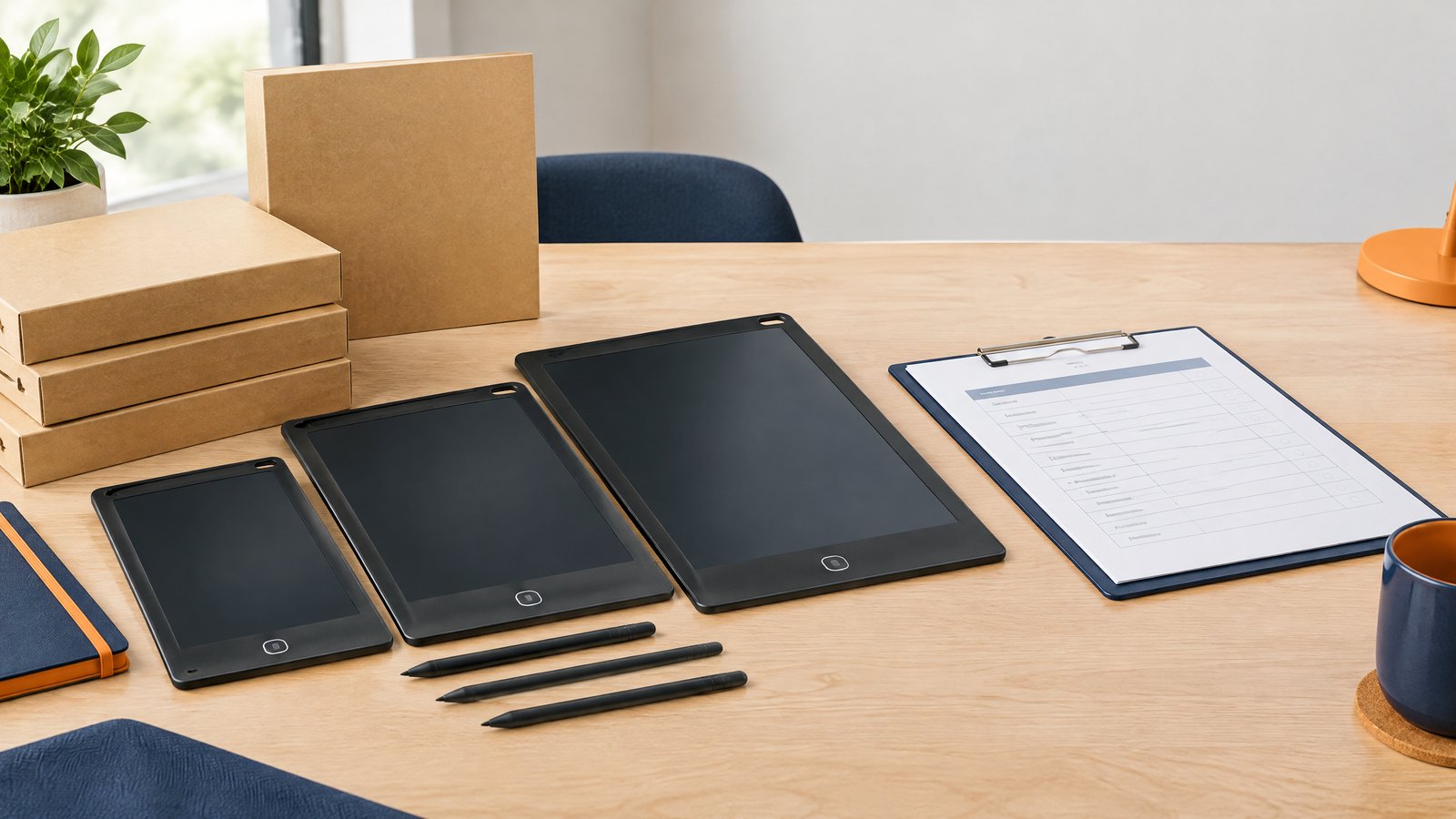
A tablet program includes the housing, erase function, stylus, power arrangement, accessories, leaflet, retail box, inner protection, and export carton. Screen artwork does not prove print quality on plastic, and an attractive box may not protect a tablet in parcel delivery.
Buyer principle: Control logo, artwork, labels, instructions, retail pack, and master carton as one specification with a version, date, owner, and written approval.
3. Who this is for
This checklist is for overseas B2B buyers sourcing an OEM or ODM LCD writing tablet under their own brand: importers, retailers, e-commerce operators, education suppliers, promotional-product businesses, corporate buyers, and private-label managers. It also works for a tablet included in a travel set, learning bundle, event giveaway, or staff-recognition kit.
It is most useful when moving from an unbranded stock unit to a retail-ready SKU. You must decide what the consumer sees, what the warehouse scans, how a retailer identifies the variant, who is named as an economic operator where necessary, and how a future investigation can isolate a batch. In the United States, children’s-product tracking information must be ascertainable from permanent distinguishing marks on the product and packaging to the extent practicable; it includes the manufacturer/importer or private labeler, production location and date, and batch or run details. 1
This guide is not legal advice or a substitute for product classification. A general office memo board can follow a different route from a product designed, marketed, or packaged as a children’s plaything. Bluetooth, rechargeable power, light, sound, or talking-learning functions can change the assessment. EU toy rules cover general and specific risks, and toys on that market must carry CE marking. 2 Set intended use and claims before finalizing packaging copy.
4. Buyer decision framework: decide what you are actually customizing
The first question is not “Can you print our logo?” It is “Which details must be fixed for a repeatable SKU?” Make five decisions from the product outward.
Define the baseline. Select the housing, display size, colour, erase mechanism, stylus, power source, accessories, and leaflet language. Review a sample or current photographs. Record dimensions and weight from the actual configuration. A changed stylus holder, battery cover, or button layout can make an approved insert or instruction diagram wrong.
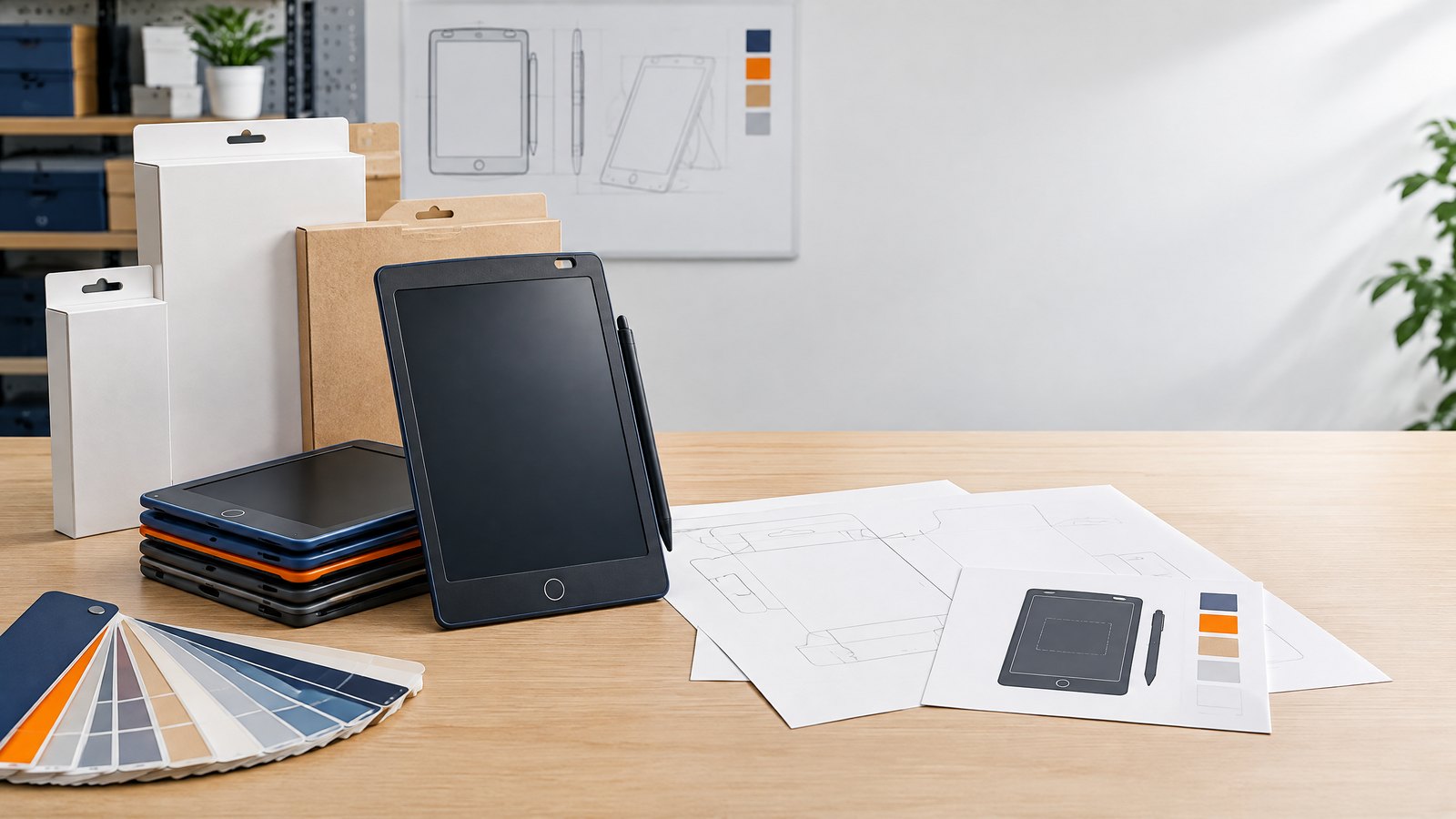
Set the brand architecture. Decide whether the mark appears on the bezel, rear housing, stylus, retail box, leaflet, carton, or only selected surfaces. Ask for the printable-area drawing, permitted colours, print process, artwork format, and surface limitations. A one-colour logo on a flat plastic area is a different task from a metallic multi-colour graphic or housing-colour change.
Choose the selling channel before the box. Shelf retail can require display-facing graphics, a barcode position, a hanger or shelf-ready case, and case-pack data. E-commerce can require compact protection and a reliably scannable label. A GTIN uniquely identifies trade items priced, ordered, or invoiced in the supply chain, so establish SKU and GTIN ownership before artwork release. 3
Use a market-and-claims gate. List markets, intended age/use, languages, product claims, power source, radio functions, and responsible parties. Seek competent market-specific advice for the finished product and marketing. The EU GPSR applies to online consumer products and requires a responsible EU economic operator for covered products; it complements more specific legislation. 4 A generic icon or report for another model is not universal approval.
Write measurable acceptance criteria. Specify the approved colour target, logo position/orientation, permitted defects, contents, barcode scan requirement, leaflet revision, box and carton dimensions, case pack, sealing method, and transit expectation. Put these in the purchase order, artwork approval, and inspection brief.
Customize only what advances your brand, retail channel, or compliance plan. A stock model with controlled logo, box, leaflet, and carton marks is often the practical starting point; invest in bespoke housing or structural packaging only when the differentiation justifies the extra development and change control.
5. Comparison/specification table: choose the right level of custom logo LCD writing tablet packaging
The table below compares common routes. It is a commercial and operational comparison, not a quotation or a promise of feasibility. Confirm the available options, minimum quantities, tooling needs, lead times, print limits, and cost with the manufacturer for the selected model.
| Customization route | Typical elements | Best fit | Buyer inputs to lock | Key control point |
|---|---|---|---|---|
| Stock product with logo | Existing tablet, one or more logo positions, standard pack or label | Pilot sales, corporate gifts, lower-complexity launch | Vector logo, print colour, location, size, proof approval | Compare actual logo adhesion, alignment, and legibility with signed proof |
| Private-label retail pack | Stock tablet plus branded retail box, insert, leaflet, barcode and carton marks | Retail, e-commerce, distributors | Dieline, product images, claims, languages, GTIN, warning and legal panel copy | Approve a physical packaged sample, not a digital PDF alone |
| Curated kit | Tablet plus stylus, batteries where applicable, case, learning cards or other accessories | Education bundles, travel sets, promotional kits | Complete bill of materials, packing order, tray layout, accessory ownership and count | Count each item and check that no loose part damages the display |
| Semi-custom product and pack | Existing platform with colour, print, accessory or layout changes plus new packaging | Brand differentiation without a wholly new platform | Colour reference, material/finish expectation, engineering drawings where available, revised manuals | Reassess product, instruction, pack fit, claims, and test scope after every feature change |
| Fully bespoke product and retail system | New enclosure, electronics/features, product identity and structural pack | Established programs with defined demand and compliance resources | Product requirement document, industrial design, tooling and IP terms, validation plan, market matrix | Use staged engineering, pilot, validation, and artwork gates before mass production |
The branded pack should make product identity clear without over-promising. Use evidence-backed, precise copy such as “LCD writing tablet,” “one-touch erase,” or “includes stylus” only if the shipped configuration supports it. Avoid vague or absolute claims such as “non-toxic,” “eco-friendly,” “safe for all ages,” “unbreakable,” “medical,” or “educationally proven” unless you have substantiation and have confirmed the claim is lawful in each target market. If a product is electrical or electronic equipment, EU RoHS restrictions may be relevant; the Commission says products with an electrical and electronic component must comply unless specifically excluded. 5
Need a controlled OEM packaging brief for an LCD writing tablet? Email info@lcdwritingtablet.com with your product model, target market, annual or trial quantity, logo files, and desired retail channel. Ask for the printable-area drawing, packaging dieline, sample route, and a clear list of buyer-supplied information before approving artwork.
6. Buyer checklist: artwork, labels, claims, and pack data
Use this checklist as a handoff document. The buyer should assign a named owner for each line and retain the approved files with their revision codes. A manufacturer can print supplied artwork, but the brand owner, importer, or other responsible economic operator may retain important legal and marketplace duties. Confirm allocation in writing.
| Checklist area | What the buyer should provide or approve | What to verify before release |
|---|---|---|
| SKU identity | Internal SKU, product name, model code, colour/size/accessory variant | One unique identity per sellable configuration; no barcode shared across materially different variants |
| Logo artwork | Editable vector file, approved colours, clear space, minimum size, placement drawing | Text is outlined or fonts supplied; logo is readable on the actual substrate and print method |
| Retail-box artwork | Printer dieline, bleed/safe areas, panels, images, finish notes, revision code | No key text crosses folds, glue flaps, windows, hang holes, or barcode quiet zones |
| Product information | Feature list, pack contents, dimensions only when verified, operating instructions | Claims match the actual unit and included accessories; images show the shipped version |
| Compliance and traceability | Destination market, intended age/use, required warnings, importer/responsible-party details where applicable, country-of-origin wording, batch code format | Text and symbols are market-reviewed; product and pack information are consistent |
| Barcode and retail data | GS1 GTIN or channel-approved identifier, human-readable digits, product title, case-pack data | Test the printed barcode on the final box surface; maintain barcode ownership and SKU mapping |
| Leaflet and languages | Final language list, instructions, battery information if applicable, warning translations | Leaflet revision matches product functions and box claims; text is legible at production size |
| Inner protection | Tray, paper insert, pouch, sleeve, screen film, accessory bag and packing order | The tablet does not move, scratch, or activate during normal handling; accessories are countable |
| Master carton | Carton dimensions, units per carton, gross-weight ceiling, shipping marks, country/origin requirements, handling marks where justified | Carton marks match actual quantity, SKU and destination; labels remain legible after handling |
| Change control | Artwork, product and carton revision log; approval names and dates | Factory uses only the released version; old artwork and labels are quarantined or destroyed |
Label content: separate “required” from “nice to have”
Do not fill the side panel with icons because competitors use them. First make a legal/market assessment, then build a label matrix. For U.S. imports, CBP states that every article of foreign origin must generally be marked legibly with the English name of its country of origin unless an exception applies. It also notes that usual filled containers must be marked with the origin of their contents unless the contents are marked and the container can be readily opened for inspection. 6 Your broker or trade adviser should confirm the correct origin statement and placement for the shipment.
For a children’s product in the United States, design traceability early. CPSC guidance says distinguishing marks should be visible, legible, and permanently affixed to the product and its packaging to the extent practicable. 1 A compact code can work if the consumer can identify whom to contact to interpret it, but do not hide the information in a code without an internal decoding record.
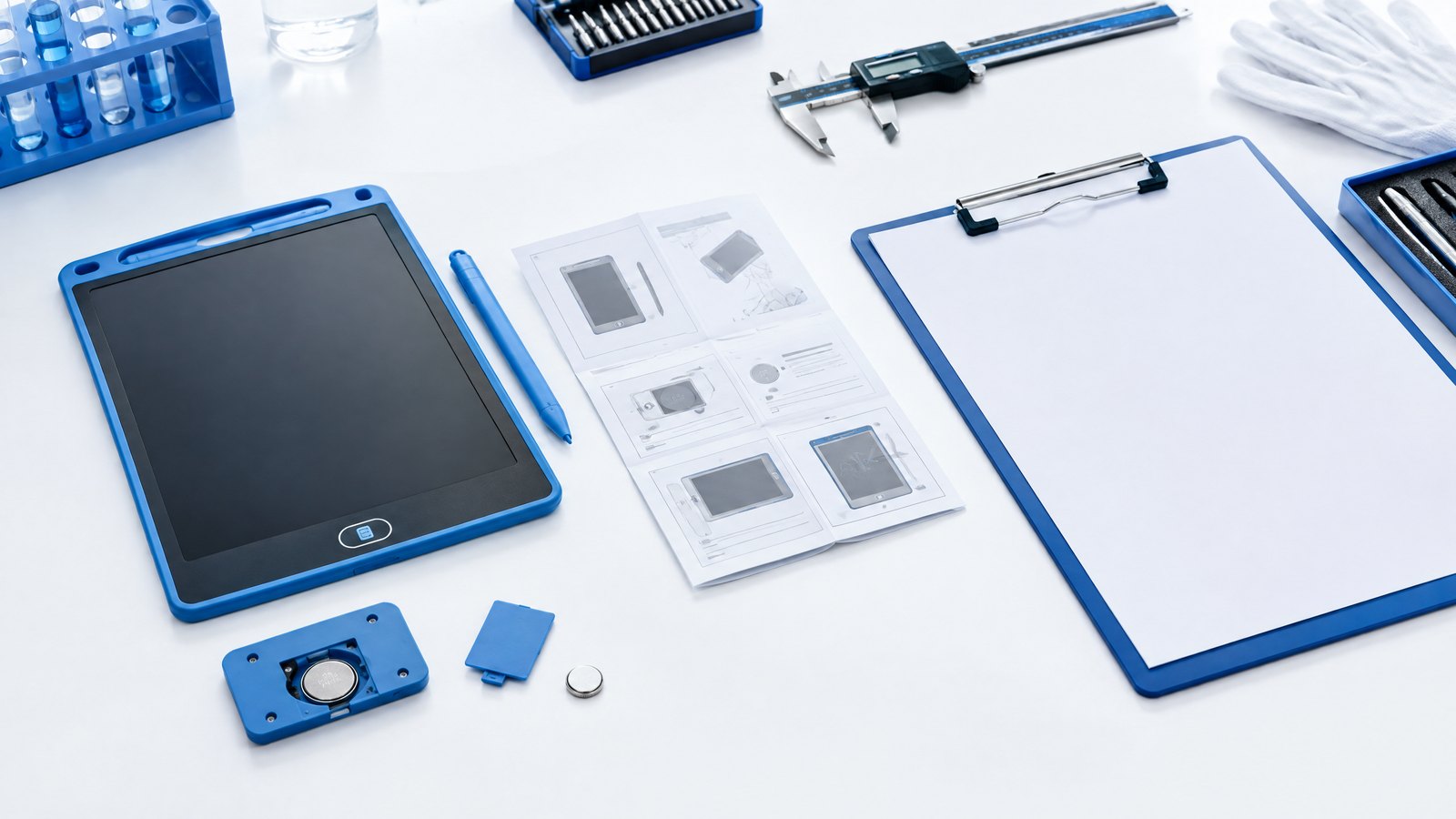
Battery and wireless features need a separate gate. For U.S. consumer products with button or coin batteries, CPSC guidance addresses secured accessible compartments, use-and-abuse accessibility, and warnings on product packaging, the product where practicable, and instructions. It also distinguishes qualifying toys subject to applicable toy-standard battery provisions. 7 For a Bluetooth or other radio-enabled variation, do not assume that a standard non-wireless tablet’s artwork and documents are enough: the FCC explains that a Bluetooth radio is an intentional radiator and that RF devices need the appropriate authorization before U.S. marketing, importation, or use. 8
The same discipline applies to environmental marks. In the UK, a business that manufactures under its own brand, resells under its own brand, imports commercially, or sells directly from outside the UK can meet the definition of an EEE producer in specified circumstances. Official guidance also identifies product marking and producer duties, including the crossed-out wheeled-bin symbol and date mark. 9 In the EU, packaging rules cover all packaging and packaging waste regardless of material or origin, and the new Packaging and Packaging Waste Regulation has its own timing and implementation details. 10 Confirm which producer-responsibility, labelling, and registration obligations rest with your legal entity in every market rather than copying marks from another country.
7. Sample, testing, factory, and shipment inspection workflow
A digital mock-up proves layout, not production quality. Use a gate-based workflow that produces evidence before you commit to full printed material or final payment.
Gate 1: artwork and specification review. Freeze a controlled pack specification containing the tablet model, logo placement, colour targets, pack contents, dieline, carton configuration, claims, legal text owner, barcode data, and inspection criteria. Review the product and instruction line by line against the package. If the retail front says “includes batteries,” verify the exact battery type, packing method, and transport implications. If it says “Bluetooth,” ensure the product really has the enabled radio configuration and the compliance route is active.
Gate 2: branding and packaging sample. Request a physical sample whenever possible: a logo-applied tablet, a printed or production-representative retail box, actual insert/leaflet, accessories, and a proposed master carton. Photograph all six sides, record barcode scans, test the erase function, stylus retention, battery-door operation, and pack fit. Check the logo under normal room light and under oblique light, because gloss variation, pinholes, and misregistration can be easy to miss in a flat photograph. Keep the accepted sample or a sealed reference pack as the “golden sample.”
Gate 3: verification and product-specific testing. Confirm the test plan with a competent laboratory or compliance professional based on the product as sold: its age grading, market, electrical configuration, batteries, radio functions, materials, claims, and intended use. Do not infer compliance from a test report that names a different model, factory, material, battery, or product configuration. U.S. CPSC guidance states that children’s products subject to relevant safety rules require third-party testing and a written Children’s Product Certificate based on a CPSC-accepted laboratory’s results; the certificate must identify the covered product and applicable rules among its required elements. 11
Gate 4: pre-production confirmation. Before the factory orders or prints all boxes, confirm the final PDF proof, colour reference, barcode file, carton stencil, and packing order. The factory should show the printed proof or first-off sample for sign-off if your timeline permits. Compare its revision code against the purchase order. This is the least expensive moment to stop an omitted warning, wrong language, or old logo.
Gate 5: in-process and pre-shipment inspection. Inspect representative finished units and packed cartons against the signed specification. A practical inspection brief should cover: model and colour; logo location, size, orientation, and durability; display/erase function; stylus and accessory count; battery compartment; paper insert; leaflet version; retail-box dimensions and print; barcode scan; batch coding; case quantity; carton marks; carton sealing; and visible damage. Record results, photographs, sampled quantities, defects, and any corrective action. A third-party inspection can add independence, but the buyer should still define the acceptance criteria and decide whether the goods can ship.
Gate 6: shipment-readiness review. Reconcile the final packing list, commercial invoice, carton count, total quantity, gross and net weights, carton dimensions, labels, and destination marks. For a carton going through parcel networks or e-commerce fulfillment, consider a transit-test plan appropriate to the route. ISTA emphasizes that pre-shipment performance testing supports decisions about how well a package protects contents during distribution and recommends representative samples, documentation, and retesting after relevant product, package, or process changes. 12 A passed sample exercise is not a guarantee of zero damage, but it is better evidence than a visual review alone.
8. Ordering and implementation preparation
Attach the released product specification, artwork files, barcode sheet, packing standard, inspection checklist, and commercial terms to the purchase order. State which document controls if files conflict. Put a part number and revision code on every artwork PDF and packaging specification.
Prepare a market matrix for each country or channel. List the legal entity placing goods on the market, intended customer and age positioning, language, documents, applicable safety or radio review, origin marking, packaging/EEE producer obligations, barcode format, and marketplace preparation. This avoids ordering one English-only box for markets with different requirements.
Prepare a claim library with each claim’s owner, evidence, approved market, wording, and artwork location. Keep legal or regulatory information distinct from marketing copy so localization does not alter a warning. Keep original logo files, dielines, PDFs, proofs, barcode allocations, relevant reports, inspection records, and change notices in a controlled folder. Maintain one SKU record mapping the unit, GTIN, carton SKU, case pack, and artwork revision.
9. Practical applications: packaging choices by use case
Retail and specialty stores. Use a sturdy retail carton with a clear product image or a window only if protection remains adequate. Reserve a side or back panel for barcode, product identity, origin, and other confirmed market information. Match case pack to the retailer’s replenishment pattern.
E-commerce and marketplace sales. Optimize for photos, scan reliability, and parcel movement. Decide whether the retail box needs a protective mailer. Keep the barcode in an unobstructed zone and avoid dark-on-dark printing, wrinkles, or fold lines through the code. Photograph the approved boxed item for listings.
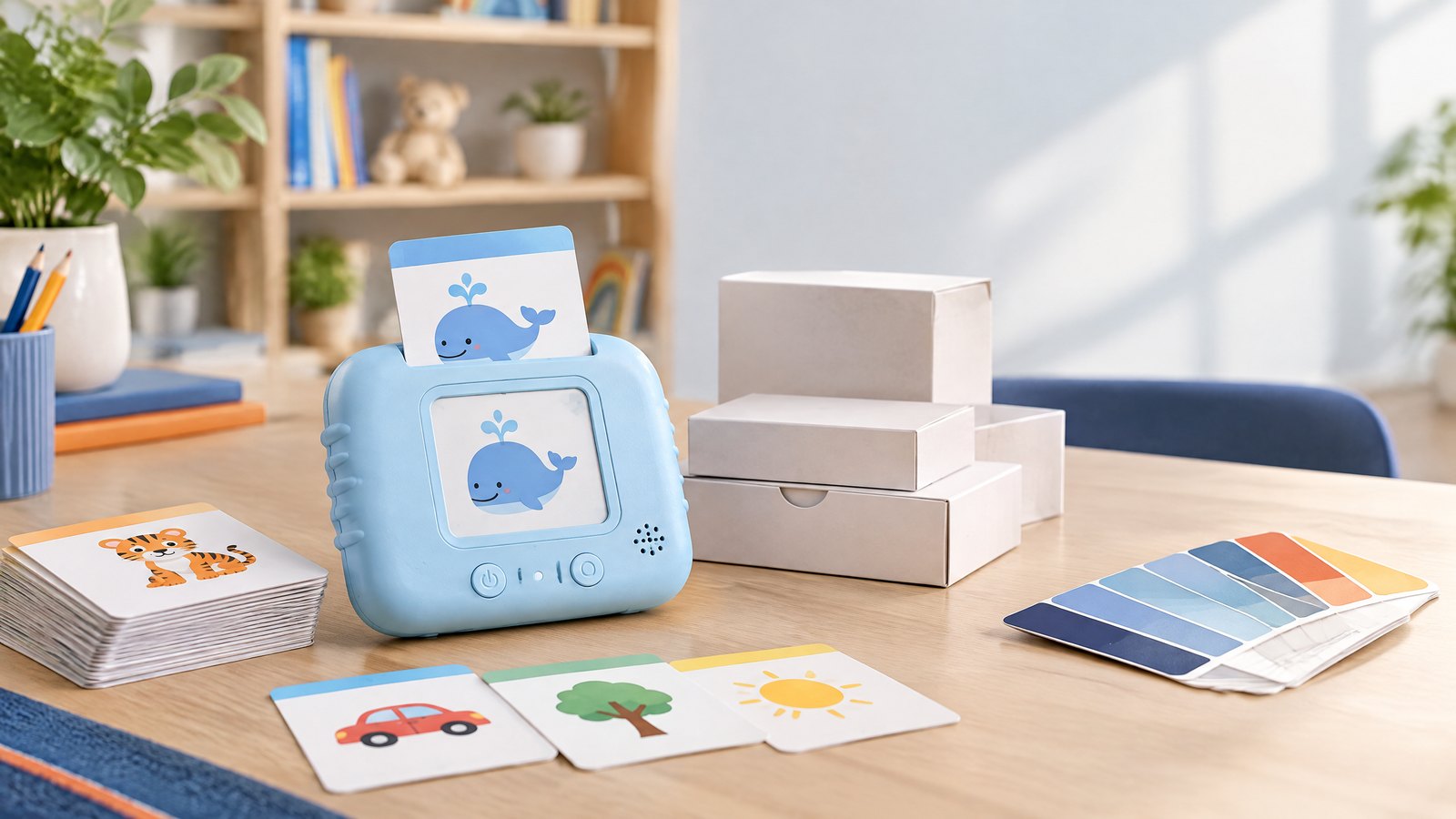
Education, libraries, and learning bundles. State kit contents clearly and create separate SKUs and packaging files for talking flashcard machines or electronic badges. Different functions can introduce different battery, charging, radio, content, or instruction considerations.
Corporate gifts and sustainability-led programs. A logo may matter more than extensive claims, so a branded sleeve, insert, or gift box can be more proportionate than a full retail system. Reduce unnecessary material without making unqualified green claims, and verify local packaging and waste obligations before adding recycling labels.
10. Detailed FAQ
Can we put our logo on the LCD writing tablet and use a stock box?
Usually, subject to the model’s printable surface and supplier capability. It can suit a pilot order or corporate gift. For permanent private-label retail, however, a stock box may lack your SKU, barcode, accurate contents, instructions, traceability, origin marking, or market information. Treat it as a sellable pack only after assessment.
What artwork files should we send to an OEM manufacturer?
Send an editable vector logo, brand colours, supplied or outlined fonts, relevant high-resolution images, and an artwork brief. Build box graphics on the final dieline and specify bleed, safe area, finish, barcode zone, and revision. Approve a copy proof and a print-ready proof, then retain the native file and signed PDF.
What is the difference between a retail box and a master carton?
A retail box is the consumer unit and carries branding, contents, instructions or insert, and a unit barcode where required. A master carton groups units for export and warehouse handling. It normally carries case quantity, carton identification, shipping marks, and agreed dimensions and weights. A retail box is not automatically suitable as a parcel shipper.
Who supplies the barcode for a private-label tablet?
The brand owner should control the product identity and obtain the identifier required for its channel. GS1 describes a GTIN as a way to uniquely identify trade items in the supply chain. 3 Give the approved number, barcode artwork, and product-title mapping to the factory, and maintain a master SKU record for variants and bundles.
Does a custom logo change product compliance?
The logo may change who is presented as brand owner, importer, or private labeler and can affect traceability documentation. Packaging can also introduce wrong claims or missing warnings. A feature change—battery, wireless module, housing material, charging method, or target age—can have a much larger impact. Assess the finished product and marketing for each market.
Do we need CE, RoHS, WEEE, FCC, CPC, or other marks on the box?
There is no universal marks checklist. Applicability depends on classification, intended user, age-related marketing, electrical and radio features, market, and responsible economic operator. EU toys need CE marking, and EEE can bring RoHS and WEEE considerations. 2 5 U.S. children’s, radio, and button-battery products may have distinct requirements. 7 8 11 Confirm obligations before adding or omitting a mark.
How do we approve packaging colour accurately?
Specify the colour standard, ink process, finish, substrate, and acceptable variation. Review a production-representative proof under agreed lighting, not only an uncalibrated screen. Retain the accepted proof or sample and compare random finished cartons during inspection.
What should the pre-shipment inspection check?
Check the agreed product and packaging features: function, logo quality, cosmetic condition, accessory count, battery-door condition, leaflet/warning revision, retail-box artwork, barcode scan, batch code, inner protection, carton quantity and print, seal integrity, and opened-carton verification. Set the sample method, defect categories, acceptance thresholds, and disposition process beforehand.
Can an OEM use our logo and artwork for another customer?
Do not rely on assumptions. Put ownership, permitted use, tooling, file access, confidentiality, and post-project handling in a written agreement appropriate to your circumstances. Limit access to released files, retain timestamped originals, and require change control. Remedies depend on the jurisdiction and agreement.
When should packaging be retested?
Reassess after changes that could affect protection or compliance: thinner board, new tray, altered dimensions, different accessories, carton size, route, or fulfillment method. ISTA advises repeating protocols when product, package, or process changes may affect performance. 12 Keep a change log to support the decision.
11. Conclusion: turn a logo request into a launch-ready specification
Custom logo LCD writing tablet packaging works best when the buyer manages it as a controlled product launch. Start with the exact model and intended market. Build a written artwork and pack specification. Separate substantiated product claims from required legal and traceability information. Approve a physical pre-production sample. Verify applicable testing and documentation for the final configuration. Inspect the finished tablet, retail pack, barcode, and master carton against a signed reference before shipment.
That approach protects brand consistency while keeping the factory, retailer, freight partner, and responsible market operator aligned. It also makes later reorders easier because the product, artwork, carton, and inspection standard are traceable by revision instead of by memory. For an OEM/ODM discussion about your LCD writing tablet logo, branded retail box, or shipment-ready packaging brief, email info@lcdwritingtablet.com. Include the target market, product model, quantity range, logo file, retail channel, and required launch date so the packaging route can be scoped correctly.
References
Turn this sourcing plan into a product brief.
Share your target market, product requirements, packaging preference and estimated volume for a practical OEM / ODM discussion.