This guide provides a practical B2B decision framework. Final specifications, market obligations, testing scope, labels, packaging and shipment requirements must be confirmed for the exact finished SKU and destination.
Corporate Promotion LCD Writing Tablets: OEM Artwork, Packaging, and Compliance
1. Direct answer: treat the promotion as a controlled branded product, not a logo add-on
A successful branded LCD writing tablet programme begins with a defined recipient, campaign objective, and destination market—not with a request to “put our logo on a tablet.” For a corporate promotion, the product needs to work as a useful giveaway, carry the brand accurately, arrive as a complete gift, and be supported by the right artwork, traceability, and market-access evidence. The practical route is to choose a stable tablet platform, freeze the logo and pack specification, approve a production-intent sample, and inspect the finished goods against a written acceptance plan.
An LCD writing tablet is usually a simple, reusable writing surface. Pressure from a stylus or finger creates a visible mark on the liquid-crystal display; a control clears the display. It is not automatically a connected computing tablet, a data-capture device, or an age-appropriate toy. Those distinctions matter. A basic, adult-targeted conference giveaway can require a very different product file from a child-directed family promotion using the same-looking board.
The central buying rule is simple: approve the finished sellable or distributable unit, including its branded artwork and documentation, before authorising mass production. A logo proof alone cannot confirm print colour, logo position, screen usability, stylus retention, packed condition, wording, or market-specific marks.
2. Buyer context: define the campaign job before selecting the tablet
A promotional LCD writing tablet can support several commercial jobs. A sales team may use a compact board as a meeting leave-behind that gives a prospect a repeat-use desk tool. An employer may include a larger board in a family-day kit. A trade-show organiser may choose a simple, clearly branded version that does not require a lengthy demonstration. A charity or public programme may need a pack that prioritises clear instructions and distribution control over premium presentation. The campaign use determines the size, packaging, copy, and evidence request.
Start with recipient experience
Ask what the recipient should understand in five seconds: “Write a quick note,” “keep children occupied while travelling,” “draw and erase,” or “use this at your desk.” Then test whether the front of pack and physical product deliver that message without unsupported promises. A corporate event item should not rely on a long instruction sheet to explain a basic erase action. Conversely, a family-oriented kit may need clear directions and an intentional place for the stylus.
Do not let an adult campaign quietly become a children’s product through its imagery, age language, play features, or sales channel without reviewing the implications. The US Consumer Product Safety Commission (CPSC) explains that a product’s intended use and audience determine whether it is a children’s product; children’s products require third-party testing and a Children’s Product Certificate where applicable.1 The intended recipient is therefore an early product and compliance decision, not wording added after artwork is complete.
3. Product and use-case explanation: make brand utility visible
The strongest corporate promotion gives the logo a reason to remain visible after the event. A promotional kids tablet supplier should therefore confirm whether child-directed artwork, age language, accessories, and packaging alter the intended-use or compliance review. An LCD board can be used for short notes, quick sketches, reminders, children’s doodles, restaurant or travel activities, and simple message boards. Its repeat-use nature can make it more durable in memory than a single-use flyer. But the perceived value comes from the complete experience: usable writing area, visible marks under normal lighting, a clear erase action, comfortable stylus, dependable stylus storage, and a package that communicates how to use it.
A corporate gift writing tablet should communicate a simple, honest purpose rather than imitate a consumer-electronics launch. Use benefit language such as “write, draw, erase, repeat” only where the approved version performs accordingly, and avoid unsubstantiated durability, safety, environmental, or rewrite-cycle claims.
Match the format to the campaign route
For a desk-oriented B2B giveaway, a mid-size unit with a clean logo placement and minimal packaging may be enough. The aim is a tidy branded object that can be used between meetings. For a mailed customer reward, protect the screen face and corners, retain the stylus, and leave adequate space for fulfilment labels without hiding mandatory content. For a family or holiday campaign, a more gift-ready colour box, sleeve, or prompt-card bundle can make the item easier to understand; every additional item also creates another count, packing, and safety-review point.
4. Specification and decision framework: turn brand choices into testable requirements
A quotation request should describe measurable outcomes, not simply ask for “premium promotional quality.” Specify the tablet platform and the finished package independently. The brand team, purchasing team, compliance owner, and factory should be able to read the same sheet and reach the same conclusion about what will be produced.
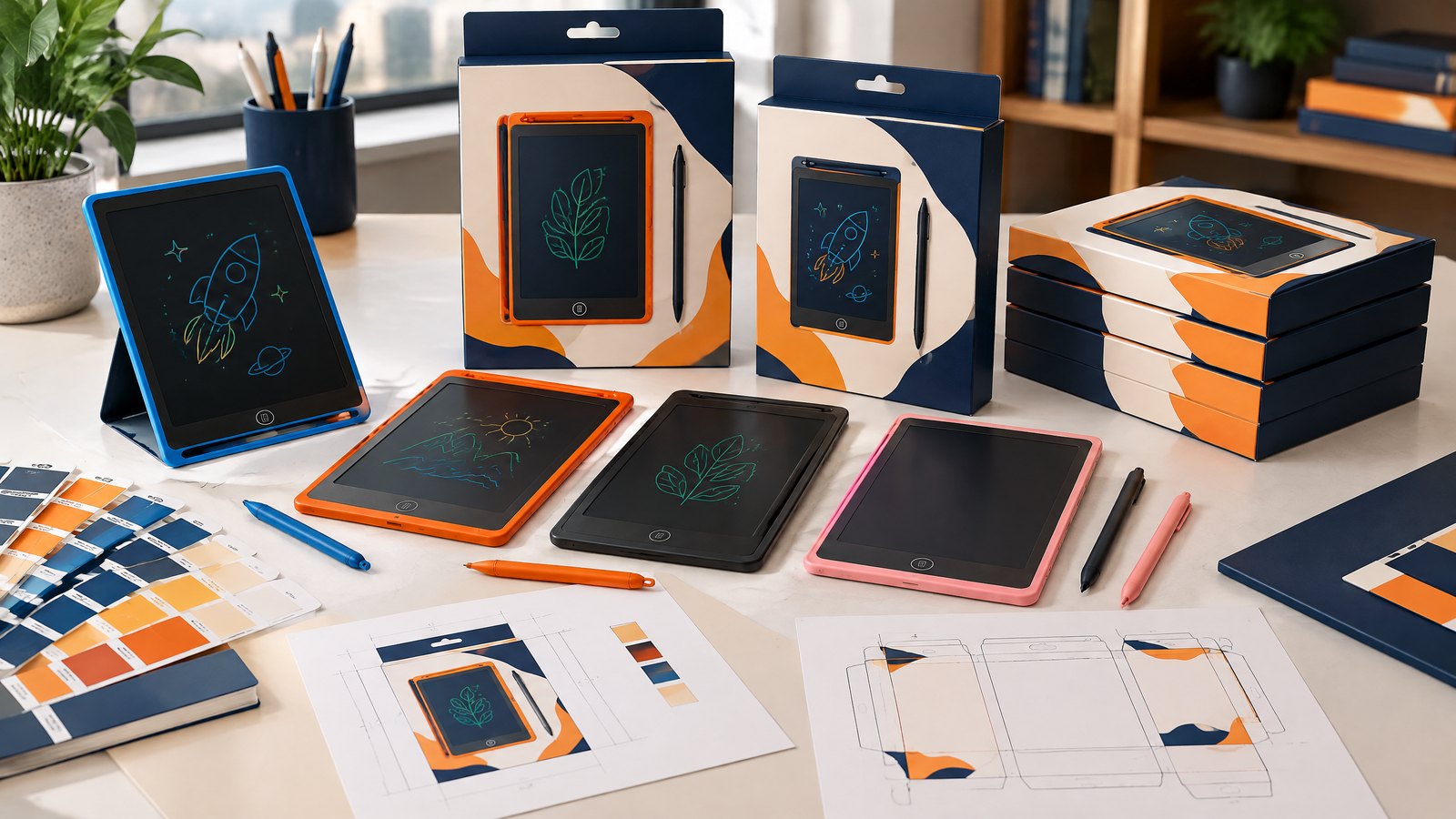
For the package, state the pack type, dieline, board or tray arrangement, whether the unit can hang or stand, opening direction, inclusion list, language panels, barcode owner and placement, recycling or disposal fields where required, and reserved areas for a retailer, fulfilment, or campaign label. The request should also specify a product and package revision. This is the foundation of an LCD writing tablet private label programme: the final product identity belongs in a controlled specification rather than scattered across proofs, chat messages, and sample photos.
Use an approval ladder
Move through four approvals, each with a distinct purpose:
- Technical feasibility: Confirm that the existing model can accommodate the requested print method, logo size, pack format, accessory, and market labelling without an unreviewed engineering change.
- Artwork preflight: Check logo file format, colour references, font licensing, bleed, dieline layers, barcode quiet zones, text accuracy, language fields, marks, and revision code. Brand approval alone is not a compliance approval.
- Production-intent sample: Inspect the branded tablet in the proposed pack with the final insert and any accessories. Test writing, clearing, lock behaviour where fitted, stylus fit, pack opening, logo quality, and the readability of the intended message.
- Golden sample and release: Sign or otherwise control one agreed sample and photo record. Link it to the purchase order, inspection checklist, and artwork revision so that the factory and any inspection provider use the same comparison point.
5. Procurement and artwork process: control the hand-offs from RFQ to release
The procurement process is where campaign speed is won or lost. Send a written request for quotation that includes the product specification, destinations, expected quantity range, packaging scope, artwork status, target handover date, inspection expectation, freight assumptions, and responsibility for documentation. Ask suppliers to separate the price of the tablet, logo application, packaging, inserts, samples, any tooling, testing or document support, and freight-related packing changes. An inexpensive quote with a generic carton is not a comparable quote for a branded campaign kit.
The phrase custom logo writing tablet wholesale should mean more than choosing a logo colour from a menu. Ask what is standard, what requires a new screen print or packaging plate, what can be sampled, and what cannot be changed after production begins. Confirm the buyer owns or has permission to use all supplied marks, illustrations, characters, and copy. The manufacturer should not be asked to infer trademark rights or translate safety text without buyer review.
A practical artwork workflow
First, issue production-ready vector logo files, brand colour references, minimum-size rules, and prohibited treatments. Second, receive the manufacturer’s dieline and product-print template rather than placing artwork over a marketing photo. Third, return the artwork with an unambiguous revision number, date, and approval status. Fourth, have the factory preflight print layers, folds, bleed, barcode contrast, and physical clearances. Finally, approve a proof and then a packed sample. Maintain an approval log identifying who approved brand appearance, wording, barcode data, and regulatory fields.
Artwork-review CTA: For an OEM/ODM quotation brief, logo-placement checklist, and packaging-proof review, email info@lcdwritingtablet.com.
Plan campaign time backward from distribution
Work backward from the date recipients need the product, not merely the date it should leave Shenzhen. Include the time needed for artwork review, sample manufacture and approval, procurement of printed materials, mass production, inspection, booking, transit, customs or import formalities, destination receiving, and fulfilment or event staging. Keep a contingency path for a corrected print proof or replacement accessories. No manufacturer should be expected to compensate for an unapproved artwork file with an informal, untracked decision at the end of production.
6. Quality and receiving controls: inspect the branded unit, not just the bare tablet
Quality control for a promotion should reflect what the recipient and campaign owner can see. A tablet that writes correctly but carries a crooked logo, a wrong colour, an incorrect insert, or a missing stylus is not a fully conforming promotional unit. Build inspections around the approved golden sample and the purchase order rather than a generic “AQL passed” statement with no defined defect catalogue.
At pre-production, check the logo’s spelling, position, adhesion, print opacity, and colour against the agreed sample or brand reference. Verify that decoration does not interfere with the writing surface, buttons, lock switch, battery access, or other functional areas. Open finished packaging to verify all components, language leaflets, warning placements, and barcode/revision fields. When the board is unpacked, test writing and clearing in normal conditions, then inspect the screen face for rubbing, scratches, pressure marks, and residue.
Use a defect taxonomy that fits promotions
Define critical, major, and minor defects with examples. A critical issue may include a safety-related fault, wrong battery configuration, missing required warning, or a product that cannot perform its primary write-and-erase function. Major issues may include wrong artwork revision, logo missing from a visible agreed location, incomplete pack, non-functioning lock where supplied, wrong destination insert, broken housing, or retail box unable to protect the screen. Minor issues may include small, agreed cosmetic tolerances that do not affect brand recognition or use. The exact categories and sampling plan belong in the purchase agreement and should be appropriate to the campaign risk.
Make receiving a reconciliation task
The destination team should receive a packing list that ties every carton run to the purchase order, product version, units per carton, gross weight, and shipment identifiers. On arrival, count cartons before breaking down pallets, photograph external damage, and compare visible carton marks with the packing list. Open a planned sample from different locations in the load, not only the top carton. Check the logo, pack revision, component count, and function before the goods move into event kits, warehouse stock, or mail fulfilment.
Keep a simple evidence file: approved sample photos, specification, purchase order, artwork proofs, inspection report, carton list, transport handover, and receiving variance report. This gives both buyer and factory a factual basis if there is a shortage, mixed version, damage pattern, or complaint. It is also useful when a retailer, marketplace, or event partner asks which version was distributed.
7. Cost, packaging, and logistics: protect the campaign outcome, not only the unit price
The landed cost of a promotional programme is driven by more than the tablet. Logo application, packaging complexity, insert languages, accessories, barcode labels, carton cube, inspection, freight mode, destination delivery, and rework exposure can all change the commercial result. Request an itemised quotation and compare like with like. If one supplier offers a bare device in a polybag while another quotes a printed box, insert, and master-carton marks, the apparent unit-price gap is not yet a sourcing decision.
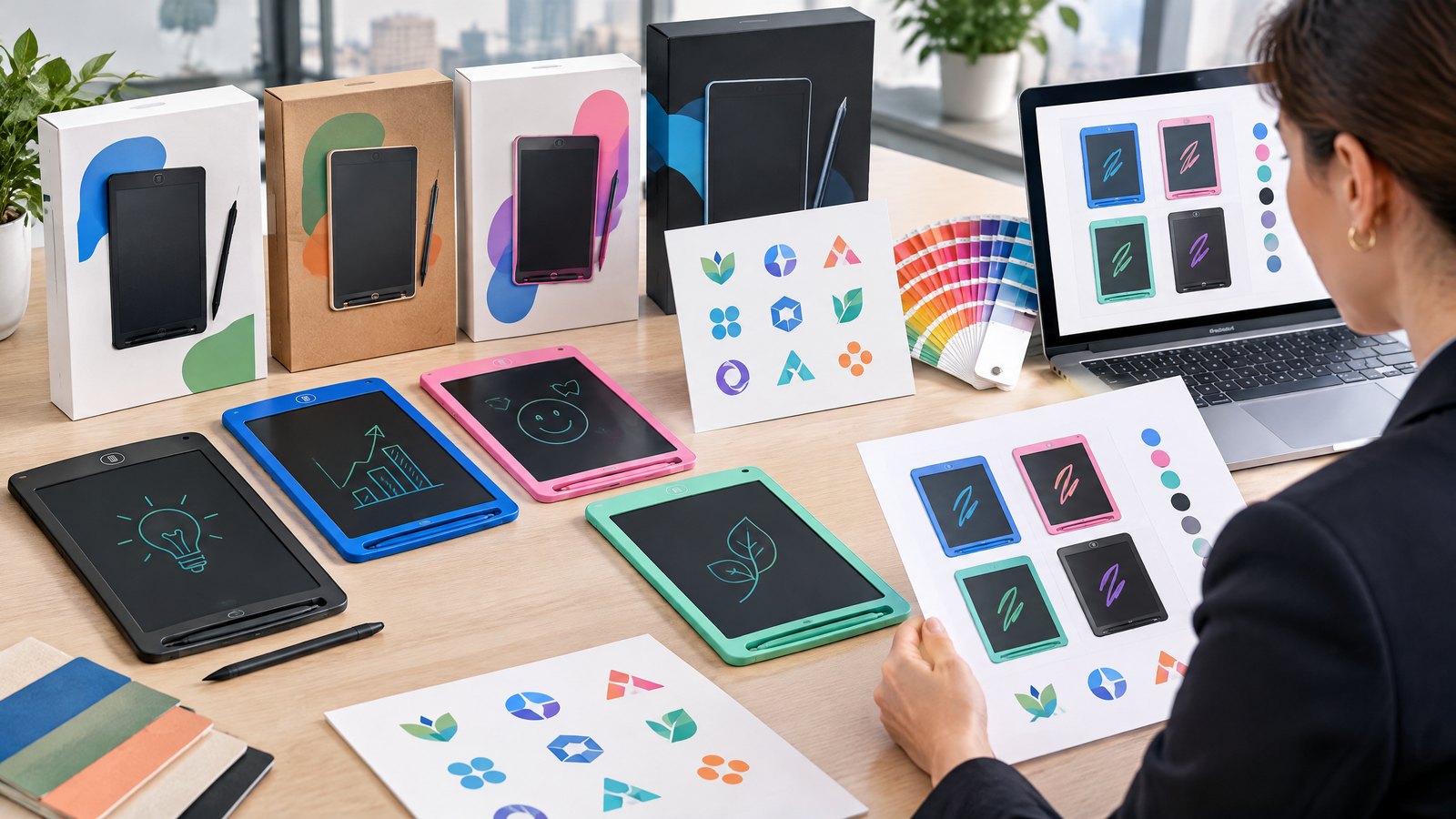
The phrase custom packaging LCD writing board should translate into a physical packing specification. Consider the screen’s exposure, the stylus’ movement, corner protection, opening experience, display method, label zones, and the route from factory to recipient. A premium window box may enhance a boardroom gift but add volume, weight, screen scuff risk, and packing labour. A compact sleeve may be appropriate for a direct handout but insufficient for a courier parcel. Choose the packaging only after mapping the route.
Quote three packaging layers
Specify the retail or campaign pack, the inner pack if used, and the master carton. The retail pack is the recipient’s brand experience. The inner pack manages counting and protects units during handling. The master carton needs a defined quantity, packing pattern, dimensions, weight, shipping marks, and adequate protection for the retail packs. Do not assume a factory’s standard carton remains correct after adding a booklet, sleeve, bundle, or thicker board.
8. Compliance caveats for the US, UK, Germany, and France: assign responsibility before printing marks
Compliance is configuration- and market-specific. This guide is procurement guidance, not legal advice. The buyer, importer, manufacturer, and any authorised representative should identify the actual rules for the intended product, audience, claims, battery design, and countries before products are released. A test report, mark, or declaration for a similar board does not automatically cover a branded version with changed materials, battery, accessory, intended age, or destination packaging.
United States
First decide whether the product is general use or a children’s product. CPSC describes a general-use product as one not designed or intended primarily for children 12 or younger and advises that intended audience, packaging, marketing, and play value can be relevant.1 Where a product is a children’s product subject to CPSC rules, third-party testing and a written CPC are required; certain general-use products subject to mandatory CPSC rules use a General Certificate of Conformity instead.1 A campaign that uses child-directed characters or messaging should not assume that an adult-oriented product file still applies.
A basic non-wireless LCD board may not be an RF device, while a model with wireless functions may trigger a different analysis. The FCC states that RF devices subject to equipment authorization must meet the applicable authorization procedure before US importation or marketing; the required route depends on the device and rules.2 Do not put an FCC label or claim on a standard board merely because an unrelated electronic product uses one. Confirm the actual electrical functions.
European Union: Germany and France
CE marking is not a quality logo or a certificate bought from a central EU issuer. Where applicable EU legislation requires it, the manufacturer must identify relevant requirements, conduct the correct conformity assessment, compile technical documentation, and sign an EU Declaration of Conformity. The European Commission notes that supporting documentation and the declaration must be maintained and retained for at least ten years after the product is placed on the market.3 The exact obligations depend on the product; do not print a CE mark simply to make the package look market-ready.
For electrical and electronic equipment in scope, RoHS restricts ten listed hazardous substances, and the European Commission states that products with an electrical/electronic component generally need to comply unless specifically excluded.4 WEEE rules address separate collection and treatment of electrical and electronic equipment and are implemented through national systems.5 In addition, the EU General Product Safety Regulation applies from 13 December 2024 and requires businesses to place only safe consumer products on the EU market; it covers online and distance sales as well as physical channels.6 Confirm traceability, economic-operator information, product identification, risk assessment, warnings, instructions, and language needs for the actual sale route.
For Germany, packaging responsibility can sit with the party classed as producer under the applicable rules. The official LUCID Packaging Register says producers must register and that a foreign company selling packaged products directly to German end users without a German branch must appoint an authorised representative for its packaging EPR obligations.7 Registration, system participation, and reporting requirements can be distinct steps. Identify the responsible party and the visible brand names before launching the packaging design.
For France, producer responsibility may apply across more than one relevant stream, including a product and its packaging. ADEME explains that each producer subject to an EPR stream requires a unique identifier (IDU) for each concerned stream, including product packaging, and that manufacturers, distributors, and importers putting in-scope products on the French market can be producers.8 Clarify the entity responsible for French EPR and what identifier or information must be communicated in the buyer’s sales materials. Do not assume a Shenzhen factory’s documentation transfers producer obligations to the European buyer.
United Kingdom
Great Britain has its own framework. GOV.UK says UKCA and CE markings demonstrate the manufacturer’s belief that a product meets relevant product requirements, and that the UK continues to recognise CE marking for many relevant product rules alongside or instead of UKCA.9 The government’s sector-specific guidance controls. Manufacturers and importers also need to indicate their name, registered trade name or trademark, and postal address on the product, packaging, or accompanying document where permitted.9 Check Great Britain, Northern Ireland, and destination-specific requirements separately rather than treating “UK” as one labelling regime.
9. Practical buyer table: a compact promotion release checklist
| Decision gate | Buyer must lock | Factory/OEM evidence or action | Receiving check |
|---|---|---|---|
| Campaign purpose | Recipient, age positioning, country, handout/mail/retail route | Quote against controlled brief; flag feasibility changes | Delivered version matches campaign allocation |
| Product identity | Model, battery arrangement, stylus, functions, logo location | Production-intent sample and revision-controlled photos | Write, erase, lock if fitted, and logo appearance checked |
| Artwork | Vector logo, colours, copy, languages, barcode, revision code | Dieline preflight, signed proof, printed sample | Pack panel, barcode, insert, and language sampled |
| Packaging | Retail pack, accessories, label zone, carton pattern | Packed sample, packing diagram, carton measurements | Carton count, pack completeness, damage, mixed-version check |
| Compliance file | Market, responsible entity, applicable evidence, required marks | Documents tied to exact configuration, not a similar model | File retained with PO, lot, carton, and revision records |
| Shipment handoff | Incoterm, delivery point, battery declaration, carton marks | Final inspection, packing list, handover record | Count, photograph, sample, and log discrepancies |
10. FAQ: common corporate-promotion buying questions
Is a digital render enough to approve corporate artwork?
No. A render is useful for early brand review, but it cannot show real print opacity, colour variation, edge registration, texture, or how the logo looks next to a writing surface. Use the render, final dieline proof, and a physical production-intent unit together. Photograph the accepted sample and link it to the purchase order and inspection checklist.
Should one package serve the US, UK, Germany, and France?
Sometimes, but only when the required copy, language, markings, responsible-party details, barcodes, and distribution route are compatible. A modular design with country-specific panels or inserts can reduce the risk of overcrowded packaging and wrong-market stock. Check legal requirements before deciding; a universal English box is not automatically sufficient for German or French consumer distribution.
What should our final inspection focus on?
Focus on the recipient-facing unit: correct model, logo quality and position, product operation, stylus, battery configuration, required information, insert, packaging condition, barcode, carton mark, and count. Use agreed defect definitions. A bare-device functional check is necessary but cannot detect an incorrect campaign message, missing French leaflet, wrong version, or a tablet packed with the wrong accessory.
When should we book freight?
Start forwarder discussions during the approved-sample phase, but book against verified production and packed-carton information. The freight provider needs the actual origin, destination, cargo-ready window, carton dimensions and weight, number of pieces, Incoterm, and battery configuration. Add time for arrival, clearance, warehouse receiving, and campaign fulfilment. The factory ship date should not be the only deadline in the plan.
11. Conclusion: release only the version you can defend and distribute confidently
A corporate promotion works best when brand, product, packaging, logistics, and compliance are managed as one release process. Choose a stable LCD writing tablet platform that fits the recipient’s real use. Turn logo and packaging decisions into controlled specifications. Approve the production-intent packed unit, inspect against a golden sample, and retain evidence that identifies the exact version shipped to each market.
For a Shenzhen OEM/ODM programme serving the US, UK, Germany, and France, use a controlled campaign brief, feasibility review, artwork preflight, packed sample, market review, final inspection, and receiving record.
Image plan
-
Purpose: Show decision-makers the finished corporate-promotion concept rather than a generic device. Placement: Immediately after the direct answer. Caption: “A branded LCD board shown as a clean corporate event giveaway with a restrained logo treatment.” ALT text: “Branded LCD writing board in a corporate promotional gift box on a meeting table.” English AI prompt: “Photorealistic B2B product photography, reusable LCD writing board with a tasteful fictional corporate logo on the lower bezel, premium minimal branded gift box, meeting-room table, natural daylight, no readable trademark, no people, high-end procurement catalogue style.”
-
Purpose: Clarify safe logo-position and packaging-artwork approval. Placement: In the specification and decision-framework module. Caption: “Artwork approval should show the print area, dieline, barcode zone, and version control together.” ALT text: “OEM artwork proof layout for a branded writing board and retail packaging.” English AI prompt: “Clean technical flat-lay illustration of an LCD writing tablet OEM artwork proof, outlined logo safe area on bezel, unfolded packaging dieline, barcode quiet zone, revision label, neutral corporate design, legible generic placeholder text only, white background.”
-
Purpose: Demonstrate a receiving and inspection sequence. Placement: In the quality and receiving-controls module. Caption: “Inspect a sealed retail unit, its contents, and master-carton markings before campaign distribution.” ALT text: “Quality inspector checking branded writing-board packaging and master carton.” English AI prompt: “Photorealistic warehouse quality-control scene, gloved inspector examining a fictional-logo LCD writing tablet retail box beside open master carton and packing list, stylus and instruction insert visible, no identifiable brand, balanced industrial lighting.”
-
Purpose: Support country-version planning without implying legal certification. Placement: In the compliance-caveats module. Caption: “Country versions need controlled language, traceability, and packaging-responsibility fields.” ALT text: “Four controlled packaging versions of an LCD writing tablet for US UK Germany and France.” English AI prompt: “Professional B2B infographic-style product layout showing four generic LCD writing tablet packaging side panels labelled US, UK, Germany, France, with neutral icons for language, traceability, recycling and documentation, no compliance marks or real brand logos, crisp white background.”
Ready to brief an OEM/ODM promotional programme? Email info@lcdwritingtablet.com with your target market, campaign date, quantity range, logo file status, and preferred pack format.
References
Continue with the next sourcing decision.
Use these internal links to compare products, check common buyer questions, review compliance preparation, or send your requirements to the factory.
Turn this sourcing plan into a product brief.
Share your target market, product requirements, packaging preference and estimated volume for a practical OEM / ODM discussion.